

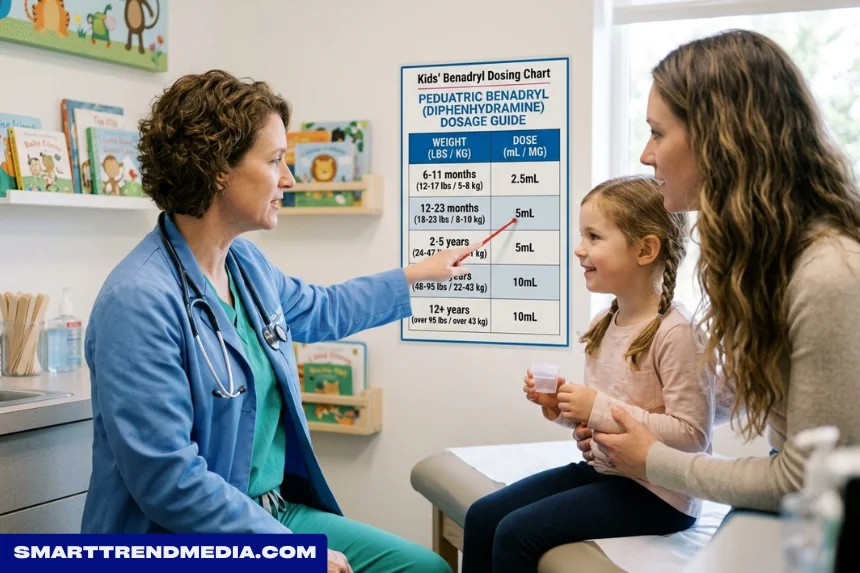
Benadryl dosing for kids depends on the child’s age, weight, the medicine’s active ingredient, and its concentration. Although many parents look for a single dosage number, different products and dosage forms can contain different amounts of diphenhydramine. Therefore, caregivers should always check the Drug Facts label before giving a dose.
The current Children’s Benadryl Allergy liquid label lists diphenhydramine HCl 12.5 mg in every 5 mL. It says not to use the medicine in children younger than 2. In addition, children ages 2 through 5 should receive it only when directed by a doctor. Children ages 6 through 11 should follow the directions on the exact product label.
However, the American Academy of Pediatrics gives more conservative parent guidance. It advises caregivers not to give diphenhydramine to children younger than 6 unless their pediatrician recommends it. For routine allergies, newer, less-sedating antihistamines may be safer choices.
Important safety notice: This article provides general U.S. medication information. It cannot determine the correct dose for an individual child. Follow your pediatrician’s instructions and the Drug Facts label on the product you have.
Quick Answer: Benadryl Dosing for Kids
Benadryl dosing for kids should be based on the exact product, the child’s age, and, when appropriate, the child’s weight. For Children’s Benadryl Allergy liquid containing 12.5 mg of diphenhydramine per 5 mL, the label lists 5–10 mL for children ages 6–11. The dose may be taken every four to six hours, but no more than six doses should be given within 24 hours.
Still, that range does not mean every child ages 6–11 should automatically receive 10 mL. Parents should use the amount shown for their child on the exact product label or follow instructions from a pediatrician or pharmacist.
Benadryl Dosing for Kids at a Glance
The following table summarizes current Children’s Benadryl label directions, AAP parent guidance, anaphylaxis recommendations, and Poison Control information.
| Question | General safety guidance |
|---|---|
| What is the active ingredient? | Diphenhydramine hydrochloride |
| What is the common children’s liquid strength? | 12.5 mg per 5 mL |
| Can children younger than 2 take it? | The current product label says do not use |
| Can children ages 2–5 take it? | Only when directed by a doctor |
| What does the AAP advise for children under 6? | Do not give diphenhydramine unless a pediatrician advises it |
| What is the label dose for ages 6–11? | 5–10 mL of the 12.5 mg/5 mL liquid |
| How often does the label allow a dose? | Every 4–6 hours when needed |
| What is the label maximum? | No more than 6 doses in 24 hours |
| Can Benadryl replace epinephrine for anaphylaxis? | No. Give available epinephrine and call 911 |
| What should you do after a possible overdose? | Call Poison Control at 1-800-222-1222 |
This table is a quick reference rather than a personalized prescription. In particular, never use the 5–10 mL range with a liquid that has a different concentration.
What Is Children’s Benadryl?
Children’s Benadryl Allergy is an over-the-counter antihistamine. Its active ingredient is diphenhydramine hydrochloride, often shortened to diphenhydramine HCl.
Histamine is one of the substances the body releases during an allergic response. Diphenhydramine blocks some of histamine’s effects. As a result, it may temporarily reduce certain allergy symptoms.
The current Children’s Benadryl liquid label lists temporary relief of:
- A runny nose
- Sneezing
- Itchy or watery eyes
- Itching of the nose or throat
A pediatric hospital dosing resource also lists allergic reactions, hives, nasal allergies, and itching as situations in which diphenhydramine may be used. Still, a parent should not assume that every rash, cough, or runny nose requires Benadryl.
Is Benadryl the Same as Diphenhydramine?
Benadryl is a brand name, while diphenhydramine is the medicine’s active ingredient. Therefore, store-brand or generic allergy medicines may contain the same active ingredient.
Nevertheless, products that contain diphenhydramine are not always interchangeable without checking the package. The concentration, dosage form, age directions, inactive ingredients, and measuring device may differ.
For example, one product may be a liquid, while another may be a chewable tablet or capsule. Moreover, a combination cough or cold medicine may include diphenhydramine along with other drugs.
Consequently, parents should check the active ingredient section of every medicine instead of relying only on the brand name.
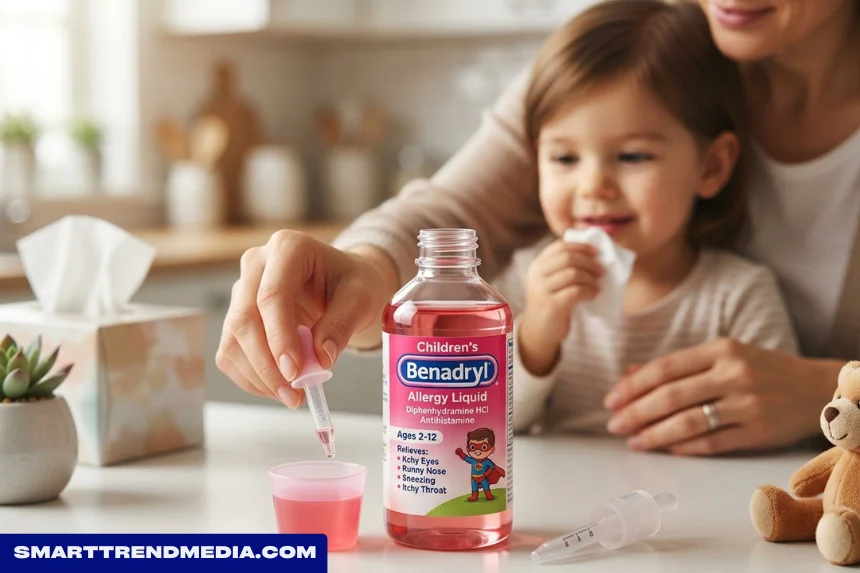
Check These Details Before Giving Benadryl
Before using a Benadryl dosage chart, complete the following safety checks.
1. Confirm the Active Ingredient
First, find the Drug Facts panel on the bottle or package. The active ingredient should clearly state diphenhydramine HCl or diphenhydramine hydrochloride.
Do not assume that every product carrying the Benadryl brand contains the same ingredient. Likewise, do not assume that products with different brand names contain different medicines.
2. Confirm the Product Concentration
Next, check how many milligrams of medicine are present in each milliliter or 5 mL serving.
The charts in this article apply only to children’s liquid containing:
Diphenhydramine HCl 12.5 mg per 5 mL
The current Children’s Benadryl Allergy label confirms this concentration.
Do not use the same milliliter amount for a liquid with a different strength. Otherwise, the child could receive too little or too much medicine.
3. Check the Child’s Age
Current Children’s Benadryl label directions state:
- Younger than 2 years: Do not use.
- Ages 2–5: Do not use unless directed by a doctor.
- Ages 6–11: Follow the product’s labeled dose.
- Age 12 or older: Follow the directions on the product intended for that age group.
In addition, current AAP parent guidance says children younger than 6 should not receive diphenhydramine unless their pediatrician advises it.
Therefore, an online weight chart should never override the age directions on the package or advice from the child’s healthcare professional.
4. Check for Duplicate Diphenhydramine
Children’s Benadryl should not be used with another product containing diphenhydramine. The official label notes that this warning includes diphenhydramine products applied to the skin.
Diphenhydramine may appear in:
- Allergy medicine
- Nighttime medicine
- Cough and cold products
- Sleep-aid products
- Multi-symptom medicine
- Certain creams or topical products
For this reason, read the active ingredients on every product before combining medicines. The AAP also recommends avoiding multi-symptom products when possible because they increase the risk of giving the same ingredient twice.
5. Review Health Conditions and Other Medicines
Ask a doctor before using the current Children’s Benadryl liquid when the child has a breathing problem such as chronic bronchitis, glaucoma, or a sodium-restricted diet. In addition, ask a doctor or pharmacist before combining it with sedatives or tranquilizers.
A pharmacist can also help confirm whether Benadryl is compatible with the child’s prescription medicines, supplements, or other over-the-counter products.
Benadryl Dosing for Kids by Age
The product label provides age-based directions. Meanwhile, some pediatric offices use a child’s weight to select a more specific amount. Both methods require parents to verify the exact concentration.
Age-Based Children’s Benadryl Guidance
| Child’s age | General U.S. guidance |
| Younger than 2 years | Do not use |
| 2–5 years | Use only when directed by a doctor |
| 6–11 years | Follow the exact product label; the referenced liquid label lists 5–10 mL |
| 12 years and older | Follow the directions on the product intended for ages 12 and older |
These directions apply to the referenced Children’s Benadryl Allergy liquid containing 12.5 mg per 5 mL. Other diphenhydramine products may have different age limits or directions.
Furthermore, the AAP recommends pediatrician guidance before giving diphenhydramine to any child younger than 6.
Why Age Alone May Not Give an Exact Dose
Two children of the same age may have very different body weights. Therefore, pediatric medication guidance often considers weight when selecting a dose.
However, weight does not cancel an age restriction. For example, a toddler may weigh as much as an older child but should not receive Benadryl without medical direction merely because the toddler fits a weight category.
Similarly, parents should not estimate the amount by comparing one child with a sibling. Instead, they should use a recent, accurate weight and follow the child-specific instructions provided by a pediatrician or the applicable product label.
Benadryl Dosing for Kids by Weight
The following pediatric diphenhydramine chart comes from Children’s Hospital Colorado. It applies to liquid containing 12.5 mg per 5 mL, chewable tablets containing 12.5 mg, and tablets containing 25 mg.
Important: Do not use this weight chart to start Benadryl in a child younger than 6 without instructions from the child’s pediatrician. The AAP advises pediatrician approval for diphenhydramine use below age 6. Also, check the product label because age restrictions and formulations can differ.
Children’s Benadryl Weight Chart
| Child’s weight | Liquid 12.5 mg/5 mL | Chewable 12.5 mg | Tablet 25 mg |
| 20–24 pounds | 4 mL | Not listed | Not listed |
| 25–37 pounds | 5 mL | 1 chewable | ½ tablet |
| 38–49 pounds | 7.5 mL | 1½ chewables | ½ tablet |
| 50–99 pounds | 10 mL | 2 chewables | 1 tablet |
The pediatric hospital chart lists different amounts for different product forms. It also advises selecting the child’s weight first and then finding the corresponding product and amount.
Nevertheless, splitting tablets may be difficult or inaccurate unless the specific tablet is designed to be divided. Therefore, ask a pharmacist before cutting a tablet for a child.
Children who weigh 100 pounds or more should follow the directions for their exact product, age, and dosage form or obtain guidance from a healthcare professional. Do not automatically increase the liquid amount beyond the package directions.
Why Product Concentration Matters
A dose has two separate measurements:
- Milligrams, which describe the amount of active medicine
- Milliliters, which describe the volume of liquid
For example, 5 mL of the referenced Children’s Benadryl liquid contains 12.5 mg of diphenhydramine. Meanwhile, 10 mL contains 25 mg.
However, 5 mL of a different liquid concentration could contain another amount of medicine. Consequently, parents should never copy the milliliter amount from one product to another without confirming that the strengths match.
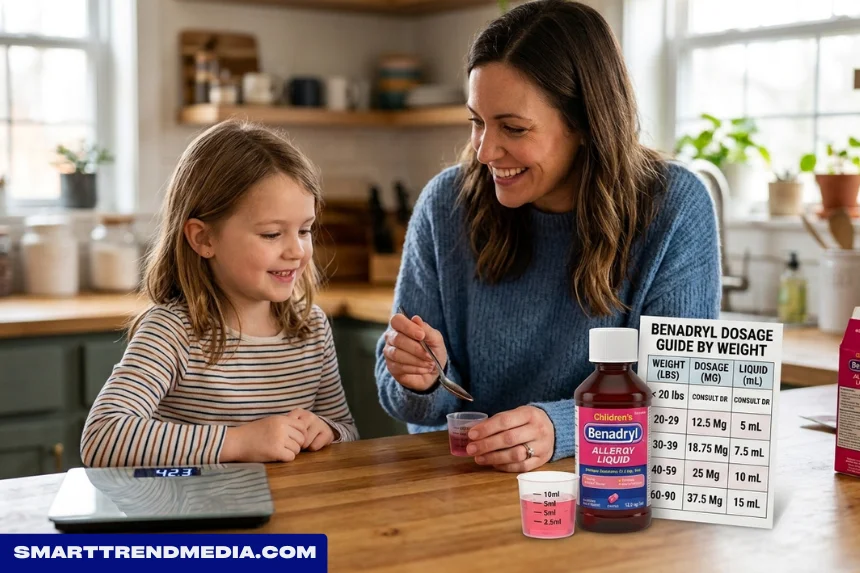
Understanding Liquid, Chewable, Tablet, and Capsule Forms
Diphenhydramine is sold in several dosage forms. Although the active ingredient may be the same, each form requires separate label checks.
Children’s Benadryl Liquid
Liquid medicine may be easier for children who cannot swallow tablets. The referenced Children’s Benadryl Allergy liquid contains 12.5 mg in 5 mL and includes a dosing cup designed for that product. The label instructs users to measure with the enclosed cup rather than another device.
However, an oral syringe may be easier for measuring small amounts when a pediatrician or pharmacist has provided a specific dose. The AAP advises using the cup or syringe included with the medicine and recommends asking a pharmacist for an appropriate tool when one is not supplied.
Never use a kitchen teaspoon or tablespoon to estimate a dose.
Children’s Chewable Diphenhydramine
The referenced pediatric weight chart lists chewable tablets containing 12.5 mg each. Depending on the child’s instructed dose, the chart may list one, one-and-a-half, or two chewables.
Still, confirm the number of milligrams in each chewable before use. Different products may not contain the same amount.
In addition, consider whether the child can chew and swallow the tablet safely. A chewable medicine may present a choking risk for a young child who has not developed reliable chewing skills.
Diphenhydramine Tablets
Some diphenhydramine tablets contain 25 mg. The pediatric hospital chart includes half-tablet amounts in certain weight ranges.
Nevertheless, do not split a tablet unless a doctor or pharmacist confirms that the specific product can be divided accurately. A liquid or appropriate chewable product may allow more precise measurement.
Diphenhydramine Capsules
Capsules generally cannot be divided accurately. Moreover, they may be difficult for younger children to swallow.
Therefore, do not open, divide, or substitute a capsule for a liquid dose unless a healthcare professional has specifically instructed you to do so.
Most importantly, never choose an adult dosage form simply because it is the only diphenhydramine product available at home. The child’s age, weight, ability to swallow, product strength, and label directions must all be considered.
How Often Can Benadryl Dosing for Kids Be Repeated?
The current Children’s Benadryl Allergy liquid label says to give the appropriate dose every four to six hours, or as directed by a doctor. In addition, the label says not to give more than six doses within 24 hours. These instructions apply to the specific liquid containing 12.5 mg of diphenhydramine in each 5 mL.
Nevertheless, parents should not switch between different dosing schedules found online. For example, a pediatric clinic may recommend a six-hour interval, while a product label may allow every four to six hours. Follow the instructions provided for the child and the exact product.
Do not give another dose early simply because the symptoms remain. Diphenhydramine may take time to produce an effect. Moreover, giving doses too close together can increase the risk of excessive sleepiness, agitation, confusion, a rapid heartbeat, or other harmful effects.
Keep a Written Dosing Record
When more than one adult cares for a child, write down:
- The medicine’s name
- The active ingredient
- The amount given
- The time it was given
- The person who gave it
- The earliest time another dose would be allowed
This simple record can prevent two caregivers from giving the same medicine. It can also help a pharmacist, pediatrician, or Poison Control specialist understand what happened after a possible dosing mistake.
What If a Dose Is Missed?
Diphenhydramine is often taken only when symptoms require it. Therefore, a missed dose usually does not need to be replaced.
When a doctor has recommended a regular schedule, follow the doctor’s instructions. If it is almost time for the next dose, skip the missed amount. Most importantly, never give a double dose to make up for one that was missed.
How to Measure Children’s Benadryl Correctly
Accurate measurement is an essential part of safe Benadryl dosing for kids. A small measuring mistake can significantly change the amount a child receives, especially when the intended dose is only a few milliliters.
Measure the Dose in Milliliters
Use mL, the abbreviation for milliliters, when measuring liquid medicine. Milliliters provide a standard measurement, while kitchen spoons do not.
The American Academy of Pediatrics advises parents to use the cup or syringe supplied with a liquid medicine. Furthermore, it recommends asking a pharmacist for a suitable measuring tool when the package does not include one. A kitchen teaspoon or tablespoon may not hold the expected amount.
Use the Device Intended for the Product
The current Children’s Benadryl liquid label specifically instructs caregivers to use the enclosed dosing cup designed for that product. Therefore, follow the package directions for the bottle you have.
An oral syringe may be easier when a pediatrician or pharmacist has instructed you to measure a small amount. It can also make the markings easier to read. However, the syringe must display milliliter measurements clearly.
Measure Liquid Medicine Step by Step
- Place the bottle on a flat, well-lit surface.
- Read the active ingredient and concentration.
- Confirm the child’s instructed amount.
- Pour or draw the medicine to the correct mL line.
- Check the measurement at eye level.
- Give the medicine while the child sits upright.
- Record the dose and time immediately.
- Wash and dry the measuring device after use.
In addition, keep the original cup or syringe with the bottle. This step reduces the chance that someone will use a device designed for another medication.
Do Not Confuse Milligrams and Milliliters
Milligrams and milliliters measure different things:
- Milligrams (mg) describe the amount of active medicine.
- Milliliters (mL) describe the amount of liquid.
For the referenced Children’s Benadryl liquid, 5 mL contains 12.5 mg of diphenhydramine. Still, another product could contain a different number of milligrams in the same liquid volume. Therefore, never convert a dose using volume alone without checking the concentration.
When May Benadryl Be Used in Children?
Children’s Benadryl is an antihistamine. The current product label lists temporary relief of symptoms caused by hay fever or other upper respiratory allergies, including:
- Runny nose
- Sneezing
- Itchy or watery eyes
- Itching of the nose or throat
Antihistamines may also help with itching, bug bites, hives, and certain mild allergic reactions. However, the appropriate medicine depends on the child’s age, symptoms, medical history, and the cause of the reaction. The AAP notes that newer antihistamines are generally safer choices for routine allergy symptoms than diphenhydramine.
Consequently, Benadryl should not become the automatic treatment for every rash, cough, stuffy nose, or skin change. Some symptoms may come from an infection, irritation, medication reaction, or another condition that requires different care.
Benadryl for Hives and Itching
Diphenhydramine may reduce itching or hives during a mild allergic reaction. Nevertheless, parents should watch for symptoms involving breathing, circulation, the throat, or several body systems.
A rapidly spreading reaction can become serious. Therefore, do not rely on Benadryl alone when a child has possible anaphylaxis. Epinephrine treats the dangerous symptoms of anaphylaxis more quickly and effectively.
Benadryl for Colds
Some diphenhydramine products include cold-related directions. However, labels and combination ingredients vary. In addition, many cough and cold products contain several active ingredients.
For this reason, check the exact package before giving any cold medicine. Do not combine it with Benadryl unless a pediatrician or pharmacist confirms that the products can be used together. Multi-symptom products increase the risk of giving the same ingredient twice.
When Not to Give Benadryl to a Child
Benadryl may be available without a prescription, but that does not make it suitable for every child or symptom.
Do not give Children’s Benadryl:
- To make a child sleepy
- To a child younger than the label allows
- With another product containing diphenhydramine
- More often than the label or doctor directs
- Without confirming the concentration
- As a replacement for epinephrine during anaphylaxis
- As an adult product substituted for a children’s product
- After an extra dose until professional guidance is obtained
The official Children’s Benadryl label says not to use the medicine to make a child sleepy. It also warns against combining it with another diphenhydramine product, including one applied to the skin.
Do Not Use Benadryl as a Sleep Aid
Diphenhydramine often causes drowsiness. Still, a side effect should not become the reason for giving the medicine.
MedlinePlus states that diphenhydramine may treat insomnia in adults but should not be used to make a child sleepy. Moreover, the medicine does not always calm children. Some become excited, restless, or unusually active instead.
Therefore, do not give Benadryl for bedtime, travel, a flight, or behavioral control unless a qualified healthcare professional has prescribed it for a specific medical reason.
Avoid Duplicate Diphenhydramine
Diphenhydramine may appear in allergy medicines, cold products, nighttime formulas, sleep aids, and topical anti-itch products. As a result, parents can accidentally give two products containing the same drug.
Before combining medicines, compare the active ingredients on both labels. Do not rely only on the product names or packaging.
Benadryl for Babies and Toddlers
Parents should use extra caution with Benadryl dosing for kids younger than 6. Infants and toddlers can be more vulnerable to medication errors, and online charts may not reflect the directions for the product in your home.
Can a Baby Take Benadryl?
The current Children’s Benadryl liquid label says do not use in children younger than 2 years. Therefore, parents should not calculate an infant dose from an online weight chart.
When a baby develops hives, swelling, vomiting, breathing trouble, unusual sleepiness, or another possible allergic-reaction symptom, seek prompt medical guidance. Call 911 immediately for trouble breathing, collapse, a seizure, or an inability to wake the baby normally.
Can a 2-Year-Old Take Benadryl?
The product label says children ages 2 through 5 should not use the medicine unless directed by a doctor. Meanwhile, the AAP advises parents not to give diphenhydramine to any child younger than 6 unless the child’s pediatrician recommends it.
Consequently, a parent should not select a dose for a 2-year-old based only on weight. A pediatrician must first decide whether diphenhydramine is appropriate.
What About Children Ages 3, 4, or 5?
The same warning applies throughout ages 2–5. Use the medicine only when a doctor gives specific instructions.
Ask the doctor to confirm:
- The reason for using diphenhydramine
- The exact product and concentration
- The amount in milliliters or milligrams
- How often it may be given
- How many doses may be used
- Which side effects require medical attention
Write the instructions down. In addition, repeat them to the doctor or pharmacist to confirm that you understood them correctly.
Why Do Some Charts List Doses for Younger Children?
Some pediatric practices publish weight-based amounts for use under professional guidance. These charts may support clinicians or families who have already received instructions for a specific child.
However, a listed weight does not mean that every child in that category should take Benadryl. Age restrictions, symptoms, medical conditions, and other medicines still matter. Therefore, online tables should not replace guidance from the child’s healthcare professional.
Benadryl Side Effects in Children
Diphenhydramine can cause side effects even when a parent gives the label-directed amount. Some effects are mild, while others require immediate attention.
Drowsiness
Marked drowsiness may occur after taking Children’s Benadryl. As a result, a child may appear tired, less coordinated, or less alert than usual.
Parents should supervise the child closely. In addition, the child should avoid activities requiring balance, coordination, or quick reactions until the effects have passed.
Sedatives and tranquilizers can increase drowsiness. Therefore, ask a doctor or pharmacist before combining diphenhydramine with any medicine that can cause sleepiness.
Excitability or Hyperactivity
Although many children become sleepy, some experience the opposite reaction. The official label warns that excitability may occur, especially in children.
Possible signs include:
- Restlessness
- Irritability
- Unusual energy
- Difficulty settling down
- Nervousness
- Agitation
Do not give an additional dose in an attempt to make the child calm or sleepy. Instead, contact a pediatrician or pharmacist when the reaction is concerning.
Other Possible Side Effects
Diphenhydramine can also cause symptoms such as:
- Dry mouth
- Dizziness
- Reduced coordination
- Blurred vision
- Upset stomach
- Difficulty urinating
A child may not describe these symptoms clearly. Therefore, watch for stumbling, unusual behavior, discomfort, confusion, or changes in alertness.
Serious Symptoms That Need Urgent Help
Call 911 when the child:
- Has trouble breathing
- Collapses
- Has a seizure
- Cannot be awakened
- Develops severe confusion
- Has significant throat or tongue swelling
- Appears faint, blue, or severely weak
Poison Control specifically advises calling 911 when a person collapses, has a seizure, has trouble breathing, or cannot be awakened.
Mild Allergic Reaction or Anaphylaxis?
Benadryl may reduce itching or hives during some mild allergic reactions. However, it cannot treat the dangerous breathing, throat, or blood-pressure problems associated with anaphylaxis.
Anaphylaxis can progress quickly. Therefore, parents should not wait for Benadryl to work when severe symptoms appear.
Possible Allergy-Symptom Comparison
| Possible mild allergy symptoms | Possible signs of anaphylaxis |
|---|---|
| A small area of itching | Trouble breathing or noisy breathing |
| A few localized hives | Throat tightness or voice changes |
| Sneezing | Significant tongue, lip, or throat swelling |
| Itchy or watery eyes | Fainting, collapse, or severe weakness |
| Mild runny nose | Severe abdominal pain |
| Limited skin redness | Repetitive vomiting with other allergy symptoms |
| Mild skin discomfort | Symptoms affecting more than one body system |
This table cannot diagnose a reaction. In addition, skin symptoms may be absent during anaphylaxis. When symptoms appear severe, spread rapidly, or involve breathing, the throat, circulation, or several body systems, treat the situation as an emergency.
Benadryl Does Not Replace Epinephrine
Epinephrine is the first-line treatment for anaphylaxis. Antihistamines may reduce milder skin symptoms, such as itching or hives, but they do not replace epinephrine.
The American Academy of Allergy, Asthma & Immunology states that epinephrine treats serious symptoms involving breathing, blood pressure, throat tightness, voice changes, severe abdominal pain, and repetitive vomiting. It also warns that antihistamines can take 30–60 minutes to begin working. Therefore, epinephrine should come first when severe symptoms occur.
What to Do for Possible Anaphylaxis
- Give the child’s prescribed epinephrine immediately.
- Call 911.
- Follow the child’s written allergy action plan.
- Keep the child with a responsible adult.
- Follow emergency-dispatcher instructions.
- Do not wait to see whether Benadryl stops the reaction.
Antihistamines may sometimes be used after epinephrine for itching or hives. However, they should not delay epinephrine or emergency medical care.
When to Contact the Child’s Pediatrician
Contact a pediatrician or pharmacist before giving Benadryl when:
- The child is younger than 6
- The correct amount is unclear
- The product concentration does not match the chart
- The child takes prescription or nonprescription medicines
- The child has chronic breathing problems or glaucoma
- The symptoms continue or repeatedly return
- The child develops an unexpected reaction
- Benadryl is needed frequently
- You are considering changing to another antihistamine
In addition, ask for advice when you are uncertain whether the symptoms come from an allergy. Treating the wrong condition may delay appropriate care.
When to Call Poison Control
Call Poison Control at 1-800-222-1222 or use its online tool after:
- An accidental double dose
- An unknown amount swallowed
- A dose from the wrong concentration
- Combining two diphenhydramine products
- Giving an adult amount to a child
- Giving doses too close together
- Any medication error that causes concern
Poison Control provides free, confidential, case-specific guidance. However, call 911 immediately when the child collapses, has a seizure, has difficulty breathing, or cannot be awakened.
What to Do After an Extra or Double Dose
Mistakes can happen even when caregivers carefully follow Benadryl dosing for kids. For example, two adults may unknowingly give the medicine, a child may drink from the bottle, or someone may use the wrong concentration.
Do not wait for symptoms before seeking case-specific advice. Instead, stop giving diphenhydramine and contact Poison Control at 1-800-222-1222. The service is free and confidential throughout the United States. Parents can also use the official webPOISONCONTROL tool for many exposures.
Follow These Steps After a Possible Dosing Error
- Do not give another dose.
- Keep the bottle or package nearby.
- Check the active ingredient and concentration.
- Estimate how much medicine the child may have received.
- Note when each dose was given.
- Call Poison Control at 1-800-222-1222.
- Follow the specialist’s instructions.
- Do not make the child vomit.
- Call 911 for severe or life-threatening symptoms.
Poison Control advises against inducing vomiting after a swallowed poison. In addition, caregivers should not try to treat an overdose at home with activated charcoal, hydrogen peroxide, or another home remedy.
Information to Have Ready
The Poison Control specialist may ask for:
- The child’s age
- The child’s approximate weight
- The product name
- The active ingredient
- The concentration
- The estimated amount swallowed
- The time of the last dose
- Any symptoms the child has developed
- Other medicines the child may have taken
Do not delay the call because some information is missing. Poison specialists can still explain the safest next step.
Signs of a Diphenhydramine Overdose
Too much diphenhydramine can cause:
- Extreme sleepiness
- Agitation or restlessness
- Confusion
- Hallucinations
- A fast or irregular heartbeat
- Seizures
- Loss of consciousness
- Coma
The FDA warns that high doses can cause serious heart problems, seizures, coma, and death. Poison Control also lists severe sleepiness, confusion, hallucinations, a rapid heartbeat, seizures, and coma among possible overdose effects.
Call 911 immediately when the child:
- Collapses
- Has a seizure
- Has trouble breathing
- Cannot be awakened
- Develops severe hallucinations or confusion
- Appears blue, faint, or critically ill
These warning signs require emergency medical attention rather than online dosing advice.
How to Prevent Benadryl Dosing Errors
Safe Benadryl dosing for kids requires more than choosing a number from a chart. Parents must also confirm the product, concentration, timing, and ingredients.
Use This Medication-Safety Checklist
Before every dose:
- Read the Drug Facts label.
- Confirm that the active ingredient is diphenhydramine.
- Check the amount listed in each 5 mL, tablet, or chewable.
- Confirm that the medicine is appropriate for the child’s age.
- Use the child’s current weight when professional guidance requires it.
- Measure liquid medicine in milliliters.
- Use the enclosed cup or an appropriate oral syringe.
- Check every other medicine for duplicate diphenhydramine.
- Record the dose and time.
- Tell other caregivers that the medicine was given.
- Return the bottle to a locked or child-resistant storage area.
The current Children’s Benadryl label identifies the liquid strength as 12.5 mg per 5 mL and instructs caregivers to use the enclosed dosing cup. However, another product may have different directions.
Store Medicine Safely
Keep diphenhydramine:
- In its original container
- With its original label and dosing device
- Out of sight and reach of children
- Away from purses, backpacks, and bedside tables
- Separate from candy or food
- With the child-resistant cap secured
Do not call medicine candy. Although this language may encourage a child to cooperate once, it can also make the bottle seem attractive later.
Coordinate Between Caregivers
Medication errors commonly occur when more than one adult is caring for a child. Therefore, use a written record, phone note, or medication-tracking app.
Record:
| Detail | Example |
|---|---|
| Medicine | Children’s diphenhydramine |
| Concentration | 12.5 mg per 5 mL |
| Amount given | Record the exact mL |
| Time given | Record the exact time |
| Given by | Caregiver’s name |
| Next possible dose | Based on the label or doctor’s instructions |
Never depend only on memory, especially during the night or when the child is being cared for in two homes.
Benadryl Versus Newer Antihistamines for Children
Diphenhydramine is a first-generation antihistamine that often causes drowsiness. Newer antihistamines include cetirizine, loratadine, fexofenadine, and levocetirizine.
The American Academy of Pediatrics states that newer antihistamines are generally safer choices for routine allergy symptoms. It also advises parents not to give diphenhydramine to a child younger than 6 unless the child’s pediatrician recommends it.
General Antihistamine Comparison
| Feature | Diphenhydramine | Newer antihistamines |
|---|---|---|
| Common example | Benadryl | Cetirizine, loratadine, fexofenadine, or levocetirizine |
| Generation | First generation | Newer generation |
| Drowsiness | Common and sometimes marked | Usually less sedating, although drowsiness may still occur |
| Unexpected excitement | Can occur, especially in children | Less commonly associated with this effect |
| Routine allergy use | May help, but is not always the preferred option | Often preferred for routine allergy symptoms |
| Child’s dose | Depends on the exact diphenhydramine product | Depends on the exact medicine, age, formulation, and label |
| Anaphylaxis treatment | Does not replace epinephrine | Does not replace epinephrine |
This table provides a general comparison only. It does not mean that every newer antihistamine is appropriate for every child.
Ask Before Switching Medicines
A pediatrician or pharmacist can help parents choose an antihistamine based on:
- The child’s age
- The child’s symptoms
- The expected length of treatment
- Other medical conditions
- Current medicines
- Previous side effects
- The need to avoid drowsiness
Do not use the Benadryl dosage to calculate an amount of cetirizine, loratadine, fexofenadine, or another antihistamine. Each drug has different strengths and directions.
Frequently Asked Questions About Benadryl Dosing for Kids
Is Benadryl Dosing for Kids Based on Age or Weight?
Both age and weight may matter. Retail labels commonly provide age-based directions, while pediatric clinicians may use weight to select a more specific amount.
However, weight does not override the product’s age restriction. Parents should first confirm that the medicine is allowed for the child’s age. Next, they should verify the concentration and follow the exact label or pediatrician’s instructions.
How Much Benadryl Can a 6-Year-Old Take?
A single amount cannot be assigned safely from age alone. The child’s weight, product concentration, dosage form, and exact label must also be considered.
The current Children’s Benadryl liquid label lists 5–10 mL for children ages 6–11 when the liquid contains 12.5 mg per 5 mL. However, caregivers should use the specific amount shown on their product or provided by a healthcare professional rather than automatically choosing the highest amount.
How Much Benadryl Can a 10-Year-Old Take?
A 10-year-old falls within the label’s 6–11 age group. Still, the correct amount depends on the exact product, concentration, dosage form, and possibly the child’s weight.
Check the Drug Facts panel before every dose. Do not use an adult tablet, liquid, or capsule merely because the child is older or larger than other children.
Can a 2-Year-Old Take Benadryl?
The current Children’s Benadryl liquid label says children ages 2–5 should not use it unless directed by a doctor. In addition, the AAP advises parents not to give diphenhydramine to a child younger than 6 unless a pediatrician recommends it.
Therefore, parents should not select a dose for a 2-year-old from an online chart without professional instructions.
Can a Baby Take Benadryl?
The current product label says not to use Children’s Benadryl liquid in children younger than 2. Parents should not calculate an infant dose from body weight alone.
Seek immediate medical help when a baby has trouble breathing, significant swelling, sudden drooling, collapse, repeated vomiting with other allergy symptoms, or unusual difficulty waking.
How Often Can Children Take Benadryl?
The referenced Children’s Benadryl liquid label says it may be taken every four to six hours when needed, with no more than six doses in 24 hours. These directions apply to that exact product and strength.
A pediatrician may give different instructions for a particular child. Follow one reliable schedule rather than combining directions from multiple websites.
Can Benadryl Make a Child Hyper?
Yes. Although drowsiness is common, diphenhydramine can cause excitability in some children. A child may become restless, irritable, nervous, or unusually active.
Do not give another dose to make the child calm or sleepy. Contact a pediatrician or pharmacist when the reaction is significant or concerning.
Can I Give Benadryl to Help My Child Sleep?
No. Diphenhydramine should not be given simply to make a child sleepy. MedlinePlus specifically states that it should not be used for this purpose in children.
This restriction also applies to travel, flights, bedtime problems, and attempts to calm behavior.
Does Benadryl Treat Anaphylaxis?
No. Benadryl does not replace epinephrine.
Epinephrine is the recommended emergency treatment for anaphylaxis. Give available prescribed epinephrine immediately, call 911, and follow the child’s emergency allergy plan. An oral antihistamine may sometimes be used for skin symptoms, but it must not delay epinephrine.
What Should I Do If I Gave My Child Too Much Benadryl?
Do not give another dose. Call Poison Control at 1-800-222-1222 for instructions based on the child’s age, weight, product, amount, timing, and symptoms.
Call 911 immediately when the child collapses, has a seizure, has trouble breathing, or cannot be awakened. Do not induce vomiting.
Is Generic Diphenhydramine the Same as Benadryl?
A generic product may contain the same active ingredient as Benadryl. However, the concentration, dosage form, inactive ingredients, age restrictions, and directions may differ.
Therefore, check the full Drug Facts label rather than assuming that two bottles are interchangeable.
Can I Give Benadryl With a Cough or Cold Medicine?
Do not combine them until you have checked every active ingredient. Some cough, cold, nighttime, and multi-symptom products contain diphenhydramine or another sedating antihistamine.
Giving two products with overlapping ingredients can lead to an accidental overdose. Ask a pediatrician or pharmacist when the labels are unclear.
Can I Give Benadryl With Acetaminophen or Ibuprofen?
These medicines treat different symptoms, but the decision still depends on the child’s age, health, symptoms, and the exact products.
Some multi-symptom medicines already contain a pain or fever reducer. Therefore, check every active ingredient and ask a pharmacist or pediatrician before combining medicines.
Can Children Take Benadryl Every Day?
Parents should not continue giving diphenhydramine daily without discussing the reason with a pediatrician. Repeated symptoms may require a clearer diagnosis or a more suitable treatment.
For routine allergy symptoms, the AAP states that newer antihistamines are generally safer choices.
Should Benadryl Be Given Before a Known Food Exposure?
No medicine makes intentional exposure to a known food allergen safe. Benadryl cannot prevent anaphylaxis or replace avoidance, an allergy action plan, and prescribed epinephrine.
Families should follow the instructions provided by the child’s allergist or pediatrician.
What If the Child Spits Out the Medicine?
Do not automatically repeat the full dose because it may be impossible to know how much the child swallowed.
Instead, contact a pharmacist or pediatrician for advice. Repeating the entire amount could accidentally result in a double dose.
What If the Child Vomits After Taking Benadryl?
Do not automatically give another dose. The correct response depends on how soon the vomiting occurred, whether medicine was visible, and the child’s symptoms.
Call a pharmacist, pediatrician, or Poison Control for case-specific guidance.
Final Safety Summary
Benadryl dosing for kids must account for the child’s age, weight, product concentration, dosage form, and label directions. The commonly referenced Children’s Benadryl liquid contains 12.5 mg of diphenhydramine per 5 mL. However, caregivers must confirm the strength printed on their own bottle before measuring a dose.
Current label directions say not to use the medicine in children younger than 2. Children ages 2–5 should receive it only when directed by a doctor. In addition, the AAP recommends pediatrician guidance for any child younger than 6.
Most importantly, Benadryl does not replace epinephrine during anaphylaxis. Give available prescribed epinephrine, call 911, and follow the child’s emergency plan. For an extra dose, unknown amount, wrong concentration, or duplicate diphenhydramine product, contact Poison Control at 1-800-222-1222.
Medical Disclaimer
This article provides general educational information for readers in the United States. It does not diagnose a condition, recommend an individualized dose, or replace advice from a pediatrician, pharmacist, allergist, Poison Control specialist, or emergency medical professional.
Always follow the Drug Facts label on the exact product you have. Seek emergency help for breathing difficulty, severe swelling, collapse, seizure, unusual unresponsiveness, or other signs of a serious allergic reaction or overdose.
LEARN MORE ABOUT : How Long Does Flu B Last in Kids