


Pulled stomach muscle female symptoms commonly include localized abdominal pain, tenderness, tightness, muscle spasms and discomfort that worsens when you cough, laugh, twist, bend or sit up. Swelling, bruising and core weakness may also develop when the muscle fibers have been more seriously injured.
A pulled stomach muscle is usually an abdominal-wall injury rather than a problem inside the stomach. However, abdominal pain in women can also come from pregnancy-related changes, a hernia, pelvic conditions or digestive problems. Therefore, the pattern of pain and any accompanying symptoms matter.
A mild strain may improve with activity changes and conservative care. Still, severe, unexplained or worsening abdominal pain needs medical evaluation. This article can help you recognize common patterns, but it cannot confirm the cause of abdominal pain.
Pulled Stomach Muscle Female Symptoms: Quick Answers
| Question | Direct answer |
|---|---|
| What does a pulled stomach muscle feel like? | It often causes localized soreness or sharp pain that worsens when the abdominal muscles tighten. |
| Does a pulled abdominal muscle hurt when coughing? | Yes. Coughing, sneezing and laughing contract the abdominal muscles and may reproduce the pain. |
| Can an abdominal strain cause swelling or bruising? | Yes. These symptoms are more likely with a moderate or severe muscle injury. |
| Can a pulled muscle cause weakness? | Yes. You may struggle to sit up, twist, lift something or engage your core normally. |
| Is nausea a normal symptom? | Nausea is not a typical feature of an uncomplicated muscle strain. It may point to another cause or occur as a response to severe pain. |
| Is an abdominal lump normal with a strain? | A distinct lump is not typical. A new bulge may indicate a hernia or another abdominal-wall condition. |
| When should I seek medical care? | Get medical advice for severe, worsening or unexplained pain, especially when it occurs with vomiting, fever, faintness, pregnancy or vaginal bleeding. |
Abdominal muscle strains commonly cause movement-related pain, spasms, difficulty moving, swelling and bruising. In contrast, a hernia is more likely to produce a lump or bulge and may cause digestive symptoms if complications develop.
What Is a Pulled Stomach Muscle?
A pulled stomach muscle is medically known as an abdominal muscle strain. It happens when muscle fibers in the abdominal wall become overstretched or torn. The injury may be mild, or it may involve a partial or complete muscle tear.
Several muscles form and support the abdominal wall:
- Rectus abdominis: The vertical muscle at the front of the abdomen, often called the “six-pack” muscle.
- External obliques: Muscles along the sides of the abdomen that help the torso twist and bend.
- Internal obliques: Deeper side muscles that assist with rotation, posture and core stability.
- Transversus abdominis: A deep muscle that wraps around the trunk and supports the spine and abdominal organs.
Because these muscles work during many everyday activities, an injury can make ordinary movement painful. For example, getting out of bed, standing from a chair, carrying groceries or laughing may tighten the damaged fibers.
An abdominal strain may affect the upper abdomen, lower abdomen or either side. The location often depends on which muscle was overloaded. Cleveland Clinic notes that significant abdominal strains may cause pain during exercise, laughing, coughing or sneezing, along with spasms, difficulty moving, swelling or bruising.
Are Pulled Stomach Muscle Symptoms Different in Women?
The basic symptoms of an abdominal strain are generally not unique to women. A muscle fiber can become overstretched or torn regardless of sex. However, several female-specific factors can change how abdominal pain should be assessed.
For example, pregnancy gradually stretches the abdominal wall. Childbirth and the postpartum recovery period may also leave the core temporarily weaker. In addition, some women develop diastasis recti, which is a widening between the left and right rectus abdominis muscles.
Diastasis recti may cause midline doming, coning, softness around the belly button, a persistent lower-belly bulge or difficulty lifting. Although it can resemble a muscle injury, it is not the same as an acute abdominal strain.
Women may also mistake pelvic, urinary, digestive or pregnancy-related pain for a pulled muscle. Therefore, pain without a clear movement-related trigger deserves careful attention, particularly when it occurs with vaginal bleeding, a missed period, fever, vomiting or urinary symptoms.

Common Pulled Stomach Muscle Female Symptoms
The most recognizable pulled stomach muscle female symptoms involve pain that becomes worse when the abdominal muscles contract. However, the intensity and exact location can vary.
Localized Abdominal Pain
A strained muscle often hurts in one identifiable part of the abdominal wall. The pain may feel sharp during movement and dull or sore while resting.
Frequently, the discomfort begins after a specific activity. You may notice it after lifting something heavy, completing a core workout, twisting suddenly or experiencing repeated coughing.
Muscular pain often changes with body position. For instance, it may increase when you sit up, bend backward, roll over in bed or rotate your torso. This movement-related pattern can help a clinician distinguish a possible muscle injury from some internal causes of abdominal pain.
Pain When Coughing, Sneezing or Laughing
Coughing, sneezing and laughing create a sudden contraction of the abdominal muscles. As a result, these actions may produce a sharp pulling sensation at the injury site.
A severe cough can also cause the injury itself. Repeated forceful contractions may overload the muscle fibers, especially when the abdominal wall is already weak or fatigued. Chronic coughing is also associated with increased abdominal pressure, so a clinician may need to rule out a hernia when a bulge is present.
Tenderness When the Area Is Touched
A strained abdominal muscle may feel sore when you lightly touch the affected area. The tenderness is often concentrated over the damaged muscle rather than spread evenly across the entire abdomen.
However, avoid repeatedly pressing deeply into a painful area to test it. A rigid abdomen or severe tenderness can occur with conditions inside the abdomen and needs prompt medical assessment, especially when accompanied by nausea, vomiting or worsening pain.
Muscle Spasms, Tightness or Stiffness
The injured area may feel tight, cramped or difficult to stretch. In addition, the muscle may spasm as it tries to protect the damaged tissue.
This tightness can affect posture. For example, you may find it uncomfortable to stand fully upright or extend your torso. Other women may feel as though the abdominal muscle “catches” during a sudden movement.
Swelling or Bruising
A mild strain may cause little or no visible change. However, a partial or serious tear can damage small blood vessels and lead to swelling or bruising.
Bruising that spreads quickly, severe swelling or intense persistent pain is not something to ignore. Although uncommon, an abdominal-wall hematoma can cause sudden pain, bruising and a noticeable mass.
Core Weakness and Difficulty Moving
The abdominal muscles stabilize your trunk during movement. Therefore, a strain may make your core feel weak or unreliable.
You may have difficulty:
- Sitting up from bed
- Standing from a chair
- Rolling onto your side
- Turning your torso
- Carrying groceries
- Lifting a child
- Exercising
- Coughing without supporting the painful area
Pain-related weakness does not always mean that the muscle has completely torn. Nevertheless, substantial weakness or an inability to move normally requires medical evaluation.
Abdominal Strain Symptoms by Severity
Healthcare professionals may describe muscle strains by grade. However, symptoms overlap, and you cannot reliably determine the injury grade at home.
| Possible severity | Common symptom pattern | Effect on daily activity | Appropriate response |
| Mild strain | Local soreness, tightness and discomfort during certain movements | Most activities remain possible, although some feel uncomfortable | Avoid painful activities and monitor for steady improvement |
| Moderate strain | Sharper pain, spasms, swelling, bruising or noticeable weakness | Lifting, twisting and sitting up may become difficult | Arrange a medical assessment if symptoms interfere with normal activity |
| Severe tear | Sudden intense pain, significant weakness, extensive bruising or a possible popping sensation | Normal movement may be severely limited | Seek prompt medical evaluation |
In general, a mild strain involves overstretched fibers or a small tear. A moderate injury affects more fibers and may cause greater weakness. Meanwhile, a severe strain can involve a complete tear and substantial loss of function.
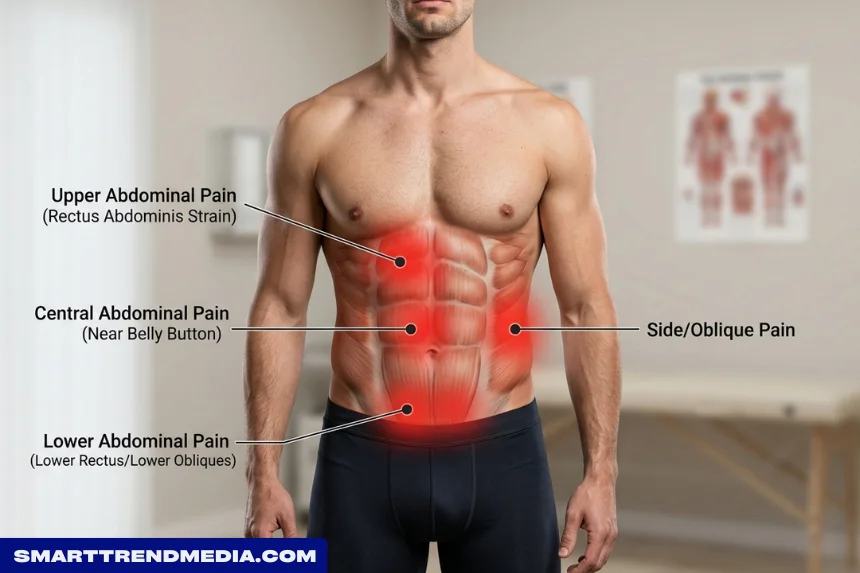
Where Can a Pulled Abdominal Muscle Hurt?
A pulled abdominal muscle can hurt in the upper abdomen, lower abdomen or on either side. The pain’s location depends on the affected muscle and the movement that caused the injury.
Upper Abdominal Muscle Pain
An upper abdominal strain may affect the top portion of the rectus abdominis or nearby muscles beneath the ribs. Common triggers include:
- Sit-ups and crunches
- Heavy overhead lifting
- Pulling exercises
- Reaching suddenly
- Repeated coughing
- A direct blow during sports
However, upper abdominal pain can also come from the stomach, gallbladder, liver, pancreas, lungs or heart. Therefore, seek medical care when upper abdominal pain is severe, persistent or associated with chest pain, breathing difficulty, vomiting or fever.
Lower Abdominal Muscle Pain
A lower abdominal strain may develop after sprinting, leg raises, heavy lifting or a sudden hip and trunk movement. It may hurt when you straighten your body, raise a leg, cough or sit up.
Still, lower abdominal pain in women requires extra caution because the ovaries, uterus, bladder, bowel and other pelvic structures can produce pain in the same general area. A muscle strain becomes more likely when the pain began after a recognizable physical activity and consistently worsens when you engage the core.
Left- or Right-Sided Abdominal Pain
Pain along one side of the abdominal wall may involve an oblique muscle. Rotational sports and exercises commonly place stress on these muscles. Golf, tennis, throwing, twisting workouts and lifting while turning can all contribute.
Muscle-related side pain typically worsens with bending, laughing, sneezing, twisting or lifting. By comparison, kidney pain does not usually change as predictably with body movement.
What Causes a Pulled Stomach Muscle in Women?
A pulled abdominal muscle usually results from sudden force, overuse or repeated contraction. In many cases, women can connect the pain to a particular activity.
Exercise and Sports
Core workouts are a common trigger, particularly when someone:
- Performs too many repetitions
- Uses poor technique
- Lifts more weight than usual
- Skips a warm-up
- Returns to exercise after a long break
- Continues exercising despite fatigue
Running, sprinting, tennis, golf, gymnastics and other activities involving rapid trunk movement may also strain the abdominal muscles.
Heavy Lifting and Household Activities
A strain does not have to occur in a gym. Moving furniture, carrying heavy groceries, lifting a child or completing yard work can overload the abdominal wall.
Twisting while holding weight increases the demand on the oblique muscles. Therefore, turning your feet and entire body instead of twisting only at the waist may reduce unnecessary strain.
Repeated Coughing, Sneezing or Vomiting
Each cough, sneeze or vomiting episode forcefully contracts the abdominal wall. Repeated episodes may eventually strain fatigued or weakened muscles.
However, these actions also raise pressure inside the abdomen. Consequently, a painful bulge after prolonged coughing or vomiting should be examined for a possible hernia rather than assumed to be a simple muscle strain.
Pregnancy and Childbirth
During pregnancy, the abdominal wall stretches to accommodate the growing uterus. This process can reduce core stability and change how the muscles handle lifting, exercise and sudden movement.
After childbirth, abdominal weakness may continue while the tissues recover. In addition, women who have had a cesarean birth may experience discomfort around the incision. A new or worsening pain near a surgical scar should be discussed with a healthcare professional rather than treated automatically as a strain.
Returning to Exercise After Pregnancy
Returning too quickly to intense core workouts may overload muscles that have not regained their previous strength and coordination. However, avoiding all movement for a prolonged period may also delay functional recovery.
A gradual approach is generally more appropriate. Women who notice midline doming, pelvic pressure, urine leakage, ongoing weakness or pain may benefit from an assessment by an obstetric clinician or pelvic-health physical therapist. Diastasis recti often causes doming or coning when the abdominal muscles contract, along with difficulty lifting or completing everyday activities.

Pulled Stomach Muscle Female Symptoms During Pregnancy
Pulled stomach muscle female symptoms during pregnancy may include localized soreness, tenderness and pain that worsens when coughing, turning, standing up or using the abdominal muscles. However, pregnancy causes several other types of abdominal discomfort. Therefore, pregnant women should not assume that new abdominal pain is only a muscle strain.
As the uterus grows, the abdominal wall stretches and the body’s center of gravity changes. The ligaments supporting the uterus also stretch. As a result, some women experience aching or brief discomfort on one or both sides of the abdomen.
A muscle strain becomes more likely when:
- The pain began after lifting, exercise, forceful coughing or sudden movement.
- The pain stays in one specific area of the abdominal wall.
- Coughing, laughing, rolling over or sitting up reproduces the pain.
- The affected area feels locally tender.
- Resting the muscle reduces the discomfort.
Nevertheless, these clues cannot confirm the diagnosis. Appendicitis, ovarian conditions and other internal problems may also become more painful with movement or coughing. Therefore, a healthcare professional may need to examine unexplained or persistent pain.
When Pregnancy-Related Abdominal Pain Needs Prompt Care
Contact an obstetric healthcare professional when abdominal pain:
- Persists or steadily worsens
- Becomes severe
- Occurs with vaginal bleeding
- Is accompanied by fever
- Causes repeated vomiting
- Occurs with painful urination
- Is associated with contractions or fluid leakage
- Develops after a fall or injury
- Makes normal movement difficult
In addition, seek emergency care for severe pelvic or abdominal pain with shoulder pain, weakness, dizziness or fainting. These can be warning signs of a ruptured ectopic pregnancy, particularly when pregnancy is possible. ACOG also advises reporting abnormal bleeding and pelvic pain because an ectopic pregnancy can initially resemble other common conditions.
Do Not Self-Treat Pregnancy Pain With Medication
Pregnant women should speak with an obstetric clinician before taking pain medicine, including over-the-counter products. A medication that was suitable before pregnancy may not be appropriate during every stage of pregnancy.
Likewise, avoid forceful abdominal stretching, heavy core exercises or repeated sit-ups to “test” the painful area. Instead, stop the movement that triggers sharp pain and ask a healthcare professional which activities are safe.
Pulled Muscle or Diastasis Recti After Pregnancy?
A pulled abdominal muscle and diastasis recti can both affect core function. However, they are different conditions.
A muscle strain involves overstretched or torn muscle fibers. In contrast, diastasis recti involves widening and thinning of the connective tissue between the left and right rectus abdominis muscles.
During pregnancy, the uterus expands and places pressure on the abdominal wall. Consequently, the tissue between the abdominal muscles may stretch and become thinner. After delivery, the separation may improve gradually. However, some women continue to notice a gap, bulge or weakness.
Signs More Consistent With a Pulled Abdominal Muscle
A strain is more likely when you experience:
- A clear injury or triggering activity
- Localized pain in one part of the abdominal wall
- Tenderness over the affected muscle
- Pain when coughing, twisting or sitting up
- Tightness or spasms
- Swelling or bruising
- Pain that gradually improves as the injury heals
The pain usually appears soon after the muscle is overloaded. For example, it may start after lifting a stroller, carrying a child, completing a difficult workout or coughing repeatedly.
Signs More Consistent With Diastasis Recti
Diastasis recti may cause:
- A visible bulge above or below the belly button
- Doming or coning along the middle of the abdomen
- A soft or jelly-like area around the belly button
- Core weakness
- Difficulty lifting or completing everyday tasks
- Poor posture
- Lower-back discomfort
- A feeling of reduced abdominal support
The separation itself is not usually painful. However, the related weakness, altered movement patterns or accompanying back and pelvic problems may cause discomfort.
Pulled Muscle Versus Diastasis Recti
| Feature | Pulled abdominal muscle | Diastasis recti |
|---|---|---|
| Main problem | Overstretched or torn muscle fibers | Widening of the connective tissue between the abdominal muscles |
| Typical onset | After lifting, exercise, coughing or sudden movement | Usually develops during pregnancy and may continue postpartum |
| Pain pattern | Localized pain that worsens when the muscle contracts | The separation itself is usually painless, although weakness may cause discomfort |
| Visible signs | Possible swelling or bruising | Midline doming, coning or a persistent bulge |
| Core strength | Temporarily reduced because of pain or injury | May remain reduced because of decreased abdominal-wall support |
| Common evaluation | Injury history and physical examination | Abdominal examination and, in some cases, ultrasound |
| Typical rehabilitation | Gradual return to activity after pain improves | Individualized core rehabilitation, sometimes with pelvic-health physical therapy |
Can You Have Both Conditions?
Yes. A woman with diastasis recti may also strain an abdominal muscle. The existing separation does not automatically mean that every new pain comes from diastasis.
For example, sudden localized pain after lifting may still indicate a muscle injury. Meanwhile, new midline doming without an acute injury may fit diastasis recti more closely.
A pelvic-health physical therapist or another qualified clinician can assess breathing, abdominal pressure, posture and core coordination. In addition, the clinician can help determine which exercises are appropriate and which movements currently place too much pressure on the abdominal wall.
Pulled Stomach Muscle or Hernia?
A hernia and an abdominal strain can cause pain in similar situations. Both may hurt during lifting, coughing, bending or straining. However, the underlying problems are different.
A pulled muscle involves damaged muscle fibers. A hernia develops when fat, tissue or part of an organ pushes through a weak area in the abdominal wall.
Signs That Suggest an Abdominal Muscle Strain
Pain may be more consistent with a strain when:
- It began after exercise, lifting or a sudden twist.
- The pain follows the direction of a particular muscle.
- The area feels sore, tight or cramped.
- You have swelling or bruising.
- Engaging the core reproduces the pain.
- The symptoms gradually improve with appropriate activity modification.
A strain does not usually create a clearly defined bulge. Therefore, a new lump deserves medical attention even when it appeared after physical activity.
Signs That Suggest a Hernia
A hernia may cause:
- A visible or noticeable lump
- A bulge that appears while standing, coughing or straining
- Pressure, aching or burning at the affected site
- Discomfort while lifting
- A heavy sensation in the abdomen or groin
- A bulge near a previous surgical scar
- Symptoms that continue even after a suspected strain should have improved
Some hernias become less visible when a person lies down. However, others remain present or become trapped.
An incisional hernia may develop near a previous abdominal surgical site. Therefore, a woman who notices a new bulge around a C-section or another abdominal scar should arrange an examination rather than assuming the area contains only scar tissue.
Pulled Abdominal Muscle Versus Hernia
| Feature | Pulled stomach muscle | Hernia |
|---|---|---|
| Cause | Muscle fibers become overstretched or torn | Tissue pushes through a weak area in the abdominal wall |
| Pain after lifting | Common | Common |
| Pain with coughing | Common | Common |
| Muscle tightness or spasms | Common | Less characteristic |
| Bruising | Possible | Not a typical feature |
| Visible bulge | Usually absent | Often present |
| Digestive symptoms | Not typical | Possible when bowel becomes involved |
| Expected progress | Usually improves as the muscle heals | The abdominal-wall opening does not normally heal through rest alone |
When a Hernia May Be an Emergency
Seek urgent medical care when a suspected hernia causes:
- Sudden or rapidly worsening pain
- A firm bulge that cannot be pushed back
- Red, purple or darkened skin over the bulge
- Nausea or repeated vomiting
- Fever
- Severe constipation
- Inability to pass stool or gas
These symptoms may occur when a hernia becomes trapped or loses its blood supply. Complicated hernias can cause severe pain, nausea, vomiting and bowel obstruction.
Do not repeatedly press a painful lump or attempt to force it back into the abdomen. Instead, obtain prompt medical care.
Could the Pain Come From an Internal or Pelvic Condition?
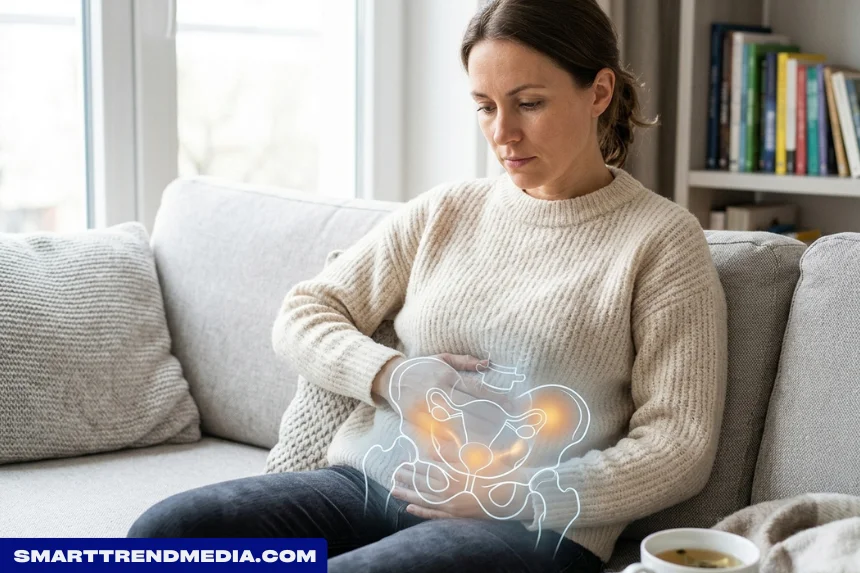
The abdomen contains muscles, nerves, blood vessels and many internal organs. Meanwhile, the lower abdomen overlaps with the pelvic region. Therefore, pulled stomach muscle female symptoms can resemble pain from reproductive, urinary or digestive conditions.
The location of pain alone cannot identify its cause. For example, right lower abdominal pain may come from a muscle, the appendix, an ovary, the bowel or the urinary tract.
Patterns That May Fit a Muscle Strain
A muscle injury becomes more likely when:
- The pain followed a specific physical activity.
- It stays near the surface of the abdominal wall.
- A particular movement consistently reproduces it.
- The area feels locally tender.
- There is tightness, spasm, swelling or bruising.
- You have no significant digestive, urinary or gynecologic symptoms.
- The pain gradually improves rather than worsening.
However, these are clues rather than proof. Some serious internal conditions can also worsen with coughing, walking or movement.
Symptoms That Point Away From a Simple Strain
Another cause should be considered when abdominal pain occurs with:
- Vaginal bleeding
- A missed period or possible pregnancy
- Sudden one-sided pelvic pain
- Changes in menstrual bleeding
- Pain during intercourse
- Fever or chills
- Persistent nausea or vomiting
- Loss of appetite
- Painful or frequent urination
- Blood in the urine or stool
- Significant bloating
- Diarrhea or constipation
- Inability to pass gas
- Faintness or dizziness
- Pain that does not change when the abdominal muscles move
- Symptoms that steadily worsen
Pelvic pain can come from the uterus, ovaries, fallopian tubes, cervix or vagina. It may also originate in the urinary tract, lower bowel, muscles or bones.
Ovarian Cysts and Ovarian Torsion
Many ovarian cysts cause few or no symptoms. However, a cyst may cause dull pelvic aching, bloating, pain with intercourse or discomfort around menstruation.
Sudden severe pelvic pain with nausea and vomiting may indicate that an ovary has twisted or that a cyst has ruptured. Both situations require urgent assessment.
Ovarian pain may sometimes feel worse during movement. Therefore, movement-related pain should not automatically be classified as muscular when severe pelvic symptoms are present.
Ectopic Pregnancy
An ectopic pregnancy occurs when a fertilized egg implants outside the uterus. Early symptoms may include abnormal vaginal bleeding and pelvic pain. However, a rupture can cause sudden severe abdominal or pelvic pain, shoulder pain, weakness, dizziness or fainting.
Seek immediate care when pregnancy is possible and these symptoms occur. A home pregnancy test may provide useful information, but a negative or uncertain result should not delay emergency care for severe symptoms.
Appendicitis
Appendicitis often causes pain that eventually settles in the lower-right abdomen. It may also cause nausea, vomiting, fever, loss of appetite, abdominal swelling, constipation or diarrhea.
Importantly, appendicitis pain may worsen with movement, coughing or sneezing. Therefore, this pattern is not exclusive to a pulled muscle. Severe or steadily worsening right-sided abdominal pain needs prompt evaluation.
Urinary and Kidney Conditions
A urinary tract infection may cause lower abdominal discomfort, burning during urination and an increased need to urinate. Meanwhile, kidney conditions may cause side or back pain, nausea, vomiting, fever or urinary symptoms.
Muscular side pain often changes predictably with twisting or bending. Nevertheless, the presence of fever, painful urination, blood in the urine or persistent nausea points away from a simple strain.
Digestive Conditions
Constipation, intestinal infections and inflammatory digestive conditions can all cause abdominal pain. In addition, gas and bowel spasms may become more uncomfortable during movement.
Digestive pain becomes more likely when abdominal discomfort occurs with:
- Changes in bowel movements
- Bloating
- Loss of appetite
- Nausea or vomiting
- Blood in the stool
- Pain connected to meals
- Inability to pass stool or gas
Although these patterns are useful, they do not replace an examination.
How Doctors Diagnose a Pulled Abdominal Muscle
A healthcare professional usually begins by asking how the pain started. A clear history is especially helpful because a muscle strain commonly follows lifting, exercise, coughing or sudden movement.
The clinician may ask:
- Where is the pain located?
- Did it begin suddenly or gradually?
- Which movement triggered it?
- Does coughing, laughing or sitting up make it worse?
- Is there bruising, swelling or a bulge?
- Are you pregnant or could you be pregnant?
- Have you had a C-section or another abdominal operation?
- Do you have fever, vomiting, urinary symptoms or vaginal bleeding?
- Is the pain improving, stable or worsening?
Physical Examination
During the examination, the clinician may gently check the abdomen for:
- Localized tenderness
- Swelling or bruising
- Muscle weakness
- Guarding or rigidity
- A lump or hernia
- Pain during specific movements
- Signs that suggest an internal or pelvic condition
A physical examination is often enough to identify a pulled muscle. However, additional testing may be needed when the injury appears severe or another diagnosis remains possible.
The clinician may also examine the abdomen while you stand, cough or change position when a hernia is suspected. Ventral hernias are often identified during a physical examination, although imaging may help when the bulge is difficult to see.
Pregnancy and Pelvic Evaluation
A pregnancy test may be recommended when pregnancy is possible. This is important because pregnancy-related conditions can change which imaging tests and treatments are suitable.
Depending on the symptoms, the clinician may also recommend a pelvic examination or a consultation with an obstetrician-gynecologist. However, the exact examination depends on the pain pattern, medical history and pregnancy status.
Imaging and Other Tests
A mild, straightforward muscle strain may not require imaging. Nevertheless, a clinician may order tests when symptoms are severe, unusual or persistent.
Possible tests include:
- Ultrasound: May help evaluate a hernia, pelvic organs, pregnancy-related concerns, fluid collections or some soft-tissue injuries.
- CT scan: Provides detailed images of abdominal and pelvic structures and may help identify internal causes of pain.
- MRI: May show the location and extent of a muscle tear without using ionizing radiation.
- Blood tests: May identify signs of infection, inflammation, bleeding or another medical problem.
- Urine tests: May help detect a urinary infection, kidney problem or pregnancy.
- X-rays: May be considered after significant trauma or when a bone injury is possible.
The tests chosen depend on the suspected condition. MedlinePlus notes that evaluations for abdominal pain may include blood, urine and stool tests, CT scans, ultrasound and other procedures based on the symptoms.
Why an Accurate Diagnosis Matters
Treating every abdominal pain as a pulled muscle can delay care for a hernia, ectopic pregnancy, ovarian emergency, appendicitis or another condition. On the other hand, identifying a true muscle strain can prevent unnecessary fear and support a safer return to normal activity.
Therefore, seek an examination when the cause remains unclear, pain interferes with daily life or the symptoms do not follow a steady pattern of improvement.
How to Treat Pulled Stomach Muscle Female Symptoms Safely
Treatment for pulled stomach muscle female symptoms depends on the injury’s severity and whether another condition could be causing the pain. A mild abdominal strain often improves with temporary activity changes, cold or warmth, and a gradual return to movement. However, severe pain, a new bulge or pregnancy-related symptoms require medical advice before home treatment.
Stop the Activity That Caused the Pain
First, avoid movements that produce sharp or pulling pain. These may include:
- Sit-ups and crunches
- Heavy lifting
- Twisting exercises
- Sprinting
- Reaching overhead
- Carrying a child on one side
- Moving furniture
- Forceful stretching
You do not necessarily need complete bed rest. Instead, continue comfortable activities that do not worsen the injury. Resting the injured muscle initially and later adding appropriate exercise or physical therapy are standard parts of strain recovery.
For example, gentle walking may feel comfortable even when lifting and twisting remain painful. Stop, however, when an activity causes sharp pain or makes the symptoms noticeably worse afterward.
Use a Cold Pack During the Early Stage
A cold pack may reduce discomfort and swelling after a recent injury. Wrap it in a thin towel before placing it on the skin. Never apply ice directly to the abdomen.
Use the cold pack for a short period, and then allow the skin to return to its normal temperature. Stop immediately if you develop numbness, burning or unusual skin discoloration. MedlinePlus recommends protecting the skin and using short ice applications during the early stage of a muscle strain.
Try Gentle Warmth for Later Stiffness
After the initial swelling has settled, gentle warmth may help relax a tight or stiff abdominal muscle. For instance, you might use a warm compress or take a comfortably warm shower.
However, do not apply strong heat over fresh bruising, significant swelling or an unexplained abdominal lump. Cleveland Clinic notes that alternating cold packs and warm compresses may help manage abdominal muscle strains.
Support the Area When Coughing
If coughing or sneezing triggers pain, you may gently support the sore area with your hand or a small pillow. Do not press forcefully.
Supporting the abdomen may reduce sudden pulling during a cough. Nevertheless, a prolonged cough should also be treated because repeated abdominal contractions can continue to aggravate the injury.
Consider Physical Therapy
Physical therapy may be useful when pain continues, the strain repeatedly returns or core weakness interferes with normal activity. A physical therapist can assess posture, breathing, lifting technique and abdominal coordination.
Physical therapy may be particularly helpful for women who also experience:
- Postpartum weakness
- Diastasis recti
- Pelvic pressure
- Urine leakage
- Lower-back discomfort
- Difficulty returning to exercise
- Midline abdominal doming
Cleveland Clinic recommends specialized exercises for diastasis recti and notes that physical therapy can support abdominal-wall rehabilitation.
Ask Before Taking Pain Medication
Some adults use over-the-counter pain medicine for a muscle strain. However, these products are not appropriate for everyone.
Check with a healthcare professional before taking pain medicine when you:
- Are pregnant or breastfeeding
- Take blood thinners
- Have kidney or liver disease
- Have stomach ulcers
- Have a history of gastrointestinal bleeding
- Take several prescription medications
- Are preparing for surgery
- Have an allergy to pain relievers
Ibuprofen, naproxen and similar nonsteroidal anti-inflammatory drugs can increase the risk of stomach ulcers or bleeding in some people. They may also interact with anticoagulants and other medications.
Pregnant women should speak with their obstetric clinician before using any over-the-counter pain medicine. The FDA advises avoiding NSAIDs at approximately 20 weeks of pregnancy or later unless a healthcare professional specifically recommends them.
What Not to Do With a Pulled Abdominal Muscle
Although most mild strains recover without surgery, certain actions can delay improvement or make the injury worse.
Avoid:
- Repeating sit-ups to test whether the pain remains
- Stretching forcefully through sharp pain
- Returning immediately to heavy lifting
- Continuing the workout that caused the injury
- Massaging an area with extensive bruising
- Pressing repeatedly on a painful lump
- Wearing a tight abdominal binder without medical advice
- Ignoring worsening pain because you assume it is muscular
In addition, do not use pulled stomach muscle female symptoms as the only basis for self-diagnosis. Abdominal and pelvic conditions can overlap with muscular pain.
Starting strengthening exercises too soon may increase pain. A physical therapist can help determine when the muscle is ready for progressive stretching and strengthening.
How Long Does a Pulled Stomach Muscle Take to Heal?
Recovery depends on the amount of muscle damage, your activity level and whether you continue aggravating the area. Therefore, there is no single healing time for every woman.
In general:
| Injury pattern | Possible recovery pattern |
|---|---|
| Mild soreness without major weakness | May begin improving within several days |
| Moderate pain with spasms, bruising or weakness | May require several weeks |
| Severe or complete muscle tear | May require months of rehabilitation and specialist care |
| Pain caused by a hernia or internal condition | Will not follow a typical muscle-healing timeline |
Most sprains and strains begin to feel better within about two weeks, although strenuous activity may need to be limited longer. Severe injuries can take several months to return to normal.
Rather than relying only on the calendar, monitor function. Pulled stomach muscle female symptoms should show an overall pattern of improvement. You should gradually find it easier to:
- Stand upright
- Turn in bed
- Cough or laugh
- Walk comfortably
- Lift light objects
- Engage the core gently
A temporary increase after an awkward movement does not always mean a new tear. However, steadily worsening pain, spreading bruising or declining strength requires reassessment.
When Is It Safe to Exercise Again?
Return to exercise gradually after daily movements become comfortable. Begin with low-intensity activity that does not create sharp pain.
Before returning to heavy core training, you should be able to:
- Walk without guarding the abdomen
- Turn your torso comfortably
- Get out of bed without sharp pain
- Cough without severe discomfort
- Perform gentle core engagement
- Complete basic movements without pain afterward
If symptoms return during more demanding activity, stop and return to an easier level. AAOS advises discontinuing strenuous activity when pain returns and progressing again only after symptoms settle.
When Should a Woman See a Doctor?
Arrange a medical appointment when pulled stomach muscle female symptoms interfere with everyday life or do not steadily improve.
Contact a healthcare professional when:
- The cause of the pain is unclear
- Pain prevents you from sleeping
- You cannot stand upright comfortably
- Walking or normal movement is difficult
- Bruising or swelling is significant
- You feel a new abdominal lump
- Pain keeps returning
- Symptoms worsen instead of improving
- You have pain near a previous C-section or surgical scar
- Postpartum doming or weakness continues
- You are pregnant and develop persistent abdominal pain
Medical evaluation is also appropriate when muscle pain lasts several days without improvement or when swelling becomes more severe.
A clinician may determine that the injury is a straightforward strain. Alternatively, the examination may reveal a hernia, diastasis recti, pelvic condition or another source of pain.
Emergency Symptoms That Are Not Typical of a Simple Strain
Seek emergency medical care for:
- Sudden or unbearable abdominal or pelvic pain
- A hard or rigid abdomen
- Severe tenderness when the abdomen is gently touched
- Fainting or confusion
- Severe weakness or dizziness
- Shoulder pain with abdominal or pelvic pain
- Vaginal bleeding when pregnancy is possible
- Repeated vomiting
- A painful, hard or discolored abdominal bulge
- Inability to pass stool or gas
- High fever with worsening pain
- Rapidly increasing swelling or bruising
- Shortness of breath
- Severe pain after a fall, crash or direct abdominal injury
A rigid, painful abdomen may occur with serious internal abdominal conditions and requires immediate medical assessment.
In addition, sudden severe pelvic pain, shoulder pain, dizziness or fainting may signal a ruptured ectopic pregnancy. Abnormal bleeding and pelvic pain should be reported promptly when pregnancy is possible.
How to Prevent Another Abdominal Muscle Strain
You cannot prevent every injury. However, several habits may reduce your risk.
Warm Up Before Exercise
Begin with light movement before intense lifting, sprinting or core training. A warm-up gradually prepares your muscles for greater force.
Increase Exercise Gradually
Avoid suddenly doubling the weight, repetitions or exercise duration. Instead, increase the challenge in small steps.
This approach is especially important when returning after:
- Pregnancy
- Childbirth
- Abdominal surgery
- Illness
- A long exercise break
- A previous muscle strain
Use Better Lifting Technique
Keep the object close to your body and turn your feet instead of twisting only at the waist. Ask for help when an item is too heavy or awkward.
Train More Than the Visible Abdominal Muscles
A balanced program should include the deep abdominal muscles, back, hips and pelvic floor rather than focusing only on crunches.
However, exercises should match your current strength and medical condition. Women with postpartum doming or pelvic symptoms may need individualized instruction.
Allow Adequate Recovery
Fatigued muscles handle sudden force less effectively. Therefore, alternate intense training with lighter activity and recovery days.
Address Repeated Coughing
A persistent cough can repeatedly stress the abdominal wall. Treating its underlying cause may reduce continued strain and the risk of a hernia.
Rest, proper conditioning, core strengthening and safer lifting techniques can help reduce future muscle strains.
Frequently Asked Questions
What Are the Most Common Pulled Stomach Muscle Female Symptoms?
The most common pulled stomach muscle female symptoms are localized abdominal pain, tenderness, stiffness, spasms and discomfort when coughing, laughing, bending, twisting or sitting up. A moderate strain may also cause swelling, bruising and core weakness. However, vaginal bleeding, vomiting, fever or a new bulge may suggest another condition.
How Can I Tell Whether My Stomach Pain Is Muscular?
Muscular pain often begins after exercise, lifting, coughing or sudden movement. It usually becomes worse when you contract the abdominal muscles. The area may also feel tender near the surface.
Still, these clues cannot rule out appendicitis, a hernia or a pelvic condition. Seek medical advice when the pain is severe, unexplained or worsening.
Does a Pulled Stomach Muscle Hurt When Pressed?
Yes, a strained abdominal muscle may feel locally tender when lightly touched. However, do not repeatedly press deeply into the abdomen.
Severe tenderness, guarding or a rigid abdomen is not typical of a simple mild strain and requires prompt medical evaluation.
Can Coughing Pull an Abdominal Muscle?
Yes. Repeated coughing creates forceful abdominal contractions. Over time, those contractions may overload the muscle fibers.
However, coughing also raises pressure inside the abdomen. Therefore, a lump that appears during coughing should be checked for a possible hernia.
Can a Pulled Stomach Muscle Cause Nausea?
Nausea is not a characteristic symptom of an uncomplicated abdominal muscle strain. Severe pain can occasionally make someone feel nauseated, but persistent nausea or vomiting may indicate an internal abdominal or pelvic condition.
Seek care when nausea occurs with worsening pain, fever, a swollen abdomen or an inability to pass stool or gas.
Can a Pulled Abdominal Muscle Cause a Lump?
A simple strain does not usually cause a clearly defined lump. Swelling or a hematoma may occasionally create a raised area, but a new lump can also indicate a hernia.
Any new abdominal mass should be examined, particularly when it is painful, firm, pulsating or associated with vomiting.
Can a Pulled Muscle Feel Like Ovarian Pain?
Yes. A lower abdominal muscle and an ovary can produce pain in a similar location. Muscle pain often follows activity and changes with core movement.
Ovarian or pelvic pain may occur with menstrual changes, vaginal bleeding, pain during intercourse, nausea or sudden one-sided pain. These symptoms need medical assessment.
Is Ice or Heat Better for a Pulled Stomach Muscle?
Cold may be more helpful during the early stage of a new injury, particularly when swelling is present. Later, gentle warmth may reduce stiffness.
Protect your skin and avoid extreme temperatures. Do not place heat over unexplained swelling, extensive bruising or a new lump.
Can I Exercise With a Pulled Stomach Muscle?
Gentle activity may be possible as long as it does not produce sharp pain. However, avoid heavy lifting, twisting and demanding abdominal exercises during the painful stage.
Return gradually after everyday movements become comfortable. A physical therapist can help when weakness or recurring pain makes progression difficult.
Can Pregnancy Cause a Pulled Abdominal Muscle?
Pregnancy stretches the abdominal wall and changes core function. Therefore, a pregnant woman may be more vulnerable to pain after lifting, coughing or sudden movement.
Still, abdominal pain during pregnancy has many possible causes. Persistent pain, vaginal bleeding, contractions, fluid leakage, dizziness or severe one-sided pain requires medical advice.
Is Postpartum Abdominal Pain Always Diastasis Recti?
No. Diastasis recti usually causes midline doming, bulging and core weakness. The separation itself is not normally acutely painful.
Postpartum pain may instead involve a muscle strain, healing tissues, a C-section scar, the pelvic floor or another condition. An examination can clarify the cause when symptoms persist.
When Should I Go to Urgent Care?
Consider urgent care for significant pain, bruising, swelling, limited movement or symptoms that do not improve. However, emergency care is more appropriate for severe pain, fainting, vaginal bleeding with possible pregnancy, repeated vomiting, a rigid abdomen or a painful discolored bulge.
Final Takeaway
Pulled stomach muscle female symptoms usually include localized abdominal-wall pain that worsens when coughing, laughing, bending, lifting, twisting or sitting up. Tenderness, tightness, spasms, swelling, bruising and core weakness may also occur.
However, abdominal pain in women is not always muscular. Pregnancy complications, ovarian conditions, diastasis recti, hernias and digestive or urinary problems can produce overlapping symptoms. Therefore, seek medical care when pain is severe, unexplained, worsening or accompanied by vaginal bleeding, vomiting, fever, faintness or an abdominal bulge.
This article provides general educational information and does not replace diagnosis or treatment from a qualified healthcare professional.
READ MORE ABOUT : Ibuprofen and Tylenol Together Dosage Chart for Adults