

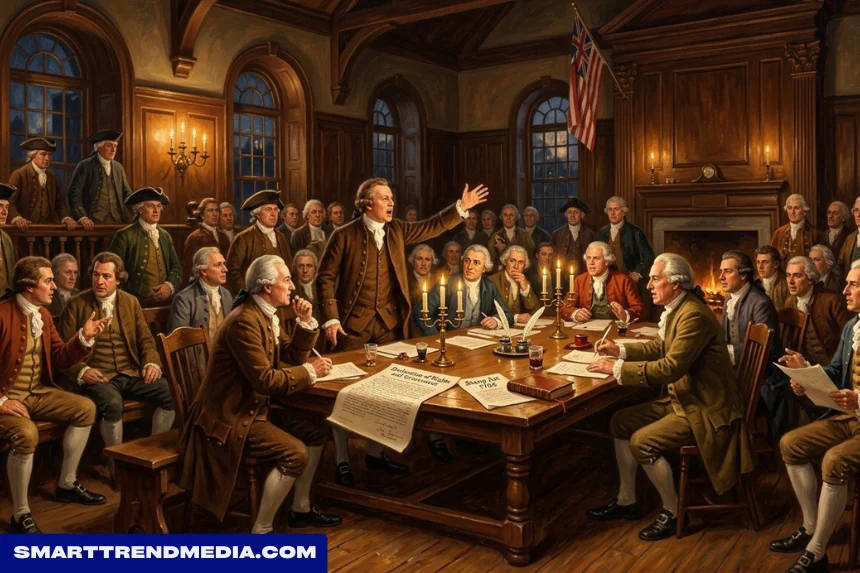
The Stamp Act Congress was an intercolonial meeting held in New York City in October 1765 to coordinate opposition to Britain’s Stamp Act. Delegates from nine of the thirteen American colonies participated. Rather than demanding independence, they argued that colonists possessed the rights of British subjects and should not be taxed without their consent through representatives. The Congress ultimately adopted the Declaration of Rights and Grievances, creating one of the clearest early statements of colonial constitutional objections to British taxation.
Although the gathering lasted only about two weeks, its importance extended far beyond the immediate Stamp Act dispute. For the first time, representatives from several colonies coordinated a shared political response to a British policy, creating a model for later intercolonial cooperation.
What Was the Stamp Act Congress?
The Stamp Act Congress was a meeting of colonial representatives who gathered in New York in October 1765 after Parliament imposed the Stamp Act on the American colonies.
The Massachusetts Assembly proposed the intercolonial meeting, and nine colonies ultimately sent representatives. The delegates discussed common grievances, challenged Parliament’s authority to impose certain taxes without colonial consent, and prepared petitions seeking relief.
The Library of Congress records 27 delegates from nine colonies at the Congress. Its major political statement became the Declaration of Rights and Grievances.
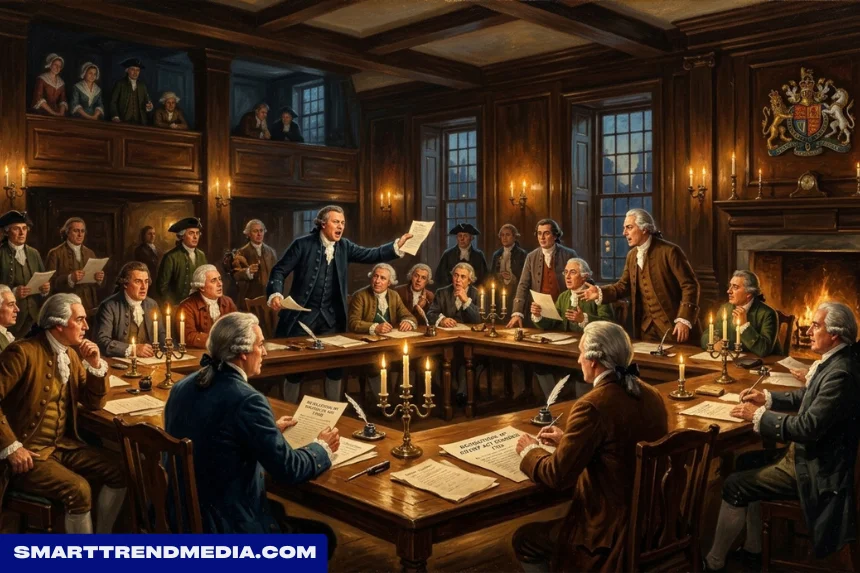
Stamp Act Congress Quick Answer
The Stamp Act Congress was a meeting of representatives from nine American colonies in New York City in October 1765. It organized opposition to the Stamp Act and adopted the Declaration of Rights and Grievances, which argued that colonists should not be taxed without their consent through representatives.
Importantly, the Congress did not call for American independence.
Instead, the delegates still presented themselves as British subjects seeking recognition of what they considered their established rights.
Stamp Act Congress Quick Facts
| Fact | Answer |
|---|---|
| Event | Stamp Act Congress |
| Year | 1765 |
| Opening date | October 7, 1765 |
| Location | New York City |
| Meeting site | Colonial New York City Hall |
| Colonies represented | 9 of 13 |
| Participating delegates | 27 according to the Library of Congress |
| Main issue | Opposition to the Stamp Act |
| Major document | Declaration of Rights and Grievances |
| Declaration date | October 19, 1765 |
| Central argument | Taxation required colonial consent |
| Did it demand independence? | No |
| Long-term significance | Early intercolonial political cooperation |
The National Park Service confirms that New York’s eighteenth-century City Hall hosted the Congress in October 1765. The Library of Congress dates the Declaration of Rights and Grievances to October 19, 1765.
Why Did Britain Pass the Stamp Act?
The Stamp Act controversy developed after years of war between Britain and France.
Britain emerged from the Seven Years’ War, known in its North American context as the French and Indian War, with major financial obligations. Moreover, Britain continued maintaining forces and administering territory in North America.
Consequently, Parliament sought additional colonial revenue.
In 1765, Parliament enacted the Stamp Act.
The Library of Congress describes it as Parliament’s first direct tax on the American colonies.
Instead of imposing only a duty on imported goods, the Stamp Act applied taxation to many documents and printed materials used within the colonies.
That difference helped turn the law into a major constitutional dispute.

What Did the Stamp Act Tax?
The law required official stamps showing that the required tax had been paid on various printed or paper items.
According to the Library of Congress, taxable materials included:
- newspapers;
- pamphlets;
- almanacs;
- broadsides;
- legal documents;
- dice;
- playing cards.
Therefore, the law affected printers, merchants, lawyers, publishers, property transactions, and other everyday activities.
However, colonial opposition quickly became about something larger than the cost of individual stamps.
The central question became:
Could Parliament directly tax colonists who did not elect representatives to Parliament?
That constitutional disagreement became the foundation of the Stamp Act Congress.
Why Did Colonists Oppose the Stamp Act?
Colonial resistance involved several overlapping complaints.
First, many colonists rejected Parliament’s attempt to impose a direct internal tax without approval from their colonial assemblies.
Second, they argued that taxation required consent.
Third, colonists had no elected representatives sitting in the British Parliament.
Additionally, the Stamp Act controversy raised concerns about limits on trial by jury and expanded use of vice-admiralty courts. The Library of Congress specifically identifies these judicial concerns alongside colonial objections to taxation.
Therefore, the dispute was not simply:
“Colonists did not want to pay taxes.”
A more accurate explanation is:
Many colonists disputed who had the constitutional authority to impose those taxes.
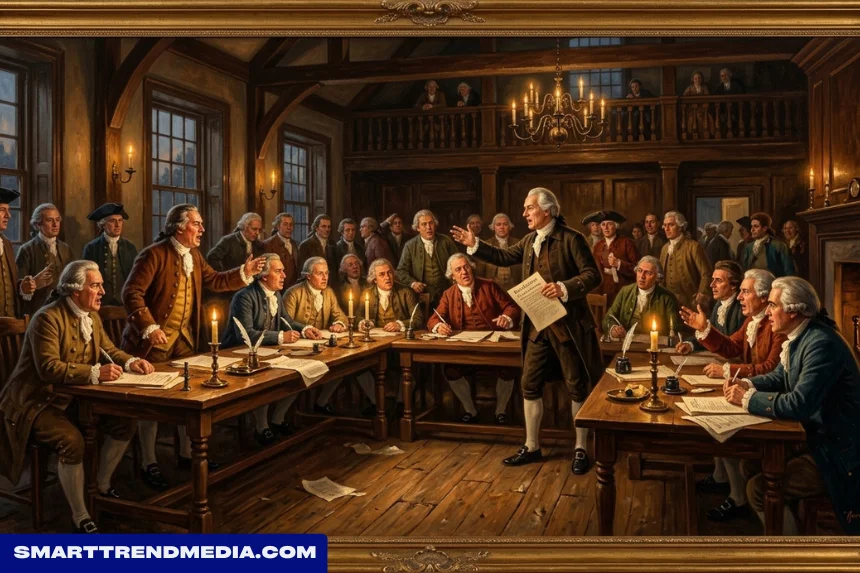
What Did “No Taxation Without Representation” Mean?
The famous idea of “no taxation without representation” summarized a central colonial objection to the Stamp Act.
Colonists elected representatives to their own colonial legislatures.
However, they did not elect members of the British Parliament.
Therefore, opponents of the Stamp Act argued that Parliament should not impose internal taxes on them without their consent through representatives they had chosen.
The Declaration of Rights and Grievances expressed this principle by asserting that taxes should not be imposed without consent given personally or through representatives.
The Colonial Argument
The logic can be simplified:
Taxation
→ requires consent
Consent
→ comes through representatives
Colonists
→ did not elect members of Parliament
Therefore:
Parliamentary taxation without colonial representation violated what the delegates considered an essential right of Englishmen.
What Was Virtual Representation?
Britain did not necessarily accept the colonial definition of representation.
British political theory included the concept of virtual representation.
Under this idea, members of Parliament represented the interests of the entire British realm, not simply the voters or districts that directly elected them.
Therefore, British officials could argue that American colonists were represented in Parliament even though they did not personally elect MPs.
Many colonists rejected that reasoning.
They increasingly insisted that meaningful taxation required representatives chosen by the people being taxed.
This difference between virtual representation and actual elected representation became an important constitutional fault line between Britain and the colonies.
Was Opposition Only About Taxes?
No.
Taxation became the most visible issue, but the Stamp Act crisis also involved questions about:
- representation;
- colonial legislative authority;
- trial by jury;
- vice-admiralty courts;
- Parliament’s constitutional power over the colonies.
The Library of Congress specifically notes that the Congress protested both the stamp tax and restrictions involving jury trials and vice-admiralty jurisdiction.
Therefore, the Stamp Act Congress should be understood as a constitutional protest, not merely an anti-tax meeting.
How Did Colonial Resistance Grow Before the Stamp Act Congress?
Opposition developed through several channels.
Colonial legislatures debated the constitutional issue.
Writers published arguments against the tax.
Merchants later supported nonimportation pressure.
Meanwhile, activist networks such as the Sons of Liberty organized popular resistance against stamp distributors.
The Library of Congress records that colonial protest grew so strong that the appointed stamp agents resigned before the law could operate normally.
The National Park Service likewise documents organized popular opposition to stamp officials during 1765.
However, the Stamp Act Congress represented a different kind of resistance.
Rather than relying primarily on street demonstrations, it brought colonial representatives together to formulate a shared political and constitutional response.
Who Proposed the Stamp Act Congress?
The Massachusetts Assembly proposed that representatives from the colonies meet and discuss a coordinated response.
The Library of Congress confirms that the intercolonial gathering was organized at Massachusetts’s suggestion.
This proposal was significant because colonies normally conducted much of their political business separately.
The Congress therefore required representatives from different colonies to consider a shared problem as a common colonial concern.
When Did the Stamp Act Congress Meet?
The first formal session took place on:
October 7, 1765
The Congress continued for roughly two weeks during October.
The U.S. House of Representatives’ historical office describes the Stamp Act Congress as an October 1765 meeting lasting approximately two weeks.
During that period, delegates debated colonial rights and prepared documents expressing their objections to the Stamp Act.
The Declaration of Rights and Grievances is dated:
October 19, 1765.
Where Did the Stamp Act Congress Meet?
The Congress met at New York City Hall.
The site stood at what is now 26 Wall Street in Manhattan.
Today, that location is associated with Federal Hall National Memorial.
However, an important historical distinction is necessary.
The present Federal Hall building is not the same building in which the Stamp Act Congress met.
The National Park Service explains that the eighteenth-century City Hall stood on the site of the current Federal Hall and hosted the Stamp Act Congress in October 1765.
Later, the site became important for several other events in American history.
Therefore, describing the Congress simply as meeting “at Federal Hall” can be misleading unless the historical building distinction is explained.
Which Colonies Attended the Stamp Act Congress?
Nine of the thirteen colonies sent representatives.
They were:
| Colony | Represented |
|---|---|
| Massachusetts | Yes |
| Rhode Island | Yes |
| Connecticut | Yes |
| New York | Yes |
| New Jersey | Yes |
| Pennsylvania | Yes |
| Delaware | Yes |
| Maryland | Yes |
| South Carolina | Yes |
The Library of Congress confirms that delegates from nine of thirteen colonies met in New York in October 1765.
The geographic range was significant.
Representatives came from New England, the Middle Colonies, and southern colonies.
Therefore, the Congress demonstrated that opposition to the Stamp Act extended beyond one local region.
Which Colonies Did Not Attend the Stamp Act Congress?
Four colonies were not represented:
- New Hampshire;
- Virginia;
- North Carolina;
- Georgia.
However, nonattendance should not automatically be interpreted as support for Parliament’s Stamp Act.
In several colonies, political procedures, governors, or the status of colonial assemblies complicated efforts to appoint delegates.
Therefore, the most accurate wording is:
Nine colonies were formally represented at the Congress, while four were not. That difference does not necessarily divide the colonies into opponents and supporters of the Stamp Act.
Indeed, opposition to the Stamp Act extended more broadly than formal representation at the meeting.
Why Did Only Nine Colonies Attend?
The colonies were not yet operating as one unified political body.
Each colony had:
- its own assembly;
- its own governor;
- different political procedures;
- different relationships with British authorities.
Therefore, Massachusetts could propose a continental meeting, but it could not compel every colonial government to participate.
That makes the attendance of nine colonies especially significant.
The event showed that intercolonial political cooperation was possible even before the First Continental Congress met in 1774.
How Many Delegates Attended the Stamp Act Congress?
The Library of Congress uses the figure:
27 delegates from nine colonies.
Some older historical compilations produce different totals depending on how delegates and attendance are counted.
Therefore, this article uses 27 participating delegates, following the current Library of Congress presentation.
This is the clearest figure for general readers.
Who Were the Important Stamp Act Congress Delegates?
The Congress included several figures who became important in colonial and Revolutionary-era politics.
Rather than treating all delegates equally, the most useful approach is to highlight the people who played major roles in the meeting or later American history.
Timothy Ruggles — Massachusetts
Timothy Ruggles was chosen to preside over the Congress.
Therefore, he served as the meeting’s chairman.
Although Ruggles later took a Loyalist position during the Revolutionary era, his role in the Stamp Act Congress demonstrates that political alliances in 1765 did not yet follow the divisions that emerged later.
James Otis — Massachusetts
James Otis was already well known for his criticism of British imperial policies.
He argued strongly for colonial rights and became one of the prominent intellectual voices associated with resistance to parliamentary taxation.
His participation connected the Congress with the broader constitutional arguments developing in Massachusetts.
John Dickinson — Pennsylvania
John Dickinson represented Pennsylvania.
He became one of the most influential political writers of the Revolutionary generation and later gained prominence for his Letters from a Farmer in Pennsylvania.
The Library of Congress identifies Dickinson among the important figures associated with the Congress and its declaration.
William Samuel Johnson — Connecticut
William Samuel Johnson represented Connecticut.
He was involved in the effort to prepare a petition based on the Declaration of Rights and Grievances. The Library of Congress specifically identifies Johnson among the delegates connected with that petitioning effort.
John Rutledge — South Carolina
John Rutledge represented South Carolina.
He later became a major figure in Revolutionary and early national politics.
His participation also demonstrates that the Stamp Act controversy brought together representatives from colonies separated by considerable geographic distance.
Caesar Rodney — Delaware
Caesar Rodney represented Delaware.
He later became famous for his role in the independence movement and signed the Declaration of Independence in 1776.
However, in 1765, independence was not yet the Congress’s objective.
Therefore, his presence helps show how some politicians moved gradually from constitutional protest to independence over the following decade.
Thomas McKean — Delaware
Thomas McKean was another Delaware representative.
Like Rodney, he later played a prominent role during the Revolutionary period and became a signer of the Declaration of Independence.
Again, his later political career should not be projected backward onto 1765.
At the Stamp Act Congress, delegates were demanding rights and repeal rather than national independence.
Key Stamp Act Congress Delegates at a Glance
| Delegate | Colony | Importance |
|---|---|---|
| Timothy Ruggles | Massachusetts | Presided over the Congress |
| James Otis | Massachusetts | Prominent advocate of colonial rights |
| John Dickinson | Pennsylvania | Important constitutional thinker |
| William Samuel Johnson | Connecticut | Connected with petition drafting |
| John Rutledge | South Carolina | Later major Revolutionary-era statesman |
| Caesar Rodney | Delaware | Later signer of Declaration of Independence |
| Thomas McKean | Delaware | Later signer and Revolutionary leader |
Who Was President of the Stamp Act Congress?
Timothy Ruggles of Massachusetts presided over the Stamp Act Congress.
Historical records generally describe his role as chairman or president of the meeting.
However, readers should not confuse this position with the presidency of the United States, which did not yet exist.
His job was to preside over the delegates and proceedings of the Congress.
What Made the Stamp Act Congress Unusual?
The individual colonies already had legislatures.
What made the Stamp Act Congress different was its intercolonial character
Representatives were not simply discussing:
Massachusetts’s problem
or:
New York’s problem.
Instead, delegates treated the Stamp Act as a political issue affecting several colonies simultaneously.
That shift mattered enormously.
It encouraged the idea that colonies with different governments and regional interests could cooperate when confronting a shared imperial policy.
Therefore, the Stamp Act Congress became important not only because of what delegates said but because of the act of meeting together itself.
Did the Stamp Act Congress Represent All Americans?
No.
Only nine colonies were formally represented.
Moreover, colonial society included many people who had no role in choosing colonial legislators or delegates.
Therefore, the Congress should not be described as a modern democratic national legislature.
Instead, it was:
an early intercolonial political gathering of representatives from participating colonial legislatures.
Even with those limitations, the meeting represented an important development toward more coordinated colonial politics.
Part A Takeaway
The Stamp Act Congress brought together representatives from nine colonies in New York City in October 1765.
Its immediate purpose was to coordinate opposition to Parliament’s Stamp Act.
However, the deeper dispute concerned:
- taxation;
- representation;
- colonial legislative authority;
- rights of British subjects;
- trial by jury.
The meeting took place at colonial New York City Hall, on the site now associated with Federal Hall. Twenty-seven delegates participated according to the Library of Congress.
Most importantly, the Congress did not demand independence.
Instead, delegates attempted to defend colonial rights within the British constitutional system.
The next step was turning those arguments into a formal statement.
What Did the Stamp Act Congress Do?
The Stamp Act Congress did more than bring colonial delegates into one room.
Its members attempted to create a common constitutional position that several colonies could support.
During the meeting, delegates:
- debated the rights of the colonies;
- discussed Parliament’s Stamp Act;
- objected to taxation without colonial consent;
- defended trial by jury;
- prepared a Declaration of Rights and Grievances;
- developed petitions seeking relief from British authorities.
Therefore, the Congress represented a formal political response to the crisis rather than the street-level resistance occurring elsewhere.
The Library of Congress describes the meeting as an organized colonial protest in which delegates challenged parliamentary taxation without representation and sought repeal of the Stamp Act.
What Was the Declaration of Rights and Grievances?
The Declaration of Rights and Grievances was the most important document produced by the Stamp Act Congress.
Delegates agreed to it on:
October 19, 1765
A manuscript associated with Connecticut delegate William Samuel Johnson is preserved by the Library of Congress.
The declaration laid out the delegates’ understanding of:
- colonial rights;
- representation;
- taxation;
- trial by jury;
- Parliament’s authority;
- the right to petition for relief.
However, it is important to understand the political position of the document.
The delegates were not yet declaring themselves independent Americans.
Instead, they presented themselves as loyal British subjects arguing that recent parliamentary policies violated rights they believed they possessed within the British constitutional system.
That makes the declaration an important transitional document.
It was more confrontational than routine colonial petitioning, yet it remained far short of the Declaration of Independence issued eleven years later.
What Did the Declaration of Rights and Grievances Say?
The original language can sound formal to modern readers.
However, its central arguments are relatively straightforward.
The delegates essentially claimed that:
- colonists remained subjects of the British Crown;
- colonists possessed the rights of British subjects;
- taxation required consent;
- colonists did not elect representatives to Parliament;
- their own colonial legislatures represented them;
- trial by jury was an important right;
- the Stamp Act and related policies threatened colonial liberties;
- colonists had a right to petition for relief.
The Library of Congress identifies taxation without representation, jury-trial concerns, and expanded vice-admiralty jurisdiction as central grievances.
Colonists Claimed the Rights of British Subjects
One of the most important things to understand is that the delegates did not begin by rejecting Britain.
Instead, they based their protest on their status within the British Empire.
They argued that colonists were entitled to the rights and liberties traditionally associated with British subjects.
Therefore, their reasoning was essentially:
Because we are British subjects, we are entitled to British constitutional rights.
This approach allowed the Congress to challenge the Stamp Act while continuing to express loyalty to the Crown.
That political position would change dramatically during the following decade.
In 1765, however, constitutional reform—not independence—remained the objective.
Taxation Required Consent
The most famous principle to emerge from the Stamp Act controversy concerned taxation and consent.
The delegates argued that a free people should not be taxed without their consent, either personally or through representatives.
That concept eventually became popularly summarized as:
No taxation without representation.
The issue was not whether governments could collect taxes at all.
Colonial assemblies already imposed taxes.
Instead, the dispute concerned which legislature had legitimate authority to impose internal taxes on colonial residents.
The delegates believed taxes on colonists should come through representative institutions in which colonists actually participated.
Colonists Did Not Elect Members of Parliament
The American colonies did not elect members to Britain’s House of Commons.
Therefore, the delegates argued that colonists were not represented there in the way required for legitimate taxation.
This created a direct conflict with the British doctrine of virtual representation.
British defenders of Parliament argued that MPs represented the interests of the entire British realm, including people who did not directly vote for them.
The UK Parliament’s historical account explains that the British government relied on this virtual-representation argument, whereas colonists pointed to their own elected assemblies as their legitimate representative institutions.
Therefore, both sides were arguing about representation—but they defined it differently.
British View
Parliament represented all British subjects.
Colonial View
Legitimate taxation required representatives chosen by the people being taxed.
This disagreement became one of the deepest constitutional problems in the imperial crisis.
Colonial Assemblies Had Taxing Authority
The Stamp Act Congress did not argue that colonists should pay no taxes.
Instead, delegates emphasized their own elected legislatures.
Colonial assemblies had long enacted laws and raised revenue within their respective colonies.
Therefore, delegates argued that these assemblies were the proper institutions through which internal colonial taxes should be imposed.
This distinction is important because the colonial argument was:
taxation through representation
rather than:
no taxation at all.
That makes the phrase “anti-tax protest” incomplete unless representation is also explained.
Trial by Jury Was a Major Right
Taxation received most of the historical attention, but it was not the only issue.
The Congress also defended the right to trial by jury.
One of its declarations described trial by jury as an inherent and valuable right of British subjects in the colonies.
The importance of this claim can be seen in later American constitutional history. The U.S. Supreme Court, in Duncan v. Louisiana, specifically referred back to the Stamp Act Congress’s 1765 declaration defending jury trial.
Therefore, the Congress should not be remembered exclusively for taxation.
It also reflected broader colonial concerns about legal procedure and the protection of individual rights.
Why Were Vice-Admiralty Courts Controversial?
The Stamp Act controversy also involved vice-admiralty courts.
These courts handled certain maritime and trade-related cases without traditional juries.
Colonists objected when Parliament expanded their role in enforcing imperial revenue laws.
Therefore, opposition to the Stamp Act involved two connected ideas:
- who had authority to tax;
- how alleged violations would be tried.
The Library of Congress identifies expanded vice-admiralty jurisdiction and limits on jury trials among the grievances behind the Congress.
Did the Stamp Act Congress Demand Independence?
No.
This is one of the most important misconceptions to correct.
The delegates did not:
- declare independence;
- create a new sovereign country;
- reject King George III;
- establish a permanent national government.
Instead, they continued expressing loyalty to Britain while challenging parliamentary policy.
The language of the declaration acknowledged allegiance to the Crown and the constitutional relationship with Britain.
Therefore:
The Stamp Act Congress was a protest for colonial rights within the British Empire, not a declaration of independence from it.
The political transformation from protest to independence took another decade.
The Revolutionary War began in 1775, while the Declaration of Independence followed in 1776.
Why Is That Distinction Important?
Looking backward from 1776 can make every earlier protest appear to be an inevitable step toward independence.
However, people living through the crisis did not know the future.
In 1765, many colonial leaders still believed reconciliation with Britain was possible.
They wanted Parliament to change its policies.
Therefore, the Stamp Act Congress is historically important partly because it reveals how the Revolution developed gradually.
The political progression was not simply:
British tax → immediate demand for independence.
Instead, it looked more like:
British policy
→ constitutional protest
→ petitions
→ economic resistance
→ repeated imperial disputes
→ deeper political separation
→ war
→ independence.
Did the Stamp Act Congress Say “No Taxation Without Representation”?
The principle certainly defined the Stamp Act controversy.
However, readers should distinguish between a famous historical slogan and the exact wording of the Congress’s resolutions.
The Declaration of Rights and Grievances stated that taxes should not be imposed without the colonists’ consent, given personally or through representatives, and it emphasized that colonists were not represented in the House of Commons.
Therefore:
“No taxation without representation” is an accurate shorthand for the Congress’s constitutional argument.
However, it is better not to imply that every modern version of the slogan was necessarily written word-for-word as a headline in the Congress’s declaration.
The Library of Congress itself uses “No Taxation Without Representation” to frame its discussion of the Stamp Act Congress and its declaration.
Was the Declaration 13 Points or 14 Resolutions?
Readers may encounter different numerical descriptions of the declaration in historical and educational sources.
Some transcriptions separate or number the propositions differently.
Therefore, counting the resolutions can depend partly on editorial presentation.
The most useful approach is not to make the number itself the historical takeaway.
Instead:
The Declaration of Rights and Grievances contained a series of resolutions setting out colonial rights and objections to the Stamp Act and related parliamentary policies.
The substance matters more than whether a modern edition labels every component using an identical numbering system.
What Should You Remember Instead?
Focus on these major themes:
| Theme | Main Argument |
|---|---|
| Loyalty | Colonists remained British subjects |
| Rights | Colonists possessed British liberties |
| Consent | Taxes required consent |
| Representation | Colonists did not elect MPs |
| Colonial legislatures | Colonists elected their own assemblies |
| Jury trial | Trial by jury was an important right |
| Stamp Act | Threatened colonial rights |
| Petition | Colonists could seek redress |
This is much more useful than memorizing a disputed resolution count.
How Did the Stamp Act Congress Send Its Protest to Britain?
The delegates did not stop with a declaration.
They also pursued the traditional British constitutional remedy of petitioning.
Petitions and addresses were prepared for British authorities, including:
- the king;
- the House of Lords;
- the House of Commons.
The right to petition itself was important.
Indeed, the U.S. Supreme Court later cited the Stamp Act Congress’s assertion that British subjects in the colonies possessed a right to petition the king or either house of Parliament.
Therefore, the Congress tried to turn colonial grievances into an organized appeal for political redress.
Why Was Petitioning Important?
Petitioning demonstrated that the delegates still expected the imperial constitutional system to provide a solution.
Their strategy was essentially:
- state colonial rights;
- identify grievances;
- explain why the law was objectionable;
- petition British institutions;
- request a change in policy.
Therefore, even while creating unprecedented intercolonial cooperation, the delegates continued using established British political methods.
That is another reason the Congress should not be confused with an independence convention.
What Role Did the Sons of Liberty Play?
The Sons of Liberty played an important role in resistance to the Stamp Act.
However:
The Sons of Liberty and the Stamp Act Congress were not the same organization.
They represented different forms of resistance.
The Sons of Liberty operated as activist networks.
Their members organized protests and applied pressure to stamp distributors.
The Library of Congress notes that Sons of Liberty organizations spread through the colonies and used public demonstrations and intimidation against stamp officials.
Meanwhile, the Stamp Act Congress used:
- debate;
- formal resolutions;
- petitions;
- constitutional arguments.
Therefore, both challenged the Stamp Act, but they did so through different methods.
Stamp Act Congress vs. Sons of Liberty
| Stamp Act Congress | Sons of Liberty |
|---|---|
| Formal intercolonial meeting | Activist networks |
| Delegates from colonial legislatures | Local political activists |
| Met in New York City | Operated across multiple colonies |
| Used resolutions and petitions | Used protests and public pressure |
| Focused on constitutional arguments | Focused heavily on direct resistance |
| October 1765 meeting | Activity continued beyond one meeting |
This distinction is essential because popular accounts sometimes blend all colonial resistance into one movement.
In reality, opposition occurred simultaneously through political, economic, and popular channels.
Did the Sons of Liberty Use Violence?
Some Stamp Act protests included intimidation, property destruction, effigies, and attacks on property associated with British officials.
A 2026 Library of Congress historical feature describes protesters hanging effigies of Stamp Act administrators and, in some cases, ransacking the homes of tax collectors.
Therefore, it would be inaccurate to describe every Stamp Act protest as peaceful petitioning.
However, it would also be inaccurate to attribute all such popular actions directly to the Stamp Act Congress.
The Congress itself pursued formal political measures.
Why Did Stamp Distributors Resign?
Colonial protest made enforcement extremely difficult.
Stamp officials faced intense political and social pressure.
The Library of Congress reports that appointed stamp agents resigned before the Stamp Act could operate normally.
Consequently, resistance affected not only public opinion but also the practical ability to implement the tax.
This is important when evaluating why Parliament eventually reconsidered the law.
How Did Merchants and Boycotts Affect the Stamp Act Crisis?
Another major form of resistance was nonimportation.
Colonial merchants and consumers reduced or threatened to reduce purchases of British goods.
This mattered because American colonies represented an important market for British merchants.
Therefore, economic resistance moved the dispute beyond constitutional theory.
British businesses could now feel the consequences of colonial opposition directly.
The UK Parliament’s historical account states that protests and boycotts damaged British trade before repeal.
What Was Nonimportation?
Nonimportation meant refusing or agreeing not to import certain British goods.
The basic strategy was:
Reduce purchases of British products
→ British merchants lose business
→ merchants pressure Parliament
→ Parliament reconsider colonial policy.
Therefore, economic resistance gave colonists another method of influence despite their lack of elected representatives in Parliament.
Did the Stamp Act Congress Organize Every Boycott?
No.
The Stamp Act Congress formed part of a much wider resistance movement.
Nonimportation agreements, popular protests, colonial legislative action, and activism developed in different places.
Therefore, it would be too simplistic to say:
“The Stamp Act Congress created all colonial resistance.”
A better interpretation is:
The Congress provided formal intercolonial political coordination while other groups and communities applied economic and popular pressure.
These forms of resistance reinforced one another.
Was the Stamp Act Congress Successful?
Yes—but not completely.
The Congress achieved several important goals.
It Coordinated Multiple Colonies
Nine colonies participated.
That alone represented an important political development.
It Produced a Shared Constitutional Argument
Instead of nine separate complaints, the Congress articulated principles that several colonies could support.
It Petitioned Britain
Delegates transformed resistance into formal constitutional appeals.
It Contributed to Pressure for Repeal
The Congress formed part of the wider colonial opposition that eventually helped make the Stamp Act politically costly.
However, the meeting also had limitations.
Four colonies were not represented.
Moreover, Parliament did not accept the American claim that it lacked broad legislative authority over the colonies.
That unresolved disagreement became increasingly important.
Did the Stamp Act Congress Cause Parliament to Repeal the Stamp Act?
The most accurate answer is:
The Stamp Act Congress contributed to repeal, but it did not cause repeal by itself.
Several pressures operated together.
These included:
- congressional petitions;
- colonial legislative opposition;
- Sons of Liberty activism;
- resignation of stamp distributors;
- merchant nonimportation;
- reduced British trade;
- lobbying by British merchants;
- political disagreement inside Parliament.
The UK Parliament notes that the Stamp Act became highly controversial and that months of protests and boycotts damaged British commerce before repeal.
Therefore, historians should avoid a simple one-cause explanation.
Why Did British Merchants Matter?
British merchants had something American colonists lacked:
direct political influence inside Britain.
When colonial nonimportation reduced trade, British businesses had stronger incentives to pressure Parliament.
Therefore, economic resistance converted colonial dissatisfaction into a domestic British commercial problem.
This helps explain why the boycott strategy mattered.
The question was no longer merely:
“Are the colonists angry?”
It also became:
“Is this policy damaging British trade?”
Was Parliament Admitting the Colonists Were Right?
Not necessarily.
This distinction is crucial.
Parliament could decide that the Stamp Act was politically or economically impractical without accepting the colonial constitutional argument that Parliament lacked authority to tax the colonies.
Indeed, what Parliament did next demonstrates precisely that distinction.
The Stamp Act was repealed.
However, Parliament simultaneously reaffirmed its claimed authority over the colonies.
That happened through the Declaratory Act.
When Was the Stamp Act Repealed?
Parliament repealed the Stamp Act on:
March 18, 1766
The repeal followed months of colonial resistance and pressure on British commerce.
The UK Parliament confirms the March 18, 1766 repeal date and emphasizes the role of protests and boycotts in the controversy.
For many colonists, repeal was a major victory.
However, the celebration could obscure an important constitutional reality.
Britain had changed one law.
It had not abandoned its claim of parliamentary supremacy.
Why Was the Repeal Important?
Repeal showed that coordinated resistance could influence imperial policy.
Colonists had used:
- petitions;
- intercolonial cooperation;
- political argument;
- nonimportation;
- popular protest.
Parliament then withdrew the controversial tax.
Therefore, colonists gained an important political lesson:
collective action could work.
That lesson would influence later resistance to British measures.
However, Britain drew a very different lesson.
Parliament wanted to make clear that repeal did not mean surrendering its constitutional authority.
What Happened on the Same Day as Repeal?
On March 18, 1766, Parliament also enacted the Declaratory Act.
The new law asserted Parliament’s authority to legislate for the colonies “in all cases whatsoever.” The UK Parliament’s historical account confirms that the Declaratory Act accompanied repeal and maintained Parliament’s claim of legislative authority over the colonies.
Therefore, the result of the Stamp Act crisis contained an important contradiction:
Colonists saw:
successful resistance and repeal.
Parliament asserted:
continued legislative supremacy.
That unresolved contradiction ensured that the imperial dispute was far from finished.
Did Repeal Solve the Constitutional Problem?
No.
It solved the immediate problem of the Stamp Act.
However, it did not resolve the deeper disagreement over:
- parliamentary sovereignty;
- colonial representation;
- taxation;
- colonial legislative authority.
Therefore, the Stamp Act crisis ended without settling the fundamental constitutional question.
That is why later British taxes and regulations produced renewed confrontation.
Why the Stamp Act Crisis Mattered Beyond 1766
The lasting importance of the crisis was not simply that one tax disappeared.
Instead, colonists had learned how to combine several forms of resistance:
formal politics
→ Stamp Act Congress
constitutional argument
→ Declaration of Rights and Grievances
popular activism
→ Sons of Liberty
economic pressure
→ nonimportation
intercolonial communication
→ cooperation among separate colonies
The Library of Congress describes the Congress as an important moment in the development of a more unified and organized American political identity.
Therefore, the Stamp Act controversy created political habits that would become increasingly important during the following decade.
Takeaway
The Stamp Act Congress transformed colonial objections to the Stamp Act into an organized intercolonial constitutional argument.
Its most important document, the Declaration of Rights and Grievances, asserted that colonists possessed the rights of British subjects and argued that taxation required consent through legitimate representation.
The Congress also defended trial by jury and the right to petition.
However, it did not demand independence.
Instead, delegates still sought redress within the British Empire.
Meanwhile, colonial resistance extended far beyond the Congress itself.
The Sons of Liberty used popular activism, merchants supported nonimportation, stamp distributors faced intense pressure, and British commerce suffered from colonial boycotts.
Consequently, Parliament repealed the Stamp Act on March 18, 1766.
Yet repeal did not settle the central constitutional dispute.
On the same day, Parliament passed the Declaratory Act, maintaining its claim to legislate for the colonies “in all cases whatsoever.”
Therefore, the Stamp Act crisis produced both:
What Was the Declaratory Act?
The repeal of the Stamp Act did not end the constitutional conflict between Britain and its American colonies.
On the same day Parliament repealed the Stamp Act in March 1766, it passed the Declaratory Act.
The new law asserted that Parliament possessed authority to make laws binding the colonies “in all cases whatsoever.” The Library of Congress confirms that repeal therefore did not represent a British surrender of parliamentary authority.
This created an important contradiction.
Colonists celebrated:
The Stamp Act had been repealed.
However, Parliament insisted:
It still possessed legislative authority over the colonies.
Therefore, the immediate tax disappeared, but the deeper constitutional dispute remained.
Why Did the Declaratory Act Matter?
The Stamp Act Congress had argued that colonists could not legitimately be taxed by Parliament without their consent through representatives.
Parliament did not accept that constitutional argument.
Instead, the Declaratory Act reaffirmed Parliament’s claim to legislative supremacy over the colonies.
Therefore, Britain effectively said:
Repealing this particular tax does not mean Parliament lacks authority to legislate for America.
This distinction explains why the repeal of the Stamp Act did not permanently restore political peace.
Why Did Repeal Not End the Conflict?
The colonies and Parliament interpreted the Stamp Act crisis differently.
Many colonists viewed repeal as evidence that coordinated resistance had worked.
They had used:
- petitions;
- political coordination;
- popular protest;
- nonimportation;
- commercial pressure.
However, Parliament continued to claim broad legislative authority.
Consequently, another major confrontation developed soon afterward.
In 1767, Parliament enacted the Townshend Acts, imposing duties on goods including glass, lead, paint, paper, and tea. Colonial nonimportation campaigns consequently reappeared.
The sequence therefore looked like:
Stamp Act
→ colonial resistance
→ Stamp Act Congress
→ repeal
→ Declaratory Act
→ Townshend Acts
→ renewed resistance
The constitutional problem had not disappeared.
Why Was the Stamp Act Congress Important?
The Stamp Act Congress mattered for reasons that extended far beyond one tax.
Its greatest significance was demonstrating that separate colonies could coordinate a political response to British policy.
Before independence, each colony had its own:
- legislature;
- governor;
- political traditions;
- local interests.
Nevertheless, representatives from nine colonies gathered and discussed a shared imperial problem.
That was an important step toward intercolonial political cooperation.
It Encouraged Intercolonial Cooperation
The colonies did not suddenly become one political community in 1765.
However, the Congress demonstrated that cooperation was possible.
Delegates from New England, the Middle Colonies, and the South participated in the same meeting.
Therefore, the Stamp Act became more than:
Massachusetts’s problem
or:
New York’s problem.
It became a common colonial issue.
That habit of coordinating political action would become increasingly important during the following decade.
It Developed a Shared Constitutional Argument
The Congress also helped turn numerous local complaints into a common political position.
Delegates emphasized ideas concerning:
- representation;
- taxation by consent;
- rights of British subjects;
- trial by jury;
- colonial legislatures;
- petitioning for redress.
Therefore, colonial resistance became more intellectually organized.
Rather than simply objecting to the cost of a tax, delegates challenged the constitutional basis on which Parliament claimed authority to impose it.
It Created a Model for Later Congresses
The Stamp Act Congress was not the First Continental Congress.
However, it demonstrated something that later became essential:
colonies could appoint delegates and send them to a common political meeting.
Nine years later, representatives gathered again for the First Continental Congress.
The U.S. House historian identifies the First Continental Congress as part of the broader progression of intercolonial cooperation that ultimately produced the Continental Congresses.
Therefore, it is reasonable to view the Stamp Act Congress as an important predecessor—not as the same institution.
It Helped Develop a Broader American Political Identity
In 1765, delegates still generally considered themselves loyal British subjects.
Nevertheless, their cooperation encouraged them to think about interests shared across colonial boundaries.
That shift matters.
A Massachusetts politician and a South Carolina politician might have very different local priorities.
However, both could oppose parliamentary taxation that they believed violated colonial rights.
Therefore, the Congress helped strengthen the idea that several colonies faced common political problems.
This did not immediately create American nationalism.
Still, it contributed to the political cooperation from which a broader American identity later developed.
Was the Stamp Act Congress Part of the American Revolution?
The best answer is:
It was part of the political buildup to the American Revolution, but it was not a wartime revolutionary government.
The Congress met in 1765.
The Revolutionary War did not begin until 1775.
Moreover, the delegates did not demand independence.
They sought relief while still operating within the British imperial system.
Therefore, calling the Congress an independence convention would be historically inaccurate.
However, its significance to the Revolution is clear.
It helped develop:
- intercolonial cooperation;
- constitutional arguments against British policy;
- coordinated resistance;
- petitioning strategies;
- shared political grievances.
Those patterns became increasingly important as relations with Britain deteriorated.
Did the Stamp Act Congress Want to Separate From Britain?
No.
Delegates still framed their claims around their rights as British subjects.
Their approach was essentially:
Britain should respect colonial constitutional rights.
It was not:
The colonies should become independent nations.
This distinction also helps explain how much political thinking changed between 1765 and 1776.
During that eleven-year period, repeated crises gradually pushed many colonists from requests for reform toward support for independence.
Stamp Act Congress vs. First Continental Congress
These two meetings are related historically, but they should never be treated as the same event.
| Stamp Act Congress | First Continental Congress |
|---|---|
| 1765 | 1774 |
| New York City | Philadelphia |
| 9 colonies represented | 12 colonies represented |
| 27 delegates according to LOC | 56 delegates |
| Stamp Act central issue | Coercive/Intolerable Acts central issue |
| Declaration of Rights and Grievances | Declaration and Resolves, Continental Association and other measures |
| Sought redress within empire | Still sought reconciliation, but resistance was broader |
| Early intercolonial cooperation | Much more developed continental coordination |
The National Archives states that the First Continental Congress met at Carpenters’ Hall in Philadelphia from September 5 to October 26, 1774, with 56 delegates representing 12 colonies; Georgia was the only colony not represented. Even then, delegates had not yet formally embraced independence.
Stamp Act Congress vs. Continental Congress
The term Continental Congress generally refers to the First and Second Continental Congresses that began meeting in 1774 and 1775.
The Stamp Act Congress came earlier.
Stamp Act Congress
Focused principally on:
- Stamp Act;
- taxation;
- colonial rights;
- petitions.
Continental Congresses
Eventually dealt with:
- broader British policies;
- continental economic resistance;
- armed conflict;
- independence;
- managing the Revolutionary War.
The U.S. House historian describes the Continental Congresses as the institutions that eventually declared independence, managed the war, and helped establish the foundation of the new nation.
Therefore:
The Stamp Act Congress was an important predecessor to continental political cooperation, not another name for the Continental Congress.
How Much Changed Between 1765 and 1774?
A great deal.
In 1765, the immediate dispute concerned the Stamp Act.
By 1774, colonial grievances included Parliament’s Coercive Acts, which followed the Boston Tea Party and significantly intensified the political crisis.
The First Continental Congress therefore addressed a much broader confrontation.
The National Archives notes that delegates met in 1774 to coordinate resistance to the Coercive Acts and adopted measures including the Continental Association.
Nevertheless, one important similarity remained.
Both gatherings showed that colonies could respond collectively to British policies.
How Did the Stamp Act Congress Influence Later Resistance?
The Congress helped establish several patterns that appeared again later.
Shared meetings
Colonies could send delegates to discuss common problems.
Shared declarations
Representatives could agree on political principles that crossed colonial boundaries.
Shared petitions
Colonies could present coordinated appeals to British authorities.
Economic pressure
Although wider resistance movements organized much of the boycotting, the Stamp Act crisis showed how political and economic action could reinforce one another.
Constitutional reasoning
Arguments concerning representation, consent, rights, and legislative authority remained central throughout later imperial disputes.
Therefore, the Congress’s influence was partly procedural.
It showed colonists how to coordinate.
How Did the Stamp Act Congress Connect to the Declaration of Independence?
The Congress did not call for independence.
Therefore, there is no direct line saying:
Stamp Act Congress → immediate Declaration of Independence.
Instead, the connection developed through a sequence of political conflicts.
The Stamp Act Congress helped establish arguments about:
- rights;
- representation;
- consent;
- political authority.
As disputes with Britain continued, those arguments evolved.
By 1774, the First Continental Congress was coordinating wider colonial resistance. The U.S. House historian notes that delegates were still not prepared for outright revolution when they gathered, but within less than a year armed conflict had transformed the crisis.
Therefore, the Stamp Act Congress belongs near the beginning of the political story that eventually produced independence.
Stamp Act Congress Timeline
| Date | Event |
| 1763 | Seven Years’ War/French and Indian War ends |
| March 1765 | Parliament passes the Stamp Act |
| 1765 | Colonial resistance grows |
| October 7, 1765 | Stamp Act Congress begins in New York |
| October 19, 1765 | Declaration of Rights and Grievances agreed |
| November 1, 1765 | Stamp Act scheduled to take effect |
| March 18, 1766 | Stamp Act repealed |
| March 18, 1766 | Declaratory Act accompanies repeal |
| 1767 | Townshend Acts renew taxation controversy |
| September 5, 1774 | First Continental Congress opens |
| April 1775 | Revolutionary War begins |
| July 1776 | Declaration of Independence adopted |
The Library of Congress confirms the Stamp Act protest, declaration, repeal, Declaratory Act and subsequent Townshend Acts sequence.
Where Is the Stamp Act Congress Site Today?
The 1765 Congress met in New York City’s colonial City Hall.
That original building no longer survives.
Today, the site at 26 Wall Street is occupied by Federal Hall National Memorial.
The National Park Service confirms that the eighteenth-century City Hall stood on the current Federal Hall site and hosted the Stamp Act Congress in October 1765.
Therefore, a precise description is:
The Stamp Act Congress met at colonial New York City Hall on the site where Federal Hall National Memorial stands today.
It is less accurate to imply that delegates met inside the present building.
Common Misconceptions About the Stamp Act Congress
Misconception 1: All 13 Colonies Attended
False.
Nine colonies were formally represented.
Four were not:
- New Hampshire;
- Virginia;
- North Carolina;
- Georgia.
However, absence did not necessarily mean support for the Stamp Act.
Misconception 2: The Congress Declared Independence
False.
The delegates sought recognition of colonial rights while remaining British subjects.
Independence did not become the Congress’s objective.
Misconception 3: It Was the First Continental Congress
False.
The Stamp Act Congress met in 1765.
The First Continental Congress met in 1774.
The Library of Congress records the First Continental Congress as meeting from September 5 to October 26, 1774.
Misconception 4: The Stamp Act Congress Alone Caused Repeal
Too simplistic.
Repeal came amid several forms of resistance, including:
- political petitions;
- popular protests;
- stamp-agent resignations;
- nonimportation;
- pressure from British merchants.
Therefore, the Congress contributed to repeal but was not its sole cause.
Misconception 5: The Sons of Liberty Were the Stamp Act Congress
False.
The Congress was a formal meeting of colonial delegates.
The Sons of Liberty were activist networks involved in popular resistance.
Both opposed the Stamp Act, but their structure and methods differed.
Misconception 6: Repeal Meant Parliament Accepted the Colonial Argument
False.
The Declaratory Act demonstrated the opposite.
Parliament repealed the Stamp Act while simultaneously affirming its claimed authority to legislate for the colonies.
Misconception 7: “No Taxation Without Representation” Meant Colonists Opposed All Taxes
Incorrect.
Colonial legislatures already imposed taxes.
The dispute centered on who possessed legitimate authority to tax colonists.
Misconception 8: The Stamp Act Congress Met in Today’s Federal Hall Building
Incorrect.
It met in the earlier colonial City Hall that stood on the site.
The present structure came later.
Why Is the Stamp Act Congress Still Studied?
The Congress provides an especially useful example of how political revolutions can develop gradually.
In 1765:
- delegates were not seeking independence;
- the colonies were not a single country;
- the Revolutionary War had not begun.
Nevertheless, the Congress already contained several ideas and political practices that would become increasingly important.
These included:
- collective colonial action;
- rights-based political arguments;
- resistance to parliamentary taxation;
- coordination among colonial legislatures.
Therefore, the Stamp Act Congress helps explain the transition from separate colonial protests toward increasingly unified resistance.
Frequently Asked Questions About the Stamp Act Congress
What was the Stamp Act Congress?
The Stamp Act Congress was an intercolonial meeting held in New York City in October 1765 to coordinate opposition to Britain’s Stamp Act.
Delegates from nine colonies participated and adopted the Declaration of Rights and Grievances.
When did the Stamp Act Congress meet?
The Congress began meeting on October 7, 1765 and continued for roughly two weeks.
Its Declaration of Rights and Grievances is dated October 19, 1765. The Library of Congress preserves an associated William Samuel Johnson manuscript from that date.
Where did the Stamp Act Congress meet?
It met at colonial New York City Hall.
The site is now occupied by Federal Hall National Memorial at 26 Wall Street.
Why was the Stamp Act Congress formed?
Colonial representatives wanted to coordinate opposition to Parliament’s Stamp Act and present common constitutional arguments concerning taxation, representation, jury trials, and colonial rights.
How many colonies attended the Stamp Act Congress?
Nine of the thirteen colonies were represented.
Which nine colonies attended?
The represented colonies were:
- Massachusetts;
- Rhode Island;
- Connecticut;
- New York;
- New Jersey;
- Pennsylvania;
- Delaware;
- Maryland;
- South Carolina.
Which colonies did not attend?
The four colonies not formally represented were:
- New Hampshire;
- Virginia;
- North Carolina;
- Georgia.
How many delegates attended?
The Library of Congress identifies 27 delegates from nine colonies.
Some historical compilations differ depending on how attendance is counted, but 27 is an appropriate figure for general use.
Who led the Stamp Act Congress?
Timothy Ruggles of Massachusetts presided over the meeting.
What did the Stamp Act Congress accomplish?
It coordinated political opposition among several colonies, adopted the Declaration of Rights and Grievances, prepared petitions, and helped establish a precedent for intercolonial political cooperation.
What was the Declaration of Rights and Grievances?
It was the major political statement adopted by the Congress.
The document asserted colonial rights and challenged taxation imposed without colonial consent through representatives.
What did “no taxation without representation” mean?
It summarized the argument that colonists should not be taxed by a legislature in which they had no elected representatives.
The phrase captures one of the central constitutional objections behind the Stamp Act controversy.
Did the Stamp Act Congress declare independence?
No.
The delegates still considered themselves British subjects and sought redress within the British Empire.
Was the Stamp Act Congress successful?
Partly.
The Stamp Act was eventually repealed, and the Congress strengthened colonial cooperation.
However, Parliament did not abandon its broader claim of authority over the colonies.
Did the Stamp Act Congress cause the Stamp Act to be repealed?
It contributed to the pressure for repeal.
However, petitions, protests, boycotts, economic pressure and lobbying by British merchants also played important roles.
When was the Stamp Act repealed?
Parliament repealed the Stamp Act on March 18, 1766.
On the same day, Parliament passed the Declaratory Act, reaffirming its claimed legislative authority over the colonies.
What was the Declaratory Act?
The Declaratory Act asserted Parliament’s authority to pass laws binding the colonies.
Therefore, Stamp Act repeal did not resolve the underlying disagreement over parliamentary sovereignty.
Was the Stamp Act Congress the First Continental Congress?
No.
The Stamp Act Congress met in 1765 in New York City.
The First Continental Congress met in Philadelphia in 1774 and represented 12 colonies.
What was the main difference between the two congresses?
The Stamp Act Congress focused primarily on the Stamp Act and associated colonial rights.
The First Continental Congress addressed the much broader imperial crisis created by the Coercive Acts and organized more extensive continental resistance.
Why was the Stamp Act Congress important to the American Revolution?
It demonstrated that separate colonies could cooperate politically and formulate shared arguments against British policies.
Therefore, it helped establish practices that later became important during the movement toward revolution.
Conclusion: Why the Stamp Act Congress Mattered
The Stamp Act Congress was one of the earliest major examples of coordinated colonial political action against British policy.
Delegates from nine colonies gathered in New York City in October 1765 and developed a common response to Parliament’s Stamp Act.
Their Declaration of Rights and Grievances argued that colonists possessed the rights of British subjects and challenged taxation imposed without their consent through representatives.
However, the Congress did not demand independence.
Instead, delegates sought constitutional redress within the British Empire.
That distinction is essential.
The real importance of the Congress lies in what happened next.
Colonists learned that:
separate colonies could organize around a shared political issue.
They also developed common arguments involving:
- taxation;
- representation;
- constitutional rights;
- trial by jury;
- colonial legislative authority.
Parliament eventually repealed the Stamp Act, but the simultaneous Declaratory Act preserved Britain’s claim of legislative supremacy. Consequently, the deeper constitutional disagreement continued.
Nine years later, the First Continental Congress demonstrated a far more developed form of intercolonial cooperation.