

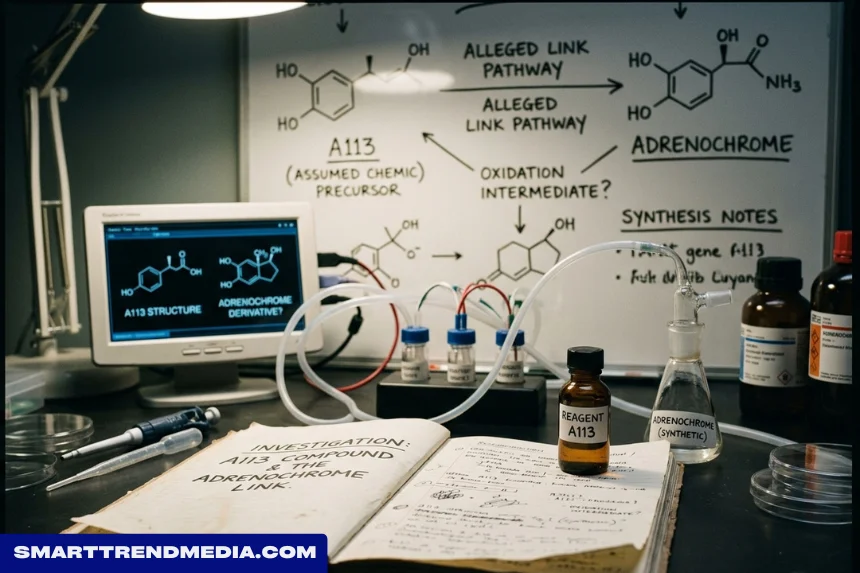
Searching for the A113 chemical compound can produce surprisingly confusing results. Some pages connect A113 with adrenochrome, while others refer to Pixar movies or a113 chemical compoun a substance called Gibberellin A113. However, these references do not describe the same thing.
A real chemical compound called Gibberellin A113 does exist. Chemical databases identify its molecular formula as C₂₀H₂₆O₅. Adrenochrome, meanwhile, is an entirely a113 chemical compoun different compound with a different chemical structure and molecular formula. In addition, the famous A113 reference that appears in Pixar and other animated productions is associated with a classroom at the California Institute of the Arts rather than either chemical.
Therefore, understanding A113 requires separating chemistry from popular-culture references and unsupported online claims. This guide begins with the actual compound before examining why several unrelated meanings of A113 have become mixed together.
What Is the A113 Chemical Compound?
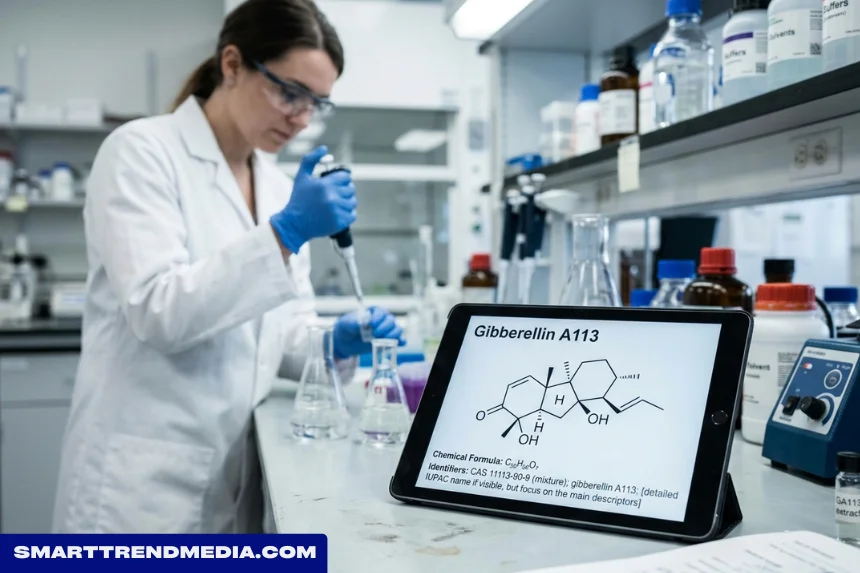
Yes, a documented chemical called Gibberellin A113 exists. It has the molecular formula C₂₀H₂₆O₅ and an average molecular mass of approximately 346.4 g/mol. The Chemical Entities of Biological Interest database, commonly known as ChEBI, classifies it as a C19-gibberellin and a gibberellin monocarboxylic acid.
However, that does not mean every appearance of the characters “A113” refers to this molecule. In chemistry databases, the name occurs specifically as Gibberellin A113, also written as GA113. In contrast, A113 has a completely separate meaning in animation and popular culture.
Most importantly, Gibberellin A113 should not be confused with adrenochrome. Although adrenochrome is itself a genuine chemical compound, its chemistry is different. The alleged connection between Pixar’s use of A113 and adrenochrome has also been investigated and rejected by fact-checkers.
A113 at a Glance
| Property | Verified Information |
|---|---|
| Chemical name | Gibberellin A113 |
| Alternative abbreviation | GA113 |
| Molecular formula | C₂₀H₂₆O₅ |
| Molecular weight | Approximately 346.4 g/mol |
| CAS number | 90806-31-8 |
| PubChem record | CID 102317583 |
| ChEBI identifier | CHEBI:172569 |
| Chemical classification | C19-gibberellin |
| Additional classification | Gibberellin monocarboxylic acid |
| Related biological category | Plant hormone |
PubChem lists Gibberellin A113 as a synonym for the compound recorded under CID 102317583 and reports the CAS number 90806-31-8. The database also reports the compound in Cucurbita and Raphanus sativus.
A113 Chemical Compound and Gibberellin A113
Gibberellin A113 belongs to the broader chemical group known as gibberellins, commonly abbreviated as GAs. Gibberellins are a large family of diterpenoid compounds associated with the regulation of plant growth and development. Consequently, the “A113” in Gibberellin A113 functions as part of a scientific naming system rather than as a secret abbreviation for another substance.
ChEBI identifies Gibberellin A113 as both a C19-gibberellin and a gibberellin monocarboxylic acid. It also assigns the compound a plant-hormone biological role. Its formula, C₂₀H₂₆O₅, shows that each molecule contains 20 carbon atoms, 26 hydrogen atoms and five oxygen atoms.
PubChem provides further chemical information. For example, it reports a molecular weight of approximately 346.4 g/mol and identifies the substance as a solid in information contributed by the Human Metabolome Database. Additionally, PubChem records Gibberellin A113 under several identifiers, allowing researchers to distinguish it from similarly named compounds.
The name itself can also appear in chemical A113 Chemical Compound databases in slightly different structural representations. For instance, PubChem has a ChEBI-linked record for Gibberellin A113 under CID 131751323 as well as a stereochemically defined record associated with CID 102317583. Both records give the molecular formula C₂₀H₂₆O₅ and molecular weight of about 346.4 g/mol.
For general readers, however, the key point is much simpler:
Gibberellin A113 is a documented chemical entity belonging to the gibberellin family. Its existence does not establish any connection between Pixar’s A113 Easter egg and adrenochrome.
A113 Chemical Compound Formula and Identifiers
A molecular formula provides a basic description of the atoms present in a chemical compound. Therefore, the molecular formula is one of the easiest ways to distinguish Gibberellin A113 from unrelated substances.
For Gibberellin A113, the formula is:
C₂₀H₂₆O₅
This corresponds to:
- 20 carbon atoms
- 26 hydrogen atoms
- 5 oxygen atoms
Meanwhile, its average molecular mass is approximately 346.423, according to ChEBI, while PubChem rounds the molecular weight to 346.4 g/mol.
Another useful identifier is the CAS Registry Number 90806-31-8, which appears in the stereochemically defined PubChem record. Unlike ordinary A113 Chemical Compound names, identifiers such as CAS numbers help distinguish chemical substances in scientific databases and catalogues.
Additionally, ChEBI assigns Gibberellin A113 the identifier CHEBI:172569. The database provides structural information, its molecular formula and its relationship to the wider gibberellin family.
These identifiers matter because the characters “A113” alone are ambiguous. Therefore, someone researching the chemical should look for terms such as Gibberellin A113, GA113, C₂₀H₂₆O₅, or CAS 90806-31-8 rather than assuming every A113 reference describes the same substance.
What Are Gibberellins?
Gibberellins are a family of plant hormones, or phytohormones, involved in multiple stages of plant development. Scientific reviews describe gibberellins as tetracyclic diterpenoid compounds that can influence processes such as seed germination, stem elongation, flowering, leaf expansion, and fruit and seed development.
For example, gibberellins can promote stem elongation by influencing cell growth. They also participate in the transition from seed dormancy to germination. Moreover, particular gibberellins affect flowering and reproductive development in certain plant species.
However, it is important not to assume that every compound carrying a gibberellin number behaves identically. The gibberellin family contains many structurally A113 Chemical Compound related molecules, and only some have strong biological activity in particular plants or tissues. Research reviews frequently identify GA1, GA3, GA4 and GA7 among the better-known biologically active gibberellins.
Therefore, the general biological functions of gibberellins should not automatically be assigned to Gibberellin A113 in exactly the same way. Its classification establishes that GA113 belongs to the gibberellin family, but determining the specific biological activity of an individual gibberellin requires experimental evidence.
This distinction is especially important for the A113 chemical compound topic. Online discussions sometimes move from finding the name “Gibberellin A113” to making much broader assumptions about what A113 means. Scientifically, however, a shared sequence of letters and numbers does not prove that unrelated references have the same origin or function.
Instead, context determines the meaning. Gibberellin A113 is a chemical entity. Adrenochrome is another chemical entity. Meanwhile, the A113 seen in animated films comes from a different historical context altogether.
Understanding those differences is essential before examining why A113 became associated with adrenochrome online.
A113 Chemical Compound vs. Adrenochrome
The connection between A113 and adrenochrome largely comes from online claims rather than established chemistry. In particular, social-media posts have circulated screenshots suggesting that searches for terms such as “A113 chemical” produced information about adrenochrome.
However, a search result does not establish a chemical relationship.
Reuters investigated the claim in 2023. According to its fact-check, screenshots showing adrenochrome-related search results helped fuel the theory that A113 represented the substance. Google told Reuters that many signals influence which pages appear in search results. Therefore, a result can appear even when a searched phrase does not occur on that page.
Reuters also consulted chemistry and pharmacodynamics expert Kabrena Rodda. She told the publication that A113 has no relationship to adrenochrome. The report further noted that Gibberellin A113 and adrenochrome have entirely different chemical structures and properties.
Consequently, seeing the two terms together online A113 Chemical Compound should not be interpreted as evidence that they describe the same chemical.
The confusion is easier to understand once the actual chemistry of adrenochrome is examined.
What Is Adrenochrome Actually?
Adrenochrome is a genuine chemical compound. However, it is not Gibberellin A113 and “A113” is not its molecular formula.
According to PubChem, adrenochrome has the molecular formula:
C₉H₉NO₃
Its molecular weight is approximately 179.17 g/mol, and its PubChem Compound ID is 5898. PubChem describes adrenochrome as a member of the indole class and records it as a pigment obtained through the oxidation of epinephrine, which is also known as adrenaline.
Key Facts About Adrenochrome
| Property | Adrenochrome |
|---|---|
| Molecular formula | C₉H₉NO₃ |
| Molecular weight | Approximately 179.17 g/mol |
| PubChem CID | 5898 |
| CAS number | 54-06-8 |
| ChEBI ID | CHEBI:166544 |
| Chemical class | Indole |
| Formation | Oxidation of epinephrine |
These identifiers make the distinction particularly clear. Chemical substances can be compared using molecular formulas, structures, database identifiers and chemical A113 Chemical Compound properties. By those measures, adrenochrome and Gibberellin A113 are plainly separate compounds.
Therefore, describing C₉H₉NO₃ as the “A113 chemical formula” would be inaccurate.
Why Gibberellin A113 and Adrenochrome Are Not the Same
The easiest way to resolve the confusion is to place both substances side by side.
| Feature | Gibberellin A113 | Adrenochrome |
| Molecular formula | C₂₀H₂₆O₅ | C₉H₉NO₃ |
| Molecular weight | ~346.4 g/mol | ~179.17 g/mol |
| PubChem CID | 102317583* | 5898 |
| Chemical context | Gibberellin / plant hormone family | Oxidation product of epinephrine |
| Contains nitrogen? | No | Yes |
| Associated with epinephrine oxidation? | No | Yes |
| Same chemical? | No | No |
*Part A explains the database records and identifiers associated with Gibberellin A113 in greater detail.
Even the molecular formulas immediately show a major difference. Gibberellin A113 contains carbon, hydrogen and oxygen. Adrenochrome, by contrast, also A113 Chemical Compound contains nitrogen.
Moreover, their molecular weights differ substantially. Their chemical classifications and biological contexts differ as well.
Reuters reached the same conclusion after consulting chemical records and an expert: there is no chemical link between A113 and adrenochrome.
This distinction matters because misinformation can begin with something partly true. Adrenochrome exists. Gibberellin A113 also exists. Nevertheless, the existence of both chemicals does not make them related.
Similarly, neither fact explains why the characters A113 repeatedly appear in animated movies.
For that answer, the relevant history is not chemistry at all.
Where Does Pixar’s A113 Actually Come From?
The well-known A113 reference in animation traces back to the California Institute of the Arts, commonly called CalArts.
CalArts itself explains that A113 refers to a former character-animation classroom where a number of artists studied. Its official news site names John Lasseter, Brad Bird, Andrew Stanton and Pete Docter among the animation figures who studied in that classroom during their time at the institute. The room later became a School of Art graphic-design studio.
Therefore, the A113 seen in Pixar productions works as an inside reference to the artists’ educational background.
Reuters independently confirmed the history with CalArts. The institute told Reuters that Room A113 had been a Character Animation classroom attended by animation artists including Brad Bird, Andrew Stanton and Pete Docter. Reuters found no evidence that Pixar’s use of the number represented adrenochrome.
The distinction can be summarized simply:
Gibberellin A113 → chemical name
Adrenochrome → separate chemical compound
Pixar A113 → CalArts classroom reference
Although all three can appear in the same search results, they do not share a common chemical meaning.

Why Does A113 Appear in Pixar Movies?
A113 became an Easter egg used by filmmakers who were familiar with the CalArts classroom. As a result, viewers can spot the sequence hidden on objects, signs, A113 Chemical Compound documents and other details across Pixar productions.
Disney’s official D23 site describes A113 as a recurring Pixar tradition and explicitly identifies it as a nod to the CalArts classroom where many Disney and Pixar animators studied.
For example, D23 documents A113 appearances in several productions:
Toy Story 2
A113 appears on the license plate of Andy’s family’s van. Disney notes that the same reference also appeared in the original Toy Story.
Up
The number appears as the courtroom number outside which Carl waits. D23 again identifies the reference as connected to the CalArts classroom.
Cars
A113 can be seen as Mater’s licence plate and on a train near the beginning of the film.
Luca
Pixar’s familiar A113 appears on a train ticket. Disney describes it as the number of a CalArts classroom where many filmmakers studied.
Turning Red
The reference appears twice: once on equipment used at the Skydome and again on concert tickets shown during the credits.
These examples demonstrate a consistent pattern. Rather than functioning as a scientific notation, the number acts as a creative signature and shared reference among animators.
Is A113 Exclusive to Pixar?
No. Although A113 is particularly famous because of Pixar, the reference did not originate at Pixar.
It originated with CalArts, and artists who studied there later worked throughout the animation industry. Therefore, A113 has appeared outside Pixar productions as well.
For example, CalArts’ own discussion of the Easter egg features an A113 appearance from the animated television series American Dad. The institute describes the sequence as a familiar reference among members of the CalArts animation community.
That broader history is important because describing A113 simply as a “Pixar code” misses its real origin.
A more accurate explanation is:
A113 became an animation Easter egg because filmmakers and artists used the number as a reference to a CalArts classroom connected to their training. Pixar helped make the reference famous, but it did not create the classroom designation.
So, Does Pixar’s A113 Have Anything to Do With Adrenochrome?
Available evidence says no.
The confusion combines three unrelated facts:
First, adrenochrome is a real chemical substance.
Second, a different chemical called Gibberellin A113 exists.
Third, A113 repeatedly appears in Pixar and other animation.
However, those facts do not form a chemical connection.
Reuters classified the claim linking Pixar’s A113 to adrenochrome as misleading. Its investigation found that Pixar’s use of the sequence has been widely documented as an homage to the CalArts classroom, while chemical evidence does not support identifying A113 as adrenochrome.
In other words, the A113 chemical compound question requires context. When the term refers to Gibberellin A113, chemistry is relevant. When A113 appears in a Pixar film, the documented explanation points to CalArts instead.
Does the A113 Chemical Compound Have a Formula?
The characters A113 by themselves are not a molecular formula. A molecular formula uses chemical element symbols and numbers to show which atoms make up a substance. For example, water has the formula H₂O, while adrenochrome has the formula C₉H₉NO₃.
However, a documented substance called Gibberellin A113, or GA113, does have a molecular formula:
C₂₀H₂₆O₅
PubChem lists Gibberellin A113 under a stereochemically defined record with CID 102317583. It gives the formula C₂₀H₂₆O₅, a molecular weight of approximately 346.4 g/mol, and CAS number 90806-31-8. PubChem also contains a ChEBI-linked Gibberellin A113 entry under CID 131751323 with the same molecular formula and molecular weight.
Therefore, the question “What is the A113 chemical formula?” needs context.
If a person means Gibberellin A113, the answer is C₂₀H₂₆O₅.
If a person means adrenochrome, its formula is C₉H₉NO₃, but adrenochrome is not chemically designated A113. PubChem independently identifies adrenochrome as CID 5898 and gives its molecular weight as approximately 179.17 g/mol.
Meanwhile, when A113 appears in a Pixar movie, it is not functioning as a molecular formula at all. CalArts identifies A113 as the former Character Animation classroom associated with several prominent animation artists.
A113 Chemical Compound: The Three Meanings Compared
Much of the confusion surrounding the A113 chemical compound search comes from three separate subjects appearing together online.
The following table separates them clearly:
| Term | What It Means | Chemical Formula | Main Context |
|---|---|---|---|
| Gibberellin A113 | A documented gibberellin compound | C₂₀H₂₆O₅ | Plant chemistry |
| GA113 | Abbreviation used for Gibberellin A113 | C₂₀H₂₆O₅ | Chemical databases |
| Adrenochrome | A separate compound associated with oxidation of epinephrine | C₉H₉NO₃ | Chemistry |
| A113 in Pixar | A recurring animation Easter egg | None | CalArts / animation |
| Room A113 | Former CalArts Character Animation classroom | None | Animation history |
The table reveals why the terms should never be treated as interchangeable.
Gibberellin A113 and adrenochrome have different formulas, molecular weights, chemical structures and classifications. Furthermore, Pixar’s A113 reference does not describe a chemical at all.
Reuters examined claims connecting the Pixar reference with adrenochrome. Its fact-check found no evidence that Pixar’s use of A113 represents the chemical. Reuters also reported that a chemistry expert said A113 had no relationship to adrenochrome and that Gibberellin A113 and adrenochrome have different structures and properties.
Why Search Results for A113 Can Be Confusing
Search engines attempt to determine what users mean, even when a query is ambiguous. Consequently, unusual searches can sometimes return pages that are related through online discussion rather than through scientific terminology.
This appears to have contributed to the A113 confusion.
Reuters reported that social-media posts circulated screenshots in which searches such as “a113 chemical” appeared to return information about adrenochrome. However, the Wikipedia adrenochrome page cited in those claims did not actually mention A113. Google also told Reuters that numerous signals influence search rankings and that results do not depend only on exact keyword matches.
Therefore, a search result should not be treated as proof of a chemical identity.
For example, searching for A113 may surface information about:
- Gibberellin A113
- Pixar Easter eggs
- CalArts
- adrenochrome
- conspiracy claims involving adrenochrome
- discussions attempting to connect those topics
Nevertheless, appearing on the same results page does not establish a scientific relationship.
Chemical identity requires stronger evidence, such as molecular structure, formula, recognised database identifiers and established scientific nomenclature.
How to Verify A113 Chemical Compound Claims
Readers do not need advanced chemistry training to check basic claims about A113. Instead, they can compare information from established scientific databases and primary sources.
Check the Molecular Formula
First, compare the formulas.
Gibberellin A113: C₂₀H₂₆O₅
Adrenochrome: C₉H₉NO₃
Because these formulas differ, the compounds cannot be identical.
PubChem confirms both records independently.
Check the Database Identifier
Next, look for recognised database identifiers.
For example, the stereochemically defined Gibberellin A113 record appears as:
PubChem CID: 102317583
CAS: 90806-31-8
Adrenochrome appears separately as:
PubChem CID: 5898
CAS: 54-06-8
ChEBI: CHEBI:166544
These identifiers help distinguish substances that may have several names or synonyms.

Check the Chemical Description
PubChem describes adrenochrome as a member of the indoles and notes that it is a pigment obtained through oxidation of epinephrine. By comparison, its Gibberellin A113 record identifies GA113 as an entirely different substance and reports its occurrence in plants including Cucurbita and Raphanus sativus.
Therefore, readers can test the claim using basic chemical information rather than relying on screenshots or viral posts.
Check the Original Source for the Pixar Claim
Chemical databases cannot explain animation history. For that question, CalArts is the more appropriate primary source.
CalArts states that A113 refers to its former Character Animation classroom. It names alumni including Brad Bird, Andrew Stanton and Pete Docter among the artists who studied there. The institute says the room later became a School of Art graphic-design studio.
Reuters also obtained confirmation directly from CalArts when investigating the adrenochrome allegation.
In other words, different claims require different authoritative sources.
Common Misconceptions About A113
Several misleading statements tend to appear when the subjects of chemistry, Pixar and online conspiracy theories become mixed together.
Misconception: A113 Is Another Name for Adrenochrome
Fact: Chemical records do not support this claim.
Adrenochrome has the molecular formula C₉H₉NO₃ and PubChem CID 5898. Gibberellin A113 has the formula C₂₀H₂₆O₅. Therefore, they are chemically different substances.
Reuters likewise concluded that there is no chemical link between A113 and adrenochrome.
Misconception: Adrenochrome Is Not a Real Chemical
Fact: Adrenochrome is a documented chemical compound.
PubChem identifies it as C₉H₉NO₃ and describes it as a substance obtained through oxidation of epinephrine.
Therefore, accurate fact-checking should distinguish between the existence of adrenochrome and unsupported claims made about it.
Misconception: There Is No Chemical Called A113
Fact: That statement is too broad.
A documented compound named Gibberellin A113 exists. PubChem lists both its GA113 synonym and its molecular formula C₂₀H₂₆O₅.
However, that fact does not make every use of A113 a reference to the compound.
Misconception: Pixar Uses A113 Because of Gibberellin A113
Fact: The documented Pixar and animation explanation points to CalArts.
CalArts describes A113 as its former Character Animation classroom. Moreover, the institute has repeatedly discussed the room’s status as an animation Easter egg.
No credible evidence establishes that the Pixar tradition originated from Gibberellin A113.
Misconception: A113 Is a Molecular Formula
Fact: “A113” does not follow the standard form of a molecular formula.
For Gibberellin A113, the actual molecular formula is C₂₀H₂₆O₅.
Similarly, adrenochrome has the molecular formula C₉H₉NO₃.
Therefore, A113 functions as part of a name or designation depending on context, not as the molecular formula of either compound.
Frequently Asked Questions
Is A113 a real chemical compound?
A real compound called Gibberellin A113, or GA113, is documented in PubChem. Its molecular formula is C₂₀H₂₆O₅, and PubChem reports a molecular weight of approximately 346.4 g/mol.
What is the chemical formula for Gibberellin A113?
The molecular formula for Gibberellin A113 is C₂₀H₂₆O₅. PubChem also lists CAS number 90806-31-8 for its stereochemically defined record.
Is A113 the chemical name for adrenochrome?
No. Adrenochrome is a separate compound with molecular formula C₉H₉NO₃ and PubChem CID 5898. Reuters found no chemical evidence connecting the substance with Pixar’s A113 reference.
Why does Pixar use A113?
A113 refers to a former Character Animation classroom at the California Institute of the Arts. Several influential animation artists studied there, and the reference later became an Easter egg in animation.
What does GA113 mean?
GA113 is a synonym or abbreviated designation used for Gibberellin A113. PubChem includes GA113 among the names associated with its Gibberellin A113 record.
Is Gibberellin A113 the same as adrenaline?
No. Gibberellin A113 belongs to the gibberellin group, whereas adrenaline is another name for epinephrine. Adrenochrome can form through oxidation of epinephrine, but that pathway does not make Gibberellin A113 part of the same compound. PubChem treats the substances separately.
Why did people connect A113 with adrenochrome?
Reuters traced part of the confusion to social-media posts showing search results that appeared to associate “a113 chemical” with adrenochrome. However, Reuters found that the chemical connection was unsupported and rated the broader claim misleading.
Final Takeaway
The A113 chemical compound question sounds simple, but the term has several unrelated meanings.
A genuine chemical called Gibberellin A113 exists, and its molecular formula is C₂₀H₂₆O₅. Adrenochrome also exists; however, it is a different compound with the formula C₉H₉NO₃. Chemical databases clearly separate the two substances.
Meanwhile, Pixar’s famous use of A113 has a different origin. CalArts identifies A113 as a former Character Animation classroom attended by several artists who later became influential figures in animation.
READ MORE ABOUT: McDonald’s Mascots