

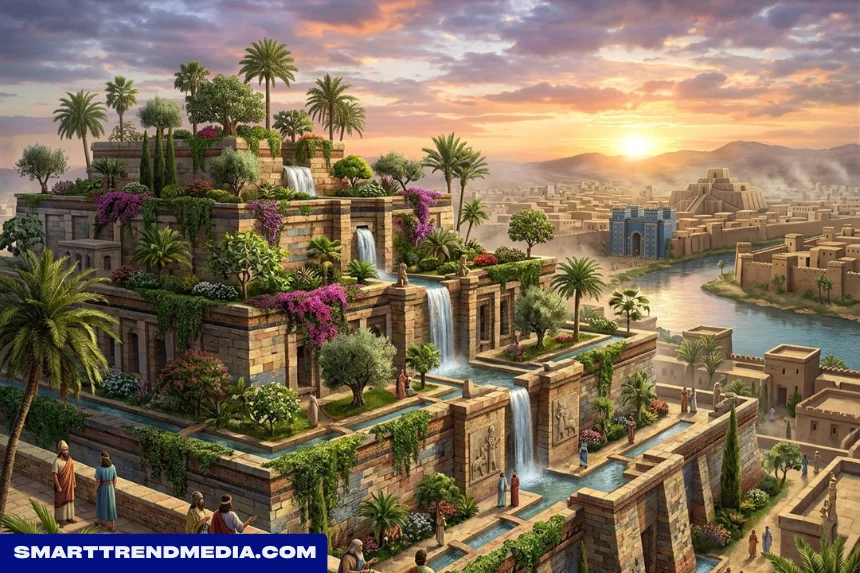
The Hanging Gardens of Babylon were described by ancient Greek and Roman writers as a remarkable elevated garden filled with trees, flowering plants, shaded walkways, and flowing water. Traditionally, the gardens stood in the ancient city of Babylon, near modern Hillah in Iraq, and King Nebuchadnezzar II supposedly ordered their construction during the sixth century BCE.
However, historians have not found universally accepted ruins or a clear contemporary Babylonian inscription that confirms the gardens’ location, design, or builder. Therefore, the Hanging Gardens remain the most mysterious of the Seven Wonders of the Ancient World.
Quick answer: The Hanging Gardens of Babylon were supposedly a series of raised, irrigated garden terraces built in ancient Mesopotamia. Later tradition connected them with Nebuchadnezzar II and Babylon. Nevertheless, their existence and exact location remain disputed, while an influential alternative theory places the famous garden at Nineveh.
Hanging Gardens of Babylon Quick Facts
| Question | Best-supported answer |
|---|---|
| What were they? | Supposed elevated royal gardens covered with vegetation |
| Traditional location | Babylon, near modern Hillah in Iraq |
| Alternative location | Nineveh, near modern Mosul in Iraq |
| Traditional builder | Nebuchadnezzar II |
| Alternative builder | Assyrian king Sennacherib |
| Traditional period | Sixth century BCE |
| Why were they built? | Later legend says they were created for a homesick queen |
| Why were they “hanging”? | Plants may have grown on raised terraces and extended over the edges |
| How were they watered? | Ancient accounts describe mechanically raised water and irrigation channels |
| Confirmed contemporary record | None clearly identifying the famous gardens in Babylon |
| Confirmed ruins | None universally accepted |
| Historical status | Their existence, builder, and location remain debated |
Babylon is a UNESCO World Heritage Site and was one of the most important cities of ancient Mesopotamia. UNESCO notes the city’s worldwide association with the Hanging Gardens, although that association does not mean archaeologists have identified the garden itself.
What Were the Hanging Gardens of Babylon?
The Hanging Gardens of Babylon were supposedly an enormous architectural and horticultural complex. According to later descriptions, builders created several elevated levels and covered them with deep soil, trees, shrubs, vines, and flowers.
As a result, the structure may have resembled an artificial green mountain rising above the surrounding city. Rather than forming one ordinary courtyard garden, it supposedly combined monumental construction with an engineered water system.
Descriptions commonly suggest that the gardens included:
- Raised or stepped terraces
- Large trees growing above ground level
- Vaults, columns, or walls supporting the planted areas
- Deep layers of soil
- Shaded pathways and galleries
- Water channels connecting different levels
- Machinery for lifting water
- Plants extending over terrace edges
Nevertheless, no surviving plan or verified Babylonian image shows the structure. Consequently, modern paintings and digital reconstructions represent imaginative interpretations of later written accounts rather than exact archaeological models.
The gardens became famous because such a project would have required considerable engineering. Builders would have needed to support the weight of wet soil, prevent water damage, raise water to higher levels, and keep mature vegetation alive in Mesopotamia’s hot climate.
Why Were They Called “Hanging” Gardens?
The name does not necessarily mean that the gardens hung from ropes, chains, or suspended platforms.
Instead, the term probably referred to plants growing on elevated structures. Trees, vines, and branches may have extended beyond terrace walls, making the vegetation appear to hang over the levels below.
Therefore, a stepped landscape is a more realistic interpretation than a floating garden. The imagined complex may have looked like a large hillside supported by human-made architecture.
This distinction is important because many modern illustrations show highly dramatic towers, waterfalls, and suspended platforms. However, those features cannot be verified from surviving physical evidence.
Were the Hanging Gardens One of the Seven Wonders?
Yes. Later Greek and Roman traditions included the Hanging Gardens of Babylon among the Seven Wonders of the Ancient World.
The commonly recognised ancient wonders were:
- The Great Pyramid of Giza
- The Hanging Gardens of Babylon
- The Statue of Zeus at Olympia
- The Temple of Artemis at Ephesus
- The Mausoleum at Halicarnassus
- The Colossus of Rhodes
- The Lighthouse of Alexandria
Unlike the other wonders, the Hanging Gardens have not been conclusively located. In fact, historians continue to debate whether the wonder stood in Babylon, stood in another Mesopotamian city, represented several gardens combined into one story, or existed mainly as a literary tradition.
The Great Pyramid of Giza remains the only ancient wonder that survives substantially intact. By contrast, the uncertainty surrounding the Hanging Gardens extends beyond their destruction because researchers cannot confidently identify their original site.
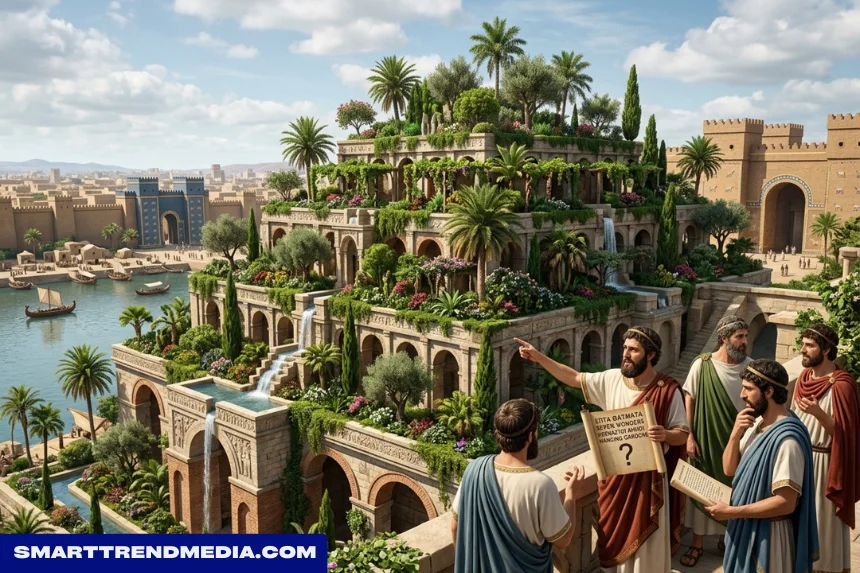
Who Built the Hanging Gardens of Babylon?
Tradition usually credits Nebuchadnezzar II, one of the most powerful kings of the Neo-Babylonian Empire.
Nebuchadnezzar II ruled Babylon during the sixth century BCE and carried out an extensive building program. Surviving inscriptions and archaeological objects connect him with temples, city walls, gates, palaces, and other construction projects that transformed Babylon into a monumental imperial capital.
Therefore, the idea that he could have commissioned a major royal garden is historically plausible. However, plausibility is not the same as proof.
Numerous surviving inscriptions celebrate Nebuchadnezzar’s achievements. Yet none clearly identifies the elaborate elevated garden described by later classical authors. For this reason, the article should say that Nebuchadnezzar traditionally, supposedly, or possibly built the gardens.
The British Museum’s biographical record associates Nebuchadnezzar II with the “so-called” Hanging Gardens. Nevertheless, the careful wording reflects the uncertainty surrounding that traditional attribution.
Why Did Nebuchadnezzar Supposedly Build the Gardens?
According to the best-known legend, Nebuchadnezzar created the gardens for his wife because she missed the green mountains and forests of her homeland.
Later tradition commonly identifies the queen as Amytis of Media. In this version of the story, Babylon’s flat, dry landscape made her homesick. Therefore, the king supposedly ordered the construction of a mountain-like garden filled with trees and flowing water.
The story has remained popular because it transforms the wonder into a romantic gift. However, no known contemporary Babylonian document confirms that Nebuchadnezzar built such a garden for Amytis.
In addition, the surviving ancient accounts were written or preserved long after the king’s lifetime. Consequently, historians cannot treat the familiar love story as verified biography.
The most accurate wording is:
Later tradition says Nebuchadnezzar II built the gardens for a Median wife who missed her mountainous homeland.
This phrasing preserves the famous story without presenting uncertain details as established facts.
When Were the Hanging Gardens Supposedly Built?
If Nebuchadnezzar II commissioned the gardens, construction would have occurred during his reign in the sixth century BCE.
The Metropolitan Museum of Art dates Nebuchadnezzar’s reign to approximately 604–562 BCE and documents the extensive construction program through which he reshaped Babylon.
However, historians cannot assign the gardens a precise construction year. No surviving foundation inscription records the beginning or completion of the famous project.
Therefore, statements such as “the gardens were built in 600 BCE” should be presented only as approximations. A safer description is that they were traditionally dated to the sixth century BCE during Nebuchadnezzar II’s reign.
Where Were the Hanging Gardens of Babylon Located?
The traditional answer places the gardens inside or near the royal palace area of ancient Babylon.
Babylon stood beside the Euphrates River in Mesopotamia, near the modern Iraqi city of Hillah and south of Baghdad. The city became a major political, religious, and cultural centre under several empires. Later, Nebuchadnezzar II transformed it through large-scale construction.
Babylon’s location beside the Euphrates would have provided access to water. Nevertheless, raising that water to elevated terraces would still have required substantial labour or mechanical technology.
Archaeologists have excavated palaces, temples, defensive walls, streets, gates, and other structures at Babylon. However, they have not found a building that scholars universally recognise as the Hanging Gardens.
As a result, historians cannot confidently mark one location inside Babylon and identify it as the confirmed wonder.
Were the Hanging Gardens Actually at Nineveh?
An influential alternative theory places the gardens at Nineveh, the capital of the Neo-Assyrian Empire, rather than Babylon.
Nineveh stood in northern Mesopotamia near modern Mosul. The Assyrian king Sennacherib developed the city and built a major palace, canals, aqueducts, and royal gardens.
Unlike the uncertain evidence from Babylon, Nineveh provides clear documentation of large-scale water engineering and carefully designed royal landscapes. The British Museum explains that Sennacherib’s canal network carried water over long distances to create a year-round oasis for the city’s gardens.
Moreover, surviving Assyrian reliefs depict richly planted landscapes, water channels, pavilions, trees, and elevated garden areas. One British Museum relief shows a hillside garden supplied by an aqueduct probably constructed during Sennacherib’s reign.
Assyriologist Stephanie Dalley has argued that later writers misidentified Nineveh’s garden as a Babylonian wonder. Her interpretation draws on cuneiform inscriptions, classical descriptions, palace reliefs, and surviving waterworks.
However, the Nineveh theory has not ended the debate. Other scholars continue to question how the classical accounts developed and whether they can be matched with one specific Assyrian garden. Therefore, Nineveh should be presented as a major scholarly theory rather than a conclusively proven answer.
What Did the Hanging Gardens of Babylon Look Like?
No one knows their exact appearance.
Later written accounts suggest an elevated structure combining garden terraces with substantial masonry supports. The planted levels may have risen gradually, creating an effect similar to a hillside or theatre.
A plausible reconstruction might include:
- A wide base connected with a palace
- Several rising planted levels
- Stone or brick supporting walls
- Vaulted chambers beneath the terraces
- Deep soil supporting mature trees
- Stairways joining different levels
- Channels carrying water through the garden
- Shaded places for walking and resting
- Branches and vines extending over the walls
Nevertheless, each feature requires qualification. The descriptions survive mainly through writers who lived centuries after the gardens were supposedly built.
For example, Diodorus Siculus and Strabo provide important architectural details. Yet both wrote much later than Nebuchadnezzar II. In addition, they appear to have drawn on earlier material that is now lost.
Therefore, historians must reconstruct the garden indirectly. They compare classical literature with Mesopotamian building methods, irrigation technology, surviving palace art, and known royal-garden traditions.
How Large Were the Hanging Gardens?
Ancient writers provided measurements, but modern readers should treat them cautiously.
Several descriptions portray the gardens as extremely large, with terraces broad enough to support trees and pathways. However, the ancient authors used units that do not always convert neatly into modern measurements.
In addition, the surviving texts may not represent independent eyewitness reports. Several writers relied on older accounts, while others may have repeated or expanded material that had already entered literary tradition.
Consequently, exact modern claims about the height, length, or area of the garden can create a false sense of certainty.
It is safer to say that classical tradition portrayed the gardens as a monumental, multi-level complex rather than to insist on one precise measurement.
How Were the Hanging Gardens Watered?
A large elevated garden would have required a continuous and carefully managed water supply.
According to later accounts, machinery raised water from a lower source to the garden’s upper level. Gravity could then move the water through channels and irrigate the terraces below.
Proposed technologies include:
- A chain of water buckets
- A rotating wheel
- Human- or animal-powered lifting devices
- A screw-like mechanism
- Elevated canals
- Gravity-fed channels
However, historians have not discovered a confirmed watering machine belonging to the Babylonian wonder.
The traditional Babylon location suggests that water may have come from the Euphrates. Nevertheless, lifting large quantities of river water every day would have demanded a powerful and reliable system.
By contrast, Nineveh’s surviving evidence includes an extensive network of canals and aqueducts. Sennacherib brought water from distant areas to support gardens, parks, and the city itself. Therefore, this infrastructure plays a central role in the argument that Nineveh may have inspired the classical wonder.
How Could the Terraces Hold Trees and Water?
The structure would have faced two major engineering challenges: weight and moisture.
First, wet soil and mature trees are extremely heavy. Therefore, the terraces would have needed thick walls, columns, vaults, or another powerful supporting system.
Second, constant irrigation could damage ordinary mud-brick construction. Builders would have needed to prevent water from leaking into the supporting rooms and weakening the structure.
Later accounts refer to combinations of materials that may have included:
- Stone or fired brick
- Reeds
- Bitumen
- Protective layers beneath the soil
- Drainage channels
- Metal or waterproof coverings
Nevertheless, these construction details remain hypothetical because archaeologists have not confirmed the garden’s foundations.
Ancient Mesopotamian builders did understand irrigation, canals, large brick structures, waterproofing materials, and monumental architecture. Therefore, the project was not technologically unimaginable. Still, historians cannot confirm which methods the legendary gardens used.
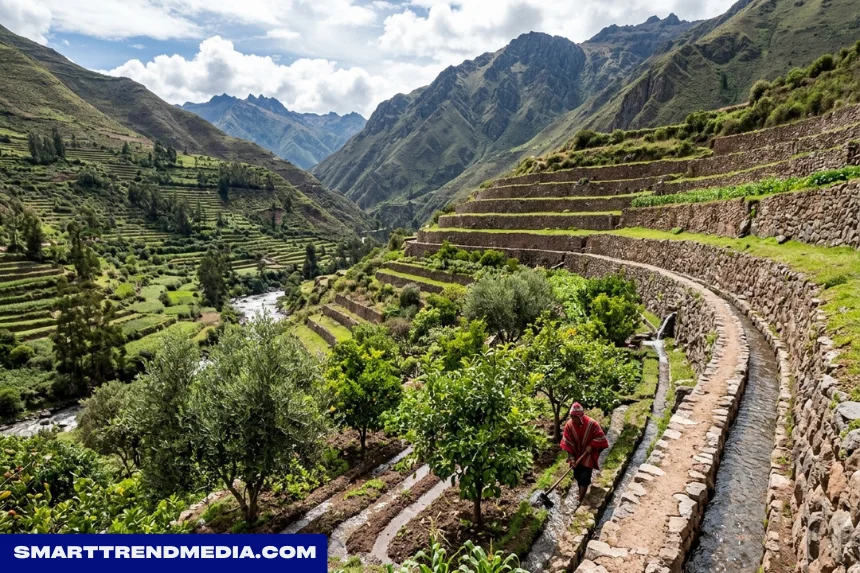
What Plants May Have Grown There?
No verified list records the plants of the Hanging Gardens of Babylon.
However, a royal Mesopotamian garden may have contained useful, symbolic, decorative, native, and imported plants. Possible examples include:
- Date palms
- Fig trees
- Pomegranate trees
- Grapevines
- Cypress
- Cedar
- Juniper
- Tamarisk
- Almond trees
- Flowering shrubs
- Aromatic plants
- Shade trees
Royal gardens could display wealth by bringing together plants from different regions. In addition, trees provided fruit, fragrance, shade, visual beauty, and connections with royal power.
Assyrian art and records provide much stronger evidence for varied palace gardens than the surviving material from Babylon. The British Museum’s Nineveh reliefs show carefully arranged trees and plants within irrigated royal landscapes.
Even so, researchers cannot use those images to prove which species grew in the legendary Babylonian garden. Therefore, any plant list should remain clearly labelled as a historically informed possibility.
Why Were the Hanging Gardens Considered an Engineering Wonder?
The Hanging Gardens were not remarkable simply because they contained plants. Instead, the wonder supposedly united large-scale architecture, horticulture, hydraulic engineering, and royal design.
Its builders would have needed to:
- Construct terraces strong enough to hold deep, wet soil.
- Support mature trees above ground level.
- Raise large amounts of water continuously.
- Move water across several elevations.
- Protect the building from moisture.
- Drain excess water safely.
- Maintain plants in a hot climate.
- Coordinate gardeners, engineers, builders, and labourers.
Furthermore, the completed garden would have created a dramatic visual contrast. A tall, green landscape rising within a major Mesopotamian city could symbolise control over water, nature, labour, and distant resources.
For ancient viewers, that combination may have appeared almost impossible. Consequently, later writers remembered the garden not merely as a park but as a demonstration of royal power and technical achievement.
Why Are the Hanging Gardens Still Important?
The Hanging Gardens of Babylon continue to attract attention because they stand between history, archaeology, engineering, and legend.
Babylon was unquestionably a real and highly influential ancient city. Nebuchadnezzar II unquestionably carried out major building projects there. Likewise, the Assyrians unquestionably created sophisticated gardens and water systems at Nineveh.
However, researchers still cannot prove how these pieces connect with the wonder described by classical writers.
Therefore, the gardens represent more than a lost monument. They reveal how historical memories can move between cities, languages, empires, and later storytelling traditions.
Their mystery also encourages an essential historical question: when later writers describe something extraordinary, how much comes from eyewitness evidence, and how much comes from inherited stories?
Which Ancient Writers Described the Hanging Gardens?
No surviving eyewitness account from Nebuchadnezzar II’s lifetime describes the Hanging Gardens of Babylon. Instead, the familiar story comes from Greek and Roman authors who wrote centuries after the gardens were supposedly constructed.
This gap is crucial. Although later writers provide architectural details, historians cannot confirm how accurately those descriptions preserved earlier traditions.
Berossus
Berossus was a Babylonian priest who wrote a history of Babylonia in Greek around 280 BCE. His original work, commonly called the Babyloniaca, has not survived.
Later authors, particularly the Jewish historian Josephus, preserved short quotations or summaries from Berossus. Those fragments connect Nebuchadnezzar II with an elevated garden created for a wife who missed the landscape of her homeland.
Berossus may have had access to Babylonian traditions and records that no longer survive. Nevertheless, he wrote roughly three centuries after Nebuchadnezzar’s reign. Moreover, modern readers know his garden account only through later writers who quoted or condensed his lost work.
Diodorus Siculus
Diodorus Siculus was a Greek historian who wrote during the first century BCE. His description presents the garden as a large, theatre-like structure rising through several levels.
According to his account, thick walls supported planted terraces containing enough soil for large trees. He also described materials intended to prevent water from damaging the structure below.
However, Diodorus did not write from direct observation of Nebuchadnezzar’s Babylon. Instead, researchers believe he relied partly on earlier works that have since disappeared, including accounts connected with Ctesias and Cleitarchus. Therefore, his description may preserve older information, literary exaggeration, or a mixture of both.
Strabo
Strabo was a Greek geographer who wrote around the end of the first century BCE and beginning of the first century CE.
His account describes vaulted terraces supported by substantial structures. In addition, he mentions machinery that supposedly raised water from the Euphrates to the upper garden levels.
Strabo’s reference to a screw-like or rotating water device has strongly influenced modern reconstructions. Nevertheless, he also lived centuries after the traditional construction period and may have depended on an earlier lost account associated with Onesicritus, a companion of Alexander the Great.
Quintus Curtius Rufus
Quintus Curtius Rufus was a Roman historian who wrote a history of Alexander the Great, probably during the first century CE.
His account also places the gardens at Babylon and presents them as part of the city’s extraordinary royal landscape. However, like Diodorus, he may have drawn on earlier traditions connected with Cleitarchus and Ctesias.
Consequently, Curtius does not provide a fully independent confirmation. Several surviving classical descriptions may ultimately derive from a small group of earlier lost sources.
The writer traditionally called Philo
A text called On the Seven Wonders also describes the engineering of the gardens.
Traditionally, the work was attributed to Philo of Byzantium. However, the surviving text appears in a much later Byzantine manuscript, and scholars continue to debate its authorship and date.
The account praises the ability of builders to support deep soil above the ground and supply sufficient water to elevated plants. Even so, it cannot serve as contemporary Babylonian evidence.
Why Does the Date of the Sources Matter?
The traditional construction of the gardens belongs to the sixth century BCE. However, the main surviving descriptions come from writers active hundreds of years later.
That time gap creates several historical problems:
- Writers may have repeated earlier accounts without checking them.
- Different gardens may have become combined into one story.
- Measurements may have been exaggerated.
- Assyrian and Babylonian locations may have been confused.
- Lost sources may have contained mistakes that later writers copied.
- Details may have changed as the story moved between languages.
- Literary descriptions may have aimed to impress rather than document architecture precisely.
Moreover, the five principal later accounts can be unclear, contradictory, and technically difficult to reconcile. Therefore, the number of surviving authors should not be mistaken for the same number of independent eyewitnesses.
This does not mean the accounts are worthless. On the contrary, they preserve valuable ancient traditions. Nevertheless, historians must compare them with cuneiform texts, archaeological remains, Assyrian reliefs, and known Mesopotamian engineering.
Why Is Herodotus’s Silence Important?
Herodotus described Babylon in the fifth century BCE. He discussed the city’s walls, buildings, river, streets, and customs. However, he did not mention the Hanging Gardens.
His silence is significant because he lived closer to the traditional period of the gardens than most authors who later described them. Moreover, a monumental artificial mountain filled with trees would seem difficult to overlook in a detailed account of Babylon.
Nevertheless, Herodotus’s omission does not prove that the gardens never existed.
Several explanations remain possible:
- Herodotus may never have visited Babylon personally.
- His information may have come from incomplete reports.
- He may have omitted features that did not fit his subject.
- Parts of his account may have been lost.
- The gardens may not have existed in their later-described form during his time.
- The famous garden may have stood somewhere other than Babylon.
Even so, Herodotus’s silence becomes more important when combined with the lack of clear contemporary Babylonian inscriptions and the absence of confidently identified ruins.
Why Are There No Clear Babylonian Records?
Nebuchadnezzar II left a large number of inscriptions celebrating his construction projects. These texts describe temples, defensive walls, palaces, gates, streets, and improvements to Babylon.
However, none of the abundant surviving sources from his reign clearly describes the monumental elevated garden known from classical literature. Extensive excavation of his palace areas has also failed to reveal a structure that specialists universally accept as the wonder.
This absence presents one of the strongest challenges to the traditional account.
A king who celebrated major building achievements might be expected to mention an unprecedented terraced garden requiring vast resources. Therefore, some researchers argue that the silence suggests the gardens were located elsewhere or developed mainly through later storytelling.
However, several cautions remain necessary.
First, not every ancient text survived. Clay tablets could break, erode, become dispersed, or remain undiscovered. Second, the Babylonians may have described the garden using terminology that modern scholars have not connected with the classical story. Finally, UNESCO reports that approximately 85% of the Babylon property remains unexcavated.
Consequently, missing evidence weakens the traditional claim but does not establish that Babylon contained no significant royal gardens.
What Have Archaeologists Found at Babylon?
Formal German excavations at Babylon took place primarily between 1899 and 1917 under the direction of Robert Koldewey. Those excavations uncovered major parts of the ancient city, including palace structures, streets, fortifications, religious buildings, and the foundations associated with the Ishtar Gate.
Koldewey believed that one vaulted building within the palace area might have supported the Hanging Gardens.
The structure attracted attention because it contained:
- Thick walls
- Vaulted rooms
- Unusual use of stone
- A possible well or water installation
- Foundations that might support considerable weight
At first, these characteristics appeared compatible with later descriptions of an elevated planted structure.
However, many specialists have not accepted the identification. The building’s location, size, function, and distance from the Euphrates create difficulties. In addition, archaeological interpretations have suggested that parts of the structure may have served administrative or storage purposes rather than supporting a monumental garden.
Therefore, the site is sometimes labelled the “so-called Hanging Gardens,” but it should not be presented as confirmed evidence.
Could Important Remains Still Be Buried at Babylon?
Yes. Large areas of Babylon remain unexcavated, while erosion, later settlement, ancient brick removal, reconstruction, warfare, and modern development have complicated the archaeological record.
Ancient builders frequently reused bricks from earlier structures. Later residents also removed material from Babylon’s ruins over many centuries. As a result, some major buildings survive mainly through foundations or incomplete wall sections.
Furthermore, UNESCO notes that modern reconstruction projects and other twentieth-century interventions damaged the site’s integrity and created authenticity concerns in several areas. The archaeological property also faces environmental pressure, encroachment, pollution, illegal construction, and continuing conservation challenges.
Therefore, researchers cannot assume that every monumental structure in Babylon has already been found in a recognisable condition.
Nevertheless, the possibility of undiscovered remains should not be used as proof that the gardens existed. It simply means the archaeological investigation remains incomplete.
What Evidence Supports the Nineveh Theory?
The strongest alternative explanation places the famous gardens in Nineveh, the Assyrian imperial capital near modern Mosul.
This argument does not depend only on the absence of evidence in Babylon. Instead, it points to positive evidence from Assyrian inscriptions, waterworks, canals, aqueducts, and palace reliefs.
Sennacherib recorded major construction projects
The Assyrian king Sennacherib ruled before Nebuchadnezzar II and transformed Nineveh into an imperial capital.
His inscriptions describe ambitious palace, landscape, and water-management projects. Unlike the missing Babylonian garden inscription, these Assyrian records provide direct evidence that Sennacherib created a technologically advanced royal environment supplied with water from distant areas.
Stephanie Dalley’s Nineveh theory argues that these cuneiform records align more closely with the classical descriptions than the evidence found at Babylon.
Nineveh had an extensive canal network
Sennacherib developed canals that carried water across long distances to Nineveh.
The British Museum explains that this network extended more than 50 kilometres into the mountains and used channels and aqueducts to provide a year-round water supply for the city and its gardens.
Such infrastructure would have supported orchards, parks, palace gardens, and planted hillsides. Furthermore, it offers a practical explanation for how an immense garden could receive enough water in a dry environment.
This documented system is one reason the Nineveh theory appears stronger than a theory depending solely on an unidentified mechanical pump beside the Euphrates.
Assyrian reliefs show irrigated royal gardens
Palace reliefs from Nineveh depict carefully designed landscapes containing trees, vines, pavilions, canals, and water-fed hillsides.
One British Museum relief from Ashurbanipal’s North Palace shows a luxurious hillside landscape watered by an aqueduct probably constructed by his grandfather Sennacherib. The museum notes that historians know much more about Assyrian royal gardens than about those of their Babylonian successors.
Another damaged relief was described as showing a garden supported on columns. Although the surviving image is incomplete, it has contributed to comparisons with classical descriptions of raised or “hanging” gardens.
These reliefs do not contain a label identifying the landscape as the famous world wonder. Nevertheless, they prove that the Assyrian court created monumental, engineered garden settings.
The water engineering matches the wonder tradition
Classical descriptions emphasise that the gardens were remarkable not only because they rose on terraces but also because they used an innovative watering system.
Nineveh’s surviving canals and aqueducts provide material evidence of precisely the kind of royal water engineering that the tradition celebrates. By contrast, excavations at Nebuchadnezzar’s Babylon have not produced a comparably clear match between text, image, infrastructure, and garden architecture.
Therefore, supporters of the Nineveh theory argue that later writers preserved a real memory but attached it to the wrong Mesopotamian city.
Why Might Ancient Writers Have Confused Nineveh and Babylon?
Modern readers usually treat Nineveh and Babylon as clearly separate capitals. However, ancient literary traditions did not always maintain that distinction accurately.
Cambridge scholarship documents examples in which classical and biblical authors confused the geography, rulers, or histories of the two cities. For example, Ctesias placed Nineveh on the Euphrates rather than the Tigris. Other ancient traditions also connected events with Babylon that more plausibly belonged to Nineveh.
Several factors may have encouraged this confusion:
- Both cities represented enormous Mesopotamian empires.
- Both became symbols of royal power and luxury.
- Later writers lived far from Iraq.
- Earlier records passed through several languages.
- Babylon became more famous in Greek, Roman, and biblical culture.
- Ancient authors sometimes used city names symbolically.
- Nineveh and Babylon became linked in later historical storytelling.
Consequently, a spectacular Assyrian garden could have entered Greek tradition under Babylon’s better-known name.
However, this explanation remains an interpretation. The surviving evidence does not provide a complete record showing exactly when or why the supposed location changed.
Does the Nineveh Theory Prove the Mystery Is Solved?
No. The Nineveh theory is influential and supported by substantial evidence, but it has not achieved universal acceptance.
Its strengths include:
- Contemporary Assyrian inscriptions
- Documented royal gardens
- Long-distance canals
- Surviving aqueduct remains
- Palace reliefs showing irrigated landscapes
- Evidence that ancient writers confused Nineveh and Babylon
- A strong match with descriptions of advanced water engineering
Nevertheless, several difficulties remain:
- Classical authors explicitly associate the wonder with Babylon.
- No surviving Assyrian text calls Sennacherib’s garden one of the Seven Wonders.
- The precise architectural match remains debated.
- Later descriptions may combine several different structures.
- The transfer of the tradition from Nineveh to Babylon cannot be documented step by step.
- Some scholars continue to investigate possible Babylonian locations.
Therefore, the best historical conclusion is not that Nineveh has unquestionably replaced Babylon. Instead, Nineveh currently provides one of the strongest evidence-based explanations for the garden tradition.
Three Main Theories About the Hanging Gardens
Researchers generally consider three broad explanations.
| Theory | Supporting evidence | Main weakness |
|---|---|---|
| The gardens stood in Babylon | Classical tradition, Babylon’s wealth, Nebuchadnezzar’s extensive construction programme and incomplete excavation | No clear contemporary Babylonian inscription or universally accepted structure |
| The gardens stood in Nineveh | Assyrian inscriptions, canals, aqueducts, palace reliefs and documented royal gardens | Classical authors identify Babylon, and no Assyrian source directly calls the garden the famous wonder |
| The gardens were legendary or combined | Late and interdependent literary sources, contradictory details and missing physical proof | The descriptions may still preserve memories of real Mesopotamian gardens |
Each theory explains part of the evidence. However, none resolves every problem.
Theory 1: A real Babylonian garden remains undiscovered
This explanation accepts the classical location and argues that surviving evidence is incomplete.
Supporters may point to Babylon’s enormous scale, Nebuchadnezzar’s known building projects, extensive unexcavated areas, centuries of brick removal, and damage to the archaeological site.
However, the theory still must explain the silence of Nebuchadnezzar’s inscriptions and the failure of major excavations to identify the structure confidently.
Theory 2: The wonder was Sennacherib’s garden at Nineveh
This explanation connects classical descriptions with Assyrian evidence.
It offers the clearest documented combination of royal gardens, advanced irrigation, canals, aqueducts, planted hillsides, and visual representations. Moreover, known confusion between Babylon and Nineveh gives the theory a possible transmission mechanism.
However, the theory remains an identification proposed through comparison rather than a discovery confirmed by an explicit ancient label.
Theory 3: The descriptions developed from several gardens
A third possibility suggests that Greek and Roman writers blended memories of Babylonian, Assyrian, Persian, and other royal landscapes.
Ancient Mesopotamian rulers certainly built gardens, orchards, parks, canals, and ceremonial landscapes. Therefore, the Hanging Gardens may preserve a cultural memory of real achievements without describing one structure exactly.
This interpretation explains why later accounts contain impressive details yet resist archaeological identification. It also explains why the descriptions may appear partly accurate and partly contradictory.
Nevertheless, a combined literary tradition remains difficult to prove because the earlier connecting texts have not survived.
Did the Hanging Gardens of Babylon Really Exist?
The most accurate answer is that historians do not know with certainty.
There is no conclusive evidence for the complete structure traditionally described at Babylon. At the same time, the tradition contains realistic features that reflect genuine Mesopotamian expertise in gardens, architecture, irrigation, waterproofing, canals, and royal landscape design.
Therefore, several conclusions can safely be made:
- Ancient Mesopotamian kings created impressive royal gardens.
- Assyrian rulers built sophisticated canal and aqueduct systems.
- Later Greek and Roman authors described a monumental raised garden.
- No universally accepted remains have been found in Babylon.
- Nineveh offers stronger direct evidence for a comparable engineered garden.
- The relationship between the historical gardens and the classical wonder remains disputed.
Consequently, calling the gardens either “definitely real” or “completely fictional” goes beyond the available evidence.
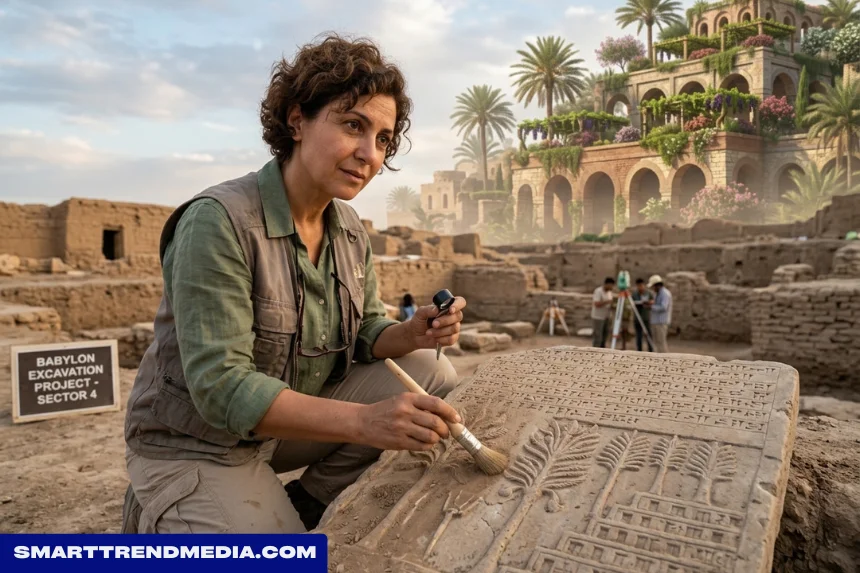
What Happened to the Hanging Gardens?
No surviving record explains when or how the gardens disappeared.
Popular accounts often claim that earthquakes destroyed them. Others suggest warfare, fire, flooding, neglect, river changes, or the gradual collapse of an abandoned irrigation system.
However, none of these explanations has been conclusively demonstrated.
Possible decline at Babylon
If the gardens stood at Babylon, they may have deteriorated as political power changed and palace maintenance declined.
An elevated garden would require constant labour. Pumps, channels, waterproof layers, drains, trees, and supporting walls would all need regular care. Therefore, even a temporary interruption in water supply could severely damage the vegetation.
Later rulers may also have altered the palace complex, reused construction material, or allowed the structure to collapse. Over time, brick removal and rebuilding could have erased much of the surviving evidence.
Possible destruction at Nineveh
If the gardens stood at Nineveh, their decline may relate to the destruction of the Assyrian capital near the end of the seventh century BCE.
Palaces and urban structures suffered heavily, while the political system responsible for maintaining the water network collapsed. Nevertheless, some canals, aqueducts, reliefs, and landscape evidence survived sufficiently to document the scale of Assyrian engineering.
Still, researchers cannot demonstrate that one particular destroyed garden became the wonder described by later authors.
Why the earthquake claim is uncertain
The earthquake explanation appears frequently in popular articles. However, it often lacks a clearly identified ancient source or confirmed archaeological layer tied to the gardens.
Without a certain location, historians cannot confidently connect the garden’s disappearance with one earthquake, invasion, flood, or date.
Therefore, the responsible conclusion is that the fate of the Hanging Gardens remains unknown.
Are There Surviving Ruins of the Hanging Gardens?
No structure is universally recognised as the surviving ruins of the Hanging Gardens of Babylon.
At Babylon, visitors can see or study remains associated with palaces, temples, walls, streets, gates, and other parts of the ancient city. However, none carries a confirmed archaeological identification as the garden wonder. UNESCO describes the Hanging Gardens as a feature attributed to Babylon by classical texts rather than as a securely identified surviving monument.
At Nineveh and across its surrounding landscape, researchers have identified Assyrian canals, aqueducts, palace remains, reliefs, and evidence for irrigated royal gardens. Nevertheless, those remains are evidence for the alternative theory rather than universally accepted ruins bearing the ancient wonder’s name.
Consequently, photographs online may be misleading when captions call general ruins at Babylon or Nineveh “the Hanging Gardens.”
Can You Visit the Hanging Gardens of Babylon Today?
Visitors cannot enter a confirmed Hanging Gardens structure because archaeologists have not conclusively identified one.
However, the archaeological site of Babylon lies near modern Hillah in Iraq. UNESCO added Babylon to the World Heritage List in 2019 because of its exceptional archaeological, historical, cultural, and symbolic importance.
Visitors may encounter:
- Ancient palace areas
- Reconstructed walls
- Sections associated with the Processional Way
- Archaeological foundations
- Modern reconstructions
- Museum or interpretive material
- Wider views of the ancient city’s landscape
Nevertheless, travellers should distinguish original remains from twentieth-century reconstruction. UNESCO specifically notes that extensive modern reconstruction has created concerns about the authenticity of some above-ground sections.
Travel conditions, access requirements, conservation rules, and security guidance may also change. Therefore, anyone planning a visit should consult current official government and local tourism information.
Why Modern Reconstructions Look So Different
Modern images of the Hanging Gardens vary dramatically because artists do not have a confirmed structure, floor plan, elevation drawing, or contemporary Babylonian illustration to follow.
Some reconstructions show:
- A stepped ziggurat covered in plants
- Large arched terraces
- A palace with rooftop gardens
- Towering waterfalls
- Greek-style stone columns
- A compact courtyard garden
- A wide artificial mountain
- An Assyrian hillside supplied by aqueducts
Each design combines selected ancient descriptions with assumptions about Mesopotamian architecture.
Moreover, many familiar paintings were created during periods when European artists imagined Babylon as an exotic city of extreme wealth and fantasy. Consequently, those images often reveal as much about later artistic taste as they do about ancient Mesopotamia.
A historically responsible caption should therefore use phrases such as:
- “Artistic reconstruction”
- “Modern interpretation”
- “Imagined view”
- “Possible appearance”
- “Not based on confirmed ruins”
This wording prevents readers from mistaking an illustration for archaeological evidence.
What Is the Strongest Evidence in the Debate?
The strongest evidence for the traditional Babylonian theory is the repeated classical attribution to Babylon and the known scale of Nebuchadnezzar II’s construction programme.
However, the strongest evidence against that theory is the absence of a clear reference in the extensive contemporary written record and the failure of excavations to locate a convincing structure.
Meanwhile, the strongest evidence for Nineveh includes:
- Sennacherib’s inscriptions
- A documented canal network
- Aqueduct remains
- Royal-garden imagery
- Irrigated hillside landscapes
- Evidence that ancient writers confused Nineveh and Babylon
The main weakness is that no discovered text explicitly says: “This is the Hanging Garden later listed among the Seven Wonders.”
Therefore, the evidence supports probability and interpretation rather than absolute certainty.
Why the Mystery May Never Be Fully Solved
A final solution depends on evidence that may no longer exist.
The original structures could have been dismantled, eroded, buried, altered, or reused. Likewise, the earliest written account may have disappeared before modern scholarship began.
In addition, ancient storytelling does not always preserve a direct line between one building and one later description. The Hanging Gardens tradition may have changed as writers translated, summarised, misunderstood, and embellished earlier material.
Nevertheless, new archaeological research, satellite analysis, cuneiform studies, landscape surveys, and reassessment of museum objects may continue to refine the debate.
For now, uncertainty remains part of the historical significance of the Hanging Gardens of Babylon. The mystery encourages readers to distinguish between tradition, possibility, probability, and confirmed evidence.
Hanging Gardens of Babylon Timeline
The history of the Hanging Gardens of Babylon combines confirmed events, later literary traditions, and modern scholarly theories.
| Approximate date | Event or development |
|---|---|
| 705–681 BCE | Sennacherib rules Assyria and develops Nineveh’s palace, canals, aqueducts, and royal gardens |
| 605–562 BCE | Nebuchadnezzar II rules Babylon and carries out extensive construction projects |
| Sixth century BCE | Traditional period in which the Hanging Gardens were supposedly built |
| Fifth century BCE | Herodotus describes Babylon but does not mention the gardens |
| Early third century BCE | Berossus writes a history of Babylonia that later authors connect with the garden tradition |
| First century BCE | Diodorus Siculus and Strabo describe elevated gardens, terraces, and water-lifting systems |
| First century CE | Quintus Curtius Rufus includes the gardens in his account of Alexander the Great |
| 1899–1917 | Robert Koldewey leads major German excavations at Babylon |
| Twentieth century | Archaeologists and historians continue searching for a convincing Babylonian location |
| Late twentieth and early twenty-first centuries | Stephanie Dalley develops and expands the theory that the gardens stood at Nineveh |
| 2019 | UNESCO adds Babylon to the World Heritage List |
This timeline should not be read as proof that every event concerns the same structure. Instead, it shows how the traditional Babylonian story, Assyrian evidence, and later classical descriptions developed across different periods.
Hanging Gardens of Babylon: Myth vs Evidence
Several popular claims about the gardens are often presented more confidently than the surviving evidence allows.
| Popular claim | What the evidence supports |
| Nebuchadnezzar II definitely built the gardens | Later tradition credits him, but no clear contemporary Babylonian inscription confirms the project |
| The gardens were built for Queen Amytis | This is a famous later story rather than a confirmed historical fact |
| The gardens were suspended in the air | They were more likely imagined as raised or stepped terraces |
| Archaeologists found the gardens in Babylon | No structure has gained universal acceptance as the wonder |
| An earthquake destroyed the gardens | The cause and date of their disappearance remain unknown |
| The plants and dimensions are known | Later writers gave descriptions, but no verified botanical list or confirmed measurements survive |
| The Nineveh theory has solved the mystery | Nineveh provides strong evidence, but the identification remains debated |
| The gardens were entirely fictional | That is possible, but the descriptions may also preserve memories of real Mesopotamian royal gardens |
Therefore, the most reliable article should distinguish among tradition, archaeological evidence, scholarly interpretation, and confirmed fact.
Was Babylon Capable of Building the Gardens?
Yes. Although the specific wonder remains unconfirmed, Babylonian builders clearly possessed the knowledge required for ambitious construction.
They understood:
- Monumental brick architecture
- Palace and temple construction
- Irrigation canals
- Bitumen waterproofing
- Large-scale labour organisation
- River management
- Urban planning
- Decorative glazed brickwork
- Garden and orchard cultivation
Nebuchadnezzar II’s Babylon contained monumental gates, ceremonial streets, palaces, temples, walls, and extensive public works. Therefore, a major royal garden would not have been technologically impossible.
However, technological capability does not prove that the exact structure described by Greek and Roman writers stood there. The central historical problem remains the lack of a clearly identified building or contemporary inscription.
Were Elevated Gardens Common in Ancient Mesopotamia?
Royal gardens were not unique to the Hanging Gardens tradition.
Mesopotamian kings created:
- Palace gardens
- Fruit orchards
- Hunting parks
- Irrigated landscapes
- Tree-lined canals
- Sacred gardens
- Collections of imported plants
- Artificial hills and landscaped terraces
These spaces served practical, symbolic, political, and recreational purposes. For example, gardens could provide fruit, shade, fragrance, and private leisure. At the same time, they displayed the ruler’s ability to control water, labour, territory, and valuable plants.
Assyrian evidence is particularly strong. Inscriptions and reliefs from Nineveh show carefully engineered landscapes supplied by extensive water systems. Consequently, even historians who doubt the traditional Babylonian location generally accept that ancient Mesopotamian rulers built extraordinary gardens.
Why Did Ancient Kings Build Royal Gardens?
Royal gardens communicated power.
A king who could create a green landscape in a dry environment demonstrated control over nature and water. Furthermore, importing plants from distant lands could symbolise authority over conquered territories.
Royal gardens may also have served several purposes:
Political display
Foreign visitors, officials, and ambassadors could experience the ruler’s wealth through rare trees, flowing water, architecture, and carefully arranged landscapes.
Religious symbolism
Gardens could represent fertility, abundance, divine favour, and an idealised world. In addition, trees and water carried deep symbolic importance in many ancient Near Eastern cultures.
Personal recreation
Kings and royal families could walk, dine, hunt, entertain guests, or rest within shaded surroundings.
Scientific and economic value
Gardens allowed rulers to cultivate useful plants, experiment with imported species, and preserve valuable botanical resources.
Therefore, a monumental garden could function as far more than decoration. It could serve as a living statement of imperial order.
How Did the Hanging Gardens Become So Famous?
The garden became famous through classical literature.
Greek and Roman writers admired large monuments that appeared to exceed ordinary human ability. Consequently, the Seven Wonders tradition highlighted structures known for scale, technical difficulty, artistic beauty, or royal ambition.
The Hanging Gardens stood apart from the other wonders because they combined nature with engineering. Instead of presenting one statue, tomb, temple, or tower, the garden supposedly created an entire artificial landscape.
Moreover, later readers were attracted to several memorable elements:
- A green mountain in a dry region
- A king building for a homesick queen
- Trees growing high above the ground
- Water rising through hidden machinery
- A lost structure without confirmed ruins
- A continuing debate between Babylon and Nineveh
As a result, the garden became both a historical puzzle and a powerful legend.
How Reliable Are Modern Images of the Hanging Gardens?
Modern illustrations should be treated as interpretations rather than evidence.
Artists frequently combine:
- Babylonian walls
- Greek or Roman columns
- Assyrian relief imagery
- Stepped ziggurats
- Waterfalls
- Palm trees
- Hanging vines
- Fantasy architecture
However, no confirmed plan, elevation, or contemporary Babylonian image survives.
For that reason, every published picture should include a clear caption such as:
Artistic reconstruction of the Hanging Gardens of Babylon. Their appearance and location remain unconfirmed.
This caption protects readers from confusing an imaginative scene with a verified archaeological reconstruction.
Hanging Gardens of Babylon in Art and Popular Culture
The mystery has made the gardens popular in:
- Historical paintings
- Novels
- Films
- Television documentaries
- Video games
- Museum exhibitions
- Architectural projects
- School textbooks
- Travel writing
- Digital reconstructions
Artists often portray the gardens as an ideal city where architecture and nature exist together. Therefore, the wonder has influenced modern discussions about rooftop gardens, sustainable buildings, vertical forests, and green urban design.
Nevertheless, modern projects described as “new Hanging Gardens” usually draw on the legend rather than a confirmed ancient blueprint.
What Can Modern Cities Learn From the Hanging Gardens?
Although historians cannot confirm the structure, the idea behind it remains relevant.
Modern cities increasingly use:
- Rooftop gardens
- Green walls
- Elevated parks
- Rainwater collection
- Urban tree planting
- Shaded public spaces
- Water-efficient irrigation
- Plants integrated into buildings
These methods can reduce heat, create shade, manage stormwater, improve air quality, and provide more attractive public spaces.
However, the ancient wonder also offers a warning. Elevated gardens require strong structures, effective drainage, continuous maintenance, suitable plants, and reliable water systems.
Therefore, successful green architecture depends on engineering and long-term care rather than appearance alone.
What Is the Historical Importance of the Hanging Gardens?
The gardens matter because they reveal how history is reconstructed from incomplete evidence.
Researchers must compare:
- Classical literature
- Cuneiform inscriptions
- Archaeological remains
- Palace reliefs
- Ancient geography
- Irrigation systems
- Later copies of lost texts
- Cultural memories
- Modern interpretations
No single source provides a complete answer. Consequently, the mystery demonstrates why historians separate what is known from what is probable or merely possible.
The debate also shows that famous historical traditions can change. A story may begin with one real place, absorb details from another, and eventually become associated with a better-known city.
Frequently Asked Questions About the Hanging Gardens of Babylon
What were the Hanging Gardens of Babylon?
They were described as elevated, irrigated garden terraces filled with trees and other plants. Later writers included them among the Seven Wonders of the Ancient World.
However, no universally accepted ruins or contemporary Babylonian description confirms their appearance.
Did the Hanging Gardens of Babylon really exist?
Historians do not know with certainty.
The classical descriptions may preserve the memory of a real Babylonian garden, an Assyrian garden at Nineveh, several combined royal gardens, or a partly legendary structure.
Who supposedly built the Hanging Gardens of Babylon?
Later tradition usually credits Nebuchadnezzar II.
Nevertheless, the surviving inscriptions from his reign do not clearly describe the famous wonder. An alternative theory credits Sennacherib with creating the garden at Nineveh.
Why were the Hanging Gardens built?
According to a popular tradition, Nebuchadnezzar built them for a wife who missed the mountains and greenery of her homeland.
However, no contemporary Babylonian document confirms this romantic story.
Was the queen named Amytis?
Later accounts commonly identify her as Amytis of Media.
Even so, the full marriage-and-garden story remains historically uncertain. Therefore, Amytis should be described as part of the traditional account rather than as a confirmed explanation.
Where were the Hanging Gardens of Babylon located?
The traditional location is Babylon, near modern Hillah in Iraq.
However, no confirmed garden structure has been found there. An influential scholarly theory places the gardens at Nineveh, near modern Mosul.
Why do some historians believe the gardens were at Nineveh?
Nineveh has direct evidence of monumental royal gardens, canals, aqueducts, irrigation systems, and planted landscapes.
In addition, Sennacherib’s inscriptions document major engineering projects. These features closely resemble parts of the classical garden descriptions.
Were the Hanging Gardens really hanging?
Probably not in the modern meaning of the word.
Plants likely grew on raised terraces and extended over the edges. Therefore, “hanging” may have referred to overhanging vegetation or elevated planting.
How were the gardens watered?
Later writers described a system that lifted water to the upper levels. Proposed methods include bucket chains, wheels, screws, pumps, canals, and gravity-fed channels.
Nevertheless, no confirmed watering mechanism from the Babylonian wonder survives.
Did the Hanging Gardens use an Archimedes’ screw?
Some descriptions have been interpreted as referring to a screw-like water-lifting device.
However, historians cannot confirm the exact technology. In addition, the evidence does not prove that the mechanism was identical to the device later associated with Archimedes.
How tall were the Hanging Gardens?
No confirmed height is available.
Ancient authors gave measurements, but their units, sources, and accuracy remain uncertain. Therefore, exact modern dimensions should be treated cautiously.
What plants grew in the Hanging Gardens?
No verified botanical list survives.
Possible plants include date palms, figs, grapes, pomegranates, cypress, cedar, juniper, flowering shrubs, and shade trees. Nevertheless, these suggestions come from wider Mesopotamian garden traditions rather than confirmed garden remains.
Why didn’t Herodotus mention the gardens?
No one knows.
He may have omitted them, relied on incomplete information, or never seen Babylon personally. Alternatively, the famous garden may not have stood in Babylon.
What did archaeologists find at Babylon?
Archaeologists uncovered palaces, temples, streets, walls, gates, and many other structures.
Robert Koldewey proposed that a vaulted palace building might have supported the gardens. However, most specialists have not accepted that identification as conclusive.
Are there ruins of the Hanging Gardens today?
No ruins are universally accepted as the Hanging Gardens.
Babylon contains significant ancient remains, while Nineveh preserves evidence of royal gardens and water systems. Still, neither site contains a structure conclusively labelled as the famous wonder.
What destroyed the Hanging Gardens?
Their fate remains unknown.
Earthquakes, warfare, flooding, neglect, changing rivers, and the collapse of maintenance systems have all been suggested. However, no theory has been proven.
Can people visit the Hanging Gardens of Babylon?
People can visit the archaeological site of Babylon when local access and security conditions allow.
However, visitors cannot see a confirmed Hanging Gardens structure because no such building has been conclusively identified.
Is Babylon a UNESCO World Heritage Site?
Yes. UNESCO added Babylon to the World Heritage List in 2019.
The listing recognises the site’s extraordinary historical and archaeological importance. Nevertheless, it does not confirm the physical location of the gardens.
Are the Hanging Gardens mentioned in the Bible?
The Bible discusses Babylon extensively, but it does not directly describe the Hanging Gardens as one of the Seven Wonders.
Therefore, biblical references to Babylon should not be treated as evidence for the garden’s architecture or location.
Which theory is most convincing?
The Nineveh theory has strong supporting evidence because of Assyrian inscriptions, canals, aqueducts, and palace reliefs.
However, the classical tradition consistently associates the wonder with Babylon. Consequently, scholars have not reached a universal conclusion.
Which Ancient Wonder still exists?
The Great Pyramid of Giza is the only one of the traditional Seven Wonders that still survives substantially intact.
The Hanging Gardens remain especially mysterious because researchers have not conclusively identified their original location.
Conclusion
The Hanging Gardens of Babylon remain one of the greatest mysteries of the ancient world.
Classical writers described an extraordinary elevated garden filled with trees, deep soil, shaded terraces, and flowing water. Later tradition credited Nebuchadnezzar II and connected the project with a queen who missed her mountainous homeland.
However, no clear contemporary Babylonian inscription confirms the story. Likewise, archaeologists have not discovered ruins that scholars universally accept as the wonder.
Meanwhile, Nineveh provides strong evidence for monumental Assyrian gardens, aqueducts, canals, and sophisticated water engineering. Therefore, some researchers believe later writers transferred an Assyrian garden tradition to Babylon.
Ultimately, three possibilities remain credible: the gardens stood in Babylon, they stood in Nineveh, or later writers combined several royal landscapes into one legendary wonder.
Their lasting importance does not depend on solving the mystery completely. Instead, the Hanging Gardens of Babylon continue to represent the ancient ambition to combine architecture, water, nature, and royal power on a breathtaking scale.