

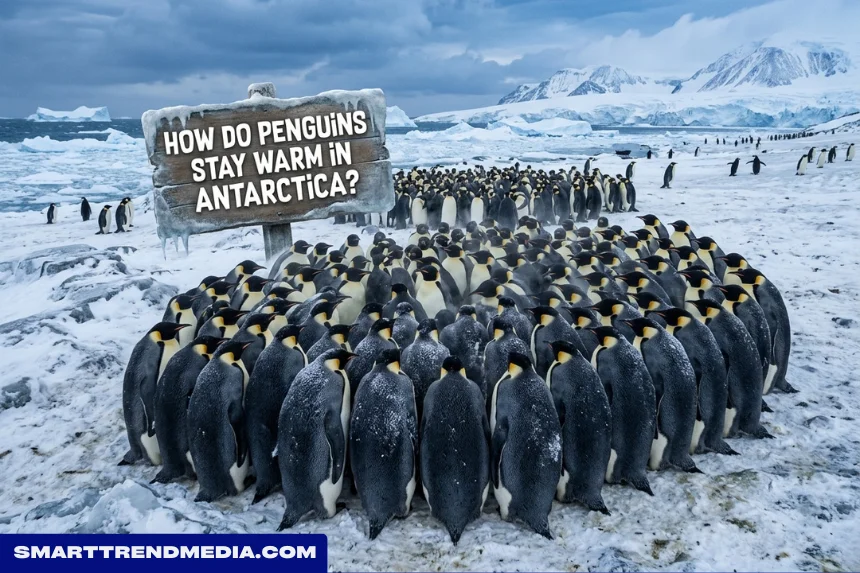
How do penguins stay warm in Antarctica? They combine tightly layered feathers, trapped air, a layer of body fat, compact bodies, controlled blood flow, heat-recovering circulation, and energy-saving behavior. Emperor penguins add one of nature’s best-known defenses: they form moving huddles that reduce exposure to wind and conserve precious energy.
No single adaptation works alone. Instead, a penguin’s body functions like a carefully managed winter system. Feathers slow heat loss, fat adds insulation and fuel, blood vessels protect the core, and behavior changes with the weather, activity, and breeding stage.
Quick Answer: How Do Penguins Stay Warm in Antarctica?
Penguins stay warm by retaining the heat produced inside their bodies. Their plumage traps insulating air, while subcutaneous fat slows heat transfer and supplies energy. Moreover, countercurrent heat exchange limits heat loss through the feet and flippers.
Emperor penguins also huddle during the Antarctic winter. The group blocks wind and reduces how much body surface faces the cold. However, not every penguin species uses adult huddles in the same way.
Key Facts: How Do Penguins Stay Warm in Antarctica?
| Cold-weather problem | Penguin solution |
|---|---|
| Freezing air and strong wind | Short, overlapping contour feathers cover insulating down and trapped air |
| Near-freezing seawater | Plumage, subcutaneous fat, and heat generated by active swimming |
| Heat loss through feet | Restricted blood flow and countercurrent heat exchange |
| Heat loss through flippers and bill | Small extremities and adjustable circulation |
| Long winter fast | Stored fat, low activity, and huddling |
| Contact with ice | Cool feet, thick skin, posture changes, and reduced contact area |
| Exposed egg | The parent balances it on the feet beneath a warm brood pouch |
| Damaged or dirty plumage | Frequent preening and an annual molt restore the insulating coat |
Penguins are endothermic birds, which means they produce metabolic heat and regulate their internal temperature. A Smithsonian overview of penguin biology places their body temperature near 100–102°F, or about 38°C. Therefore, survival depends on slowing the flow of heat from that warm core into the much colder air, ice, and water.
How Do Penguins Stay Warm in Antarctica With Feathers?
Penguin plumage works as a layered barrier rather than a simple coat of large feathers. Stiff contour feathers overlap across the surface, while softer afterfeathers and downy plumules create depth underneath. Air held within this structure conducts heat poorly, so it slows heat transfer away from the skin.
Moreover, the outer layer resists wind and water. Penguins spend substantial time preening, aligning their feathers and spreading secretions from a gland near the tail. Nevertheless, oil alone does not make a penguin waterproof. Feather shape, overlap, condition, and preening all contribute to the barrier.
A 2015 feather-structure study corrected a popular claim about penguin plumage. Emperor penguins do not appear to have the highest contour-feather density of all birds. Instead, the researchers found about nine contour feathers per square centimeter and a much larger number of tiny plumules, which may provide an additional fourfold insulating layer.
That finding explains why counting only the visible feathers misses much of the system. In addition, penguins can alter feather position. Raising the plumage increases the depth of trapped air on land, while flattening it can change heat flow and streamline the body.
Feathers remain essential in water
Some explanations say feathers work on land and fat works in the sea. That distinction is too simple. Plumage continues to reduce heat transfer and water penetration, although pressure compresses trapped air as a penguin dives. Consequently, fat and metabolic heat become increasingly important during long or deep swims.
Feather condition is so important that penguins cannot live normally with a badly damaged coat. During their annual molt, they remain ashore because the transitional plumage is not reliably waterproof. They first build energy reserves, then replace the old coat in a relatively short, intensive period.
How Does Body Fat Protect Antarctic Penguins?
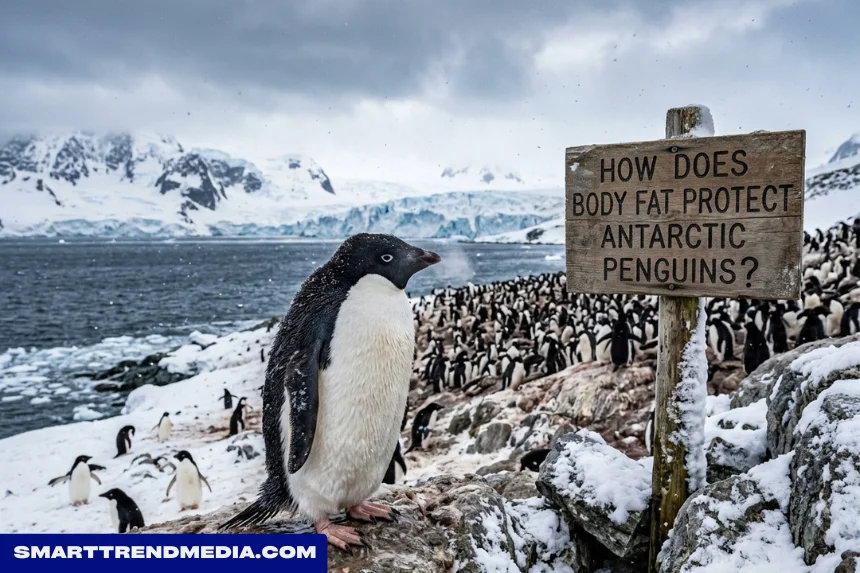
A layer of fat beneath the skin provides additional insulation, especially in cold water. It also stores chemical energy that a penguin can convert into movement and body heat. For an emperor male fasting while incubating an egg, that second function is as important as the first.
“Blubber” appears often in popular descriptions, but subcutaneous fat is the clearer term for a bird. Penguins are not mammals, and calling them warm-blooded mammals is incorrect. They are warm-blooded, flightless seabirds.
However, fat cannot solve the cold problem by itself. As fasting continues, an emperor penguin loses a large share of its stored reserves. Therefore, conserving energy through posture, low activity, and huddling becomes increasingly important as winter progresses.
How Do Penguins Stay Warm in Antarctica by Huddling?
Emperor penguins form dense huddles to reduce wind exposure and the amount of body surface directly facing cold air. Penguins inside the group encounter warm neighbors instead of open wind on most sides. As a result, each bird can maintain body temperature while spending less stored energy.
The huddle is not a motionless wall, nor does it operate through a formal queue. Time-lapse research described in a study of coordinated huddle movement found that tiny steps travel through a packed group like waves every 30–60 seconds. Over time, those steps reorganize the huddle and prevent it from becoming permanently jammed.
Conditions inside can rise far above the outside temperature. Published measurements cited in huddling research have reached above freezing and, in tight groups, close to penguin body temperature. However, those values are not constant throughout every huddle. Density, wind, position, and the stage of breeding all matter.
Huddling mainly saves energy by shielding body surfaces and reducing wind exposure. It does not mean that every bird simply receives heat donated by others. Moreover, tightly huddled birds can become warm enough that the group must loosen or reorganize.
How Does Countercurrent Heat Exchange Protect Penguin Feet?
Penguin feet do not stay as warm as the body core. Instead, circulation keeps them cool enough to reduce heat loss while still protecting living tissue. This smaller temperature difference between foot and ice limits the rate at which heat escapes.
Arteries carrying warmer blood toward the feet run close to veins carrying cooler blood back toward the body. Heat moves from the outgoing blood into the returning blood before either reaches the opposite end of the system. Scientists call this arrangement countercurrent heat exchange.
Consequently, blood reaches the feet after giving up much of its heat, while returning blood reaches the body after being rewarmed. The penguin can also constrict blood vessels and reduce the volume flowing through exposed extremities. A British Antarctic Survey guide explains that this control keeps the feet at an efficient, low temperature rather than heating them like the chest.
In addition, posture adds another defense. An emperor can rest on its heels and stiff tail, lift the toes, or cover more of the feet beneath body feathers. Therefore, less warm tissue presses directly against the ice.
Why Do Body Size and Shape Matter?
Large, compact animals lose heat more slowly than small animals with the same general shape. Volume grows faster than surface area as size increases. Therefore, a large emperor penguin has less heat-losing surface relative to the amount of warm tissue inside.
Emperors also have proportionally small bills and flippers. These shapes limit exposed area and shorten the distance through which blood must travel outside the well-insulated core. The principle resembles a thermos with a compact body and few projections.
Physiological measurements support this connection. A study of fasting emperor penguins linked their relatively low critical temperature to large body size, compact shape, and wind-resistant feathers. Nevertheless, size is only one layer of defense; smaller Antarctic penguins use the same basic insulation and circulation tools.
Penguins also generate extra heat when needed. Their muscles release heat during swimming, walking, and shivering. However, producing heat costs food or stored fat, so the most efficient strategy is to conserve existing warmth first.
Heat can also escape with every breath. Penguin nasal passages transfer some heat and moisture from warm outgoing air to cooler incoming air. A respiratory heat-and-water study located most of that exchange within a shared chamber in the nasal passages. Consequently, breathing through the nose helps conserve resources in cold conditions.
How Do Penguins Stay Warm in Antarctica While Swimming?
Cold water draws heat from a warm animal quickly, so a swimming penguin needs several defenses at once. The feather coat limits water penetration and traps some insulating air. Meanwhile, the subcutaneous fat layer slows heat flow, controlled circulation protects the core, and working muscles continually produce heat.
At the beginning of a dive, trapped air adds insulation and buoyancy. As depth increases, water pressure compresses that air. Therefore, the relative contribution of feathers, fat, circulation, and activity changes during the dive.
Penguins can also allow peripheral tissues to cool while protecting essential organs. This controlled temperature gradient reduces the difference between the outer body and the water. However, a cold surface does not mean the entire bird is cold; it often shows that the insulation is keeping core heat inside.
After returning to ice or land, a penguin may adjust blood flow and feather position again. Preening then restores feather alignment after swimming. In this way, thermoregulation remains active rather than fixed.
How Do Penguins Stay Warm in Antarctica During Egg Incubation?
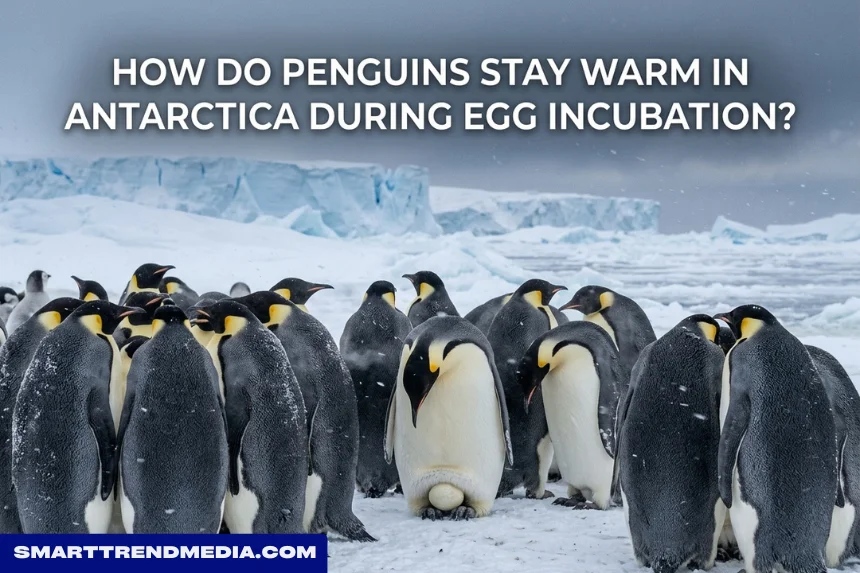
Emperor penguins breed during the Antarctic winter, and the male incubates one egg while fasting. He balances the egg on top of his feet instead of placing it on the ice. A feathered fold called the brood pouch then covers the egg and supplies warmth from the parent’s body.
This position protects the egg from direct conductive heat loss. Meanwhile, the male stands with a small contact area, conserves activity, uses stored fat, and joins other males in huddles. A British Antarctic Survey wildlife summary describes this winter breeding system and the importance of the male’s fat reserve.
The egg transfer between parents is dangerous because even brief exposure to the ice can cool it rapidly. Therefore, the adults coordinate the handoff carefully. After hatching, the chick continues to shelter on the parent’s feet beneath the brood pouch until it can regulate its temperature more effectively.
Later, chicks may gather in groups called crèches. These groups can reduce exposure and provide some collective protection, although they are not identical to the dense winter huddles of fasting emperor males.
Do All Antarctic Penguins Use the Same Strategies?
All penguins use feathers, fat, metabolism, and circulatory control, but the balance differs by species and season. Emperor penguins provide the most extreme example because they reproduce on sea ice during winter. Adélie penguins also live exclusively in the Antarctic region, while chinstrap and gentoo penguins commonly breed in milder maritime areas.
Not every adult penguin forms giant heat-saving huddles. Many species defend nests, alternate incubation with a partner, seek shelter, or time breeding for summer. Chicks of several species group in crèches, but their behavior serves warmth, predator defense, and parental foraging schedules.
The broader species overview provides useful background on the emperor’s unusual winter breeding cycle. Still, the physical principles—insulation, controlled heat flow, body shape, and behavior—apply across penguin species in different combinations.
What Popular Penguin-Warmth Myths Need Correction?
Several memorable claims simplify or misstate the science:
- Myth: Penguins are mammals. Penguins are birds. They are endothermic, but “warm-blooded” does not mean mammal.
- Myth: They have fur. Penguins have several types of feathers, including contour feathers, afterfeathers, plumules, and filoplumes.
- Myth: They have the densest feathers of any bird. A modern emperor-feather study did not support that claim for contour feathers.
- Myth: Waterproof oil does all the work. Plumage structure, overlap, preening, and secretions work together.
- Myth: Fat alone keeps them warm underwater. Feathers, fat, circulation, muscle heat, and behavior all contribute.
- Myth: Every penguin constantly huddles. Dense adult winter huddling is especially associated with emperors.
- Myth: Birds march through a perfectly ordered rotation. Research shows coordinated small movements and gradual reorganization, not a commanded line.
- Myth: Penguins never get too hot. Their insulation can create overheating problems when weather or activity raises the heat load.
Accurate explanations matter because each myth hides the main lesson: penguins regulate heat through an integrated system. No single feather, fat layer, or social behavior explains survival on its own.
Penguin Warmth Timeline: From Sea to Winter Huddle
| Stage | What happens thermally |
|---|---|
| Before entering the sea | The penguin preens and aligns its protective plumage |
| At the surface | Trapped air and fat slow the first rush of heat into the water |
| During a dive | Air compresses; circulation, fat, and muscle heat become more important |
| After surfacing | Blood flow and feather position adjust to the new conditions |
| Before a long fast or molt | The bird builds energy reserves |
| During emperor incubation | The male protects the egg on his feet beneath the brood pouch |
| During severe winter weather | Emperor males form and reorganize energy-saving huddles |
| As conditions ease | The huddle loosens, and individuals resume more independent activity |
FAQs About How Penguins Stay Warm in Antarctica
Do penguins feel cold?
Penguins can experience cold stress, so they actively regulate heat loss and heat production. However, healthy Antarctic species are highly adapted to conditions that would be dangerous for humans.
How do penguins stay warm in Antarctica at night?
Their feathers, fat, compact shape, and controlled circulation work without sunlight. In addition, emperor penguins may huddle during cold, windy winter darkness to conserve energy.
Do penguins have fur?
No. Penguins have feathers, including stiff outer contour feathers and softer insulating feather types beneath them.
How many layers of feathers do penguins have?
Popular sources often describe several overlapping layers, but “layers” is not a universal fixed count. Scientists instead identify different feather types and a deep, three-dimensional arrangement that traps air.
Why do penguin feet not freeze?
Penguins limit warm blood flow to their feet and use countercurrent heat exchange to recover heat from returning blood. Their feet remain much cooler than the body core, which reduces heat transfer to the ice.
Do all penguins huddle for warmth?
No. Dense adult huddling is most strongly associated with emperor penguins, while other species use different nesting, sheltering, and seasonal behaviors. Nevertheless, chicks of several species gather in crèches.
How warm can an emperor penguin huddle become?
Research has recorded local conditions inside tight huddles well above freezing and sometimes close to penguin body temperature. However, the temperature varies with density, wind, position, and duration.
How do penguins stay warm in freezing water?
Water-resistant plumage, trapped air, subcutaneous fat, controlled circulation, and heat from swimming muscles work together. As a dive deepens and trapped air compresses, the other defenses become more important.
How do penguin chicks stay warm?
Young emperor chicks shelter on a parent’s feet under the brood pouch. Later, many penguin chicks form crèches, although growing plumage and parental care remain essential.
Can Antarctic penguins overheat?
Yes. Thick insulation can retain too much heat during activity or milder weather. Consequently, penguins can loosen feathers, change posture, increase blood flow to exposed areas, pant, or move away from a tight huddle.
Conclusion: How Do Penguins Stay Warm in Antarctica?
How do penguins stay warm in Antarctica? They retain internally generated heat through layered plumage, trapped air, subcutaneous fat, compact bodies, heat-recovering circulation, and carefully timed behavior. Emperor penguins add dense, dynamic huddles that reduce wind exposure and lower the energy cost of surviving winter.
Ultimately, the answer is a system rather than a trick. Feathers protect the surface, fat insulates and fuels, blood vessels manage vulnerable extremities, muscles generate heat, and social behavior responds to changing conditions. Together, those adaptations let a warm-bodied bird live, swim, and even raise a chick in Earth’s coldest environment.
LEARN MORE ABOUT : Hanging Gardens of Babylon