

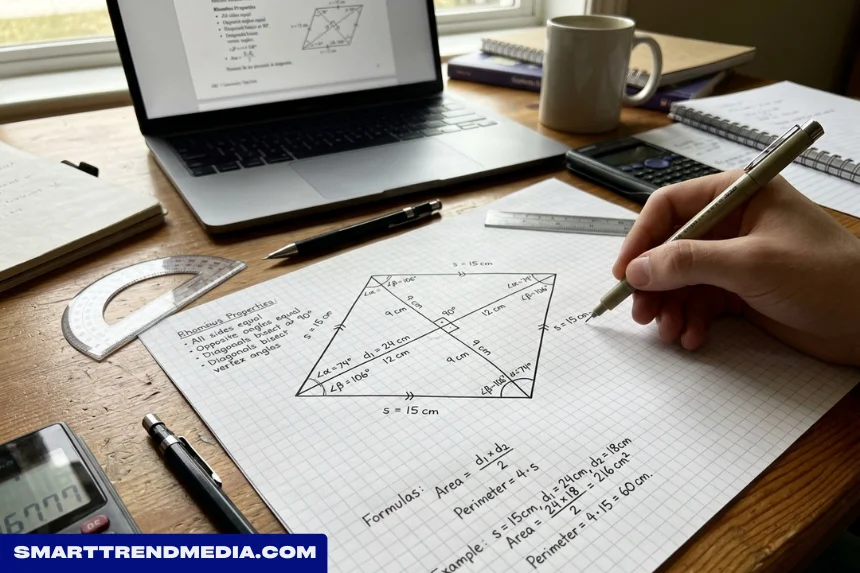
The properties of a rhombus start with one defining fact: all four sides have equal length. Consequently, a rhombus also has parallel opposite sides, congruent opposite angles, supplementary adjacent angles, and perpendicular diagonals that bisect each other and the vertex angles. Its perimeter is (4s), while its area can be (bh), (\frac{d_1d_2}{2}), or (s^2\sin\theta).
Orientation does not matter, and a square qualifies as a special rhombus. For broader background, consult this general encyclopedia overview.
What Are the Properties of a Rhombus?
A rhombus is a quadrilateral with four congruent, or equal-length, sides. From that definition, you can establish seven central properties:
- All four sides are congruent.
- Both pairs of opposite sides are parallel.
- Opposite angles are congruent.
- Each pair of consecutive angles is supplementary, so the two angles total (180^\circ).
- The diagonals bisect each other at right angles.
- Each diagonal bisects a pair of opposite vertex angles.
- The two diagonals form four congruent right triangles.
Moreover, every rhombus inherits the standard parallelogram rules. Its equal sides also create additional diagonal and symmetry rules.
Properties of a Rhombus: Quick Answer
| Feature | Quick answer |
|---|---|
| Focus topic | properties of a rhombus |
| Definition | A quadrilateral with four congruent sides |
| Opposite sides | Parallel and congruent |
| Angles | Opposite angles are congruent; consecutive angles are supplementary |
| Diagonals | Perpendicular; they bisect each other and the vertex angles |
| Area | (A=bh), (A=\frac{d_1d_2}{2}), or (A=s^2\sin\theta) |
| Perimeter | (P=4s) |
| Special case | A rhombus with four right angles is a square |
Here, (s) means side length, (b) means base, (h) means perpendicular height, and (d_1) and (d_2) are the diagonal lengths. Likewise, (\theta) represents an interior angle.
Properties of a Rhombus at a Glance
The following table separates rules that always hold from facts that apply only to the square special case.
| Category | Rule for every rhombus | Important qualification |
|---|---|---|
| Sides | (AB=BC=CD=DA) | Equal sides define the shape |
| Parallel lines | (AB\parallel CD) and (BC\parallel AD) | Therefore, every rhombus is a parallelogram |
| Opposite angles | (\angle A=\angle C) and (\angle B=\angle D) | The two angle measures can differ |
| Consecutive angles | Each adjacent pair totals (180^\circ) | If one angle is (70^\circ), either neighbor is (110^\circ) |
| Interior-angle sum | (360^\circ) | This holds for every simple quadrilateral |
| Diagonal bisection | Each diagonal cuts the other into two equal segments | The two complete diagonals need not equal each other |
| Diagonal intersection | The diagonals meet at (90^\circ) | This is stronger than the rule for a general parallelogram |
| Angle bisection | Each diagonal bisects two opposite vertex angles | The two diagonals bisect different angle pairs |
| Symmetry | The diagonals are reflection axes | A nonsquare rhombus has two reflection axes |
| Rotation | The figure matches itself after a (180^\circ) turn | A square also matches after (90^\circ) turns |
| Equal diagonals | Not required | Equal diagonals make the rhombus a square |
The university quadrilateral hierarchy confirms the inclusive classification: rhombi include squares. Therefore, a general rhombus does not need right angles, but it can have them.
Why Is a Rhombus a Parallelogram?
Every rhombus is a parallelogram because its opposite sides are parallel. Although some textbooks build parallel sides into the definition, you can also derive them from the four equal sides.
Suppose (ABCD) has four congruent sides, and draw (AC). Triangles (ABC) and (CDA) share (AC), while their other sides match. Therefore, the triangles are congruent by side-side-side, or SSS.
Consequently, corresponding alternate interior angles prove (AB\parallel CD) and (BC\parallel AD). Thus, the quadrilateral is a parallelogram.
This classification supplies several rules at once: opposite angles match, adjacent angles are supplementary, and the diagonals bisect each other.
How Do the Diagonal Properties of a Rhombus Work?
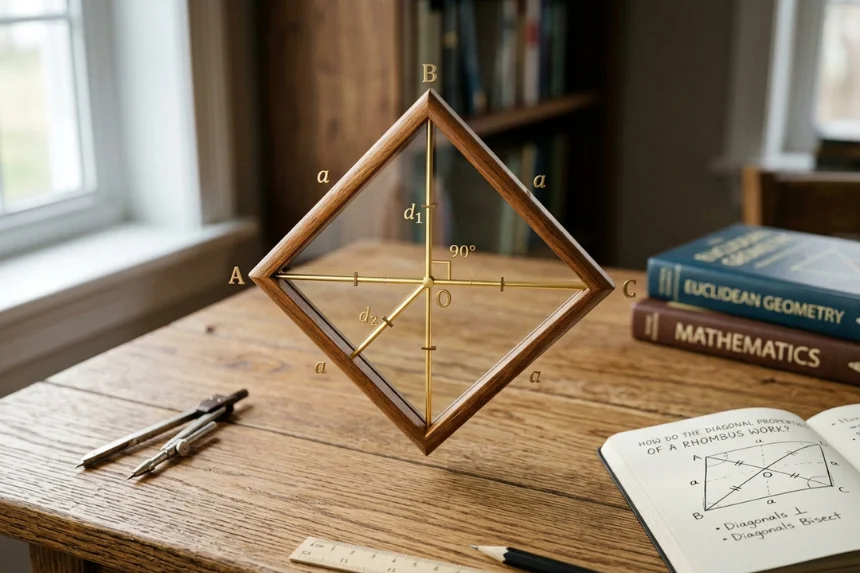
The diagonals of a rhombus are perpendicular bisectors of each other. In addition, each diagonal bisects the two opposite angles that it connects.
“Bisect each other” means that the intersection splits each diagonal into two equal segments. It does not mean that the complete diagonals match. Equal full diagonals occur only in the square case.
To see why the diagonals meet at (90^\circ), let them intersect at (O). Because a rhombus is a parallelogram, (BO=DO). Also, (AB=AD), and (AO) is common to triangles (AOB) and (AOD). SSS congruence makes (\angle AOB) and (\angle AOD) equal. Since those angles form a straight line, each must measure (90^\circ).
The diagonals also create four congruent right triangles. Therefore, half of each diagonal forms a leg, and a side of the rhombus forms the hypotenuse:
[
\left(\frac{d_1}{2}\right)^2+\left(\frac{d_2}{2}\right)^2=s^2
]
Equivalently,
[
d_1^2+d_2^2=4s^2
]
The Wolfram geometry reference gives this identity with the main area and angle formulas.
How Do the Angle Properties of a Rhombus Work?
Opposite angles in a rhombus are congruent, while consecutive angles are supplementary. Therefore, one angle measurement determines all four angles.
For example, suppose (\angle A=64^\circ). Then (\angle C=64^\circ) because the angles are opposite. Meanwhile, (\angle B=\angle D=116^\circ) because (180^\circ-64^\circ=116^\circ).
Each diagonal also bisects the angles at its endpoints. Consequently, a diagonal through a (64^\circ) vertex creates two (32^\circ) angles.
If one angle measures (90^\circ), its supplementary neighbor also measures (90^\circ). Therefore, all four angles are right angles, and the figure is a square.
What Symmetry Does a Rhombus Have?
A nonsquare rhombus has two lines of reflection symmetry: its two diagonals. Folding the figure along either diagonal matches one half with the other.
In addition, a rhombus has rotational symmetry of order two. In other words, a (180^\circ) turn maps the figure onto itself. However, a (90^\circ) turn works only for the square special case.
The diagonal intersection is also the center of rotational symmetry. A square adds four reflection axes and rotational symmetry of order four.
Properties of a Rhombus Formulas
The correct formula depends on the measurements provided. Therefore, identify the givens before choosing an equation.
| What you know | Formula | What the symbols mean |
|---|---|---|
| One side | (P=4s) | (P) is perimeter; (s) is side length |
| Base and perpendicular height | (A=bh) | In a rhombus, the base can be any side |
| Both diagonals | (A=\frac{d_1d_2}{2}) | (d_1) and (d_2) are complete diagonal lengths |
| Side and an interior angle | (A=s^2\sin\theta) | (\theta) is either interior angle |
| Both diagonals | (s=\sqrt{(d_1/2)^2+(d_2/2)^2}) | Use the Pythagorean theorem |
| Side and acute angle | (d_{\text{long}}=2s\cos(\theta/2)) | (\theta) is the acute interior angle |
| Side and acute angle | (d_{\text{short}}=2s\sin(\theta/2)) | The other diagonal is shorter |
Express perimeter in linear units and area in square units. Moreover, do not replace the perpendicular height with the slanted side unless the rhombus is a square.
Why Do the Rhombus Area Formulas Work?
The base-height formula works because a rhombus is a parallelogram. If you cut a triangular piece from one end and move it to the other, the shape becomes a rectangle with the same base and perpendicular height. Therefore,
[
A=bh
]
The diagonal formula follows from the four right triangles inside the rhombus. Each triangle has legs (d_1/2) and (d_2/2), so its area is:
[
\frac12\left(\frac{d_1}{2}\right)\left(\frac{d_2}{2}\right)=\frac{d_1d_2}{8}
]
There are four such triangles. Consequently,
[
A=4\left(\frac{d_1d_2}{8}\right)=\frac{d_1d_2}{2}
]
The right-triangle area derivation adds diagrams and practice. Meanwhile, substitute (h=s\sin\theta) and (b=s) into (A=bh) to get:
[
A=s(s\sin\theta)=s^2\sin\theta
]
Worked Examples Using Properties of a Rhombus
These examples show how the same rules support different problem types. For additional diagonal-area exercises, the open-textbook area lesson includes guided examples.
Example 1: Find the perimeter from a side
A rhombus has a side length of 7 inches. Since all four sides are equal,
[
P=4s=4(7)=28\text{ inches}
]
Therefore, the perimeter is 28 inches.
Example 2: Find area and perimeter from the diagonals
Suppose the diagonals measure 10 centimeters and 24 centimeters. First, find the area:
[
A=\frac{d_1d_2}{2}=\frac{10(24)}{2}=120\text{ cm}^2
]
Next, use the half-diagonals, 5 and 12, to find the side:
[
s=\sqrt{5^2+12^2}=\sqrt{169}=13\text{ cm}
]
Therefore,
[
P=4(13)=52\text{ cm}
]
The area is 120 square centimeters, and the perimeter is 52 centimeters.
Example 3: Find all angles from one angle
Suppose one angle measures (72^\circ). Its opposite angle also measures (72^\circ). In addition, each adjacent angle measures:
[
180^\circ-72^\circ=108^\circ
]
Thus, the four angles are (72^\circ), (108^\circ), (72^\circ), and (108^\circ). A diagonal through either (72^\circ) vertex would split that angle into two (36^\circ) angles.
Example 4: Verify a rhombus on the coordinate plane
Consider (A(0,3)), (B(4,0)), (C(0,-3)), and (D(-4,0)). The distance formula gives:
[
AB=BC=CD=DA=\sqrt{4^2+3^2}=5
]
Therefore, the quadrilateral has four congruent sides and is a rhombus. As a check, diagonal (AC) is vertical with length 6, while (BD) is horizontal with length 8. They meet at their common midpoint, ((0,0)), and they are perpendicular.

How Can You Prove a Quadrilateral Is a Rhombus?
The most direct proof shows four congruent sides. However, several sufficient tests reach the same conclusion.
| Information you can prove | Why it is sufficient |
|---|---|
| All four sides are congruent | This is the definition |
| A parallelogram has two consecutive congruent sides | Opposite sides already match, so all four sides match |
| A parallelogram has perpendicular diagonals | The resulting right triangles force adjacent sides to match |
| A parallelogram has one diagonal that bisects a pair of opposite angles | Triangle congruence forces adjacent sides to match |
| The diagonals perpendicularly bisect each other | Mutual bisection gives a parallelogram; perpendicularity then gives a rhombus |
An interactive construction activity tests the definition and equivalent diagonal condition. Nevertheless, perpendicular diagonals alone are insufficient because a kite can also have them.
Similarly, equal diagonals alone are insufficient; rectangles and some trapezoids can have them. Therefore, use every condition in a valid test.
Rhombus vs. Square, Rectangle, Parallelogram, and Kite
A rhombus belongs to a hierarchy of quadrilaterals. Consequently, one figure can have more than one correct name.
| Feature | Rhombus | Square | Rectangle | General parallelogram | Kite |
|---|---|---|---|---|---|
| Four equal sides | Yes | Yes | Not required | Not required | Not required |
| Opposite sides parallel | Yes | Yes | Yes | Yes | Not required |
| Four right angles | Not required | Yes | Yes | Not required | Not required |
| Diagonals bisect each other | Yes | Yes | Yes | Yes | Usually only one bisects the other |
| Diagonals perpendicular | Yes | Yes | Not generally | Not generally | Yes |
| Diagonals equal | Only if square | Yes | Yes | Not generally | Not generally |
| Each diagonal bisects vertex angles | Yes | Yes | Not generally | Not generally | Not generally |
Every square is both a rhombus and a rectangle. However, a nonsquare rhombus lacks the four right angles needed for a rectangle. Likewise, a general parallelogram may have only opposite sides equal.
Definitions of a kite vary between curricula. Under an inclusive definition, a kite has two pairs of adjacent congruent sides, so a rhombus also counts as a special kite. Under an exclusive definition, the two pairs must have different lengths, which excludes rhombi. Therefore, follow the convention used in your course.
What Are Common Rhombus Mistakes?
First, do not assume that the full diagonals are equal. They split each other into equal halves. If the complete diagonals also match, the rhombus is a square.
Second, do not use the side as the height automatically. Height means the perpendicular distance between opposite sides. Therefore, (A=s^2) works only for the square case, while a general rhombus uses (A=sh).
Third, remember the one-half in the diagonal-area formula. The product (d_1d_2) represents twice the area of the rhombus. Consequently, the correct rule is (A=\frac{d_1d_2}{2}).
Finally, do not classify a figure by its orientation. Instead, check its side, angle, parallel-line, and diagonal evidence.
A Rhombus Problem-Solving Workflow
Use this sequence to choose a formula efficiently and catch common errors.
| Stage | Action | Quick check |
|---|---|---|
| 1. Identify | List the known sides, height, diagonals, or angles | Are the diagonal values full lengths or half-lengths? |
| 2. Choose | Match the givens to a property or formula | Do not use a slanted side as height |
| 3. Calculate | Substitute values and solve in small steps | Keep the factor (\frac12) in the diagonal-area formula |
| 4. Validate | Check size, units, and classification | Area needs square units; perimeter needs linear units |
For example, if both diagonals are known, use (A=\frac{d_1d_2}{2}). If you also need the side, halve each diagonal and apply the Pythagorean theorem. As a result, one diagram can supply both area and perimeter.
FAQs About Properties of a Rhombus
What are the seven main properties of a rhombus?
A rhombus has four equal sides, two pairs of parallel opposite sides, congruent opposite angles, supplementary adjacent angles, mutually bisecting perpendicular diagonals, diagonal angle bisectors, and four congruent right triangles formed by its diagonals. In addition, all four interior angles total (360^\circ).
Are all four sides of a rhombus equal?
Yes. Four congruent sides provide the defining condition for a rhombus. Therefore, if even one side has a different length, the figure is not a rhombus.
Are the diagonals of a rhombus perpendicular?
Yes. The diagonals always intersect at a right angle. Moreover, they bisect each other, so their intersection divides each diagonal into two equal segments.
Are the diagonals of a rhombus equal?
Not usually. The two complete diagonals are equal only when the rhombus is a square. However, each diagonal is always divided into two equal halves by the other diagonal.
Do the diagonals of a rhombus bisect its angles?
Yes. Each diagonal bisects the pair of opposite angles at its endpoints. Consequently, a (70^\circ) vertex angle becomes two (35^\circ) angles when its diagonal passes through it.
Is every square a rhombus?
Yes. A square has four congruent sides, so it meets the definition of a rhombus. Moreover, its four right angles and congruent diagonals give it additional properties.
Is every rhombus a parallelogram?
Yes. The opposite sides of every rhombus are parallel, which makes it a parallelogram. Nevertheless, not every parallelogram has four equal sides, so the reverse statement is false.
What is the area formula for a rhombus?
Use (A=bh) when the base and perpendicular height are known, or (A=\frac{d_1d_2}{2}) when both diagonals are known. Alternatively, use (A=s^2\sin\theta) when a side and an interior angle are given.
What is the perimeter formula for a rhombus?
The perimeter is (P=4s), where (s) is one side length. Because all four sides are congruent, multiplying one side by four gives the total distance around the figure.
How can you identify a rhombus from its diagonals?
Show that the diagonals bisect each other and meet perpendicularly. Mutual bisection first establishes a parallelogram; perpendicularity then establishes a rhombus. However, perpendicular diagonals without mutual bisection are not enough.
Conclusion: Properties of a Rhombus
The essential properties of a rhombus follow from four congruent sides. Opposite sides are parallel, opposite angles are equal, adjacent angles total (180^\circ), and the perpendicular diagonals bisect each other and the vertex angles. Therefore, these rules support both shape classification and efficient calculations.
For most problems, start with the measurements you know. Use (P=4s) for perimeter, (A=bh) or (A=\frac{d_1d_2}{2}) for area, and the Pythagorean relationship between half-diagonals and a side when needed. Finally, remember the key classification rule: every square is a rhombus, but not every rhombus is a square.
READ MORE ABOUT : Hanging Gardens of Babylon