

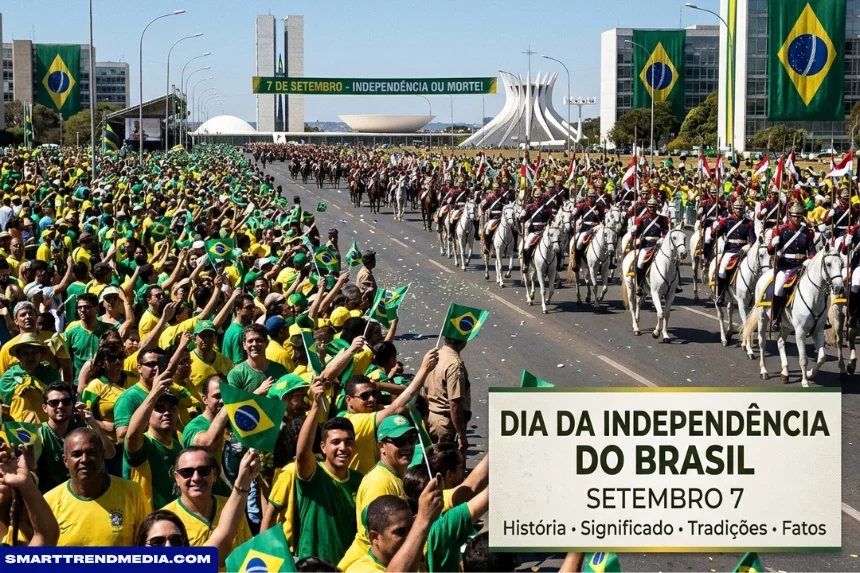
Dia da Independência do Brasil, or Brazil’s Independence Day, is celebrated every year on September 7. The holiday commemorates Brazil’s political separation from Portugal in 1822 and the famous declaration associated with Dom Pedro near the Ipiranga River in São Paulo.
However, Brazil’s independence did not happen through one isolated event. Political pressure from Portugal, decisions by Maria Leopoldina and José Bonifácio, regional conflicts, and the actions of Dom Pedro all contributed to the creation of an independent Brazilian state.
Historical material from the Brazilian National Library explains how events surrounding September 7 formed part of a broader political process.
Today, September 7 is one of Brazil’s most important national holidays. Civic ceremonies, military parades, Brazilian flags, school programs, and public events commonly mark the occasion.
Brazilian law officially recognizes September 7 as Dia da Independência, making the date both historically and legally significant.
Dia da Independência do Brasil: Quick Facts
| Fact | Details |
|---|---|
| Holiday | Independence Day of Brazil |
| Portuguese name | Dia da Independência do Brasil |
| Date | September 7 |
| Historic year | 1822 |
| Main historical figure | Dom Pedro I |
| Famous location | Ipiranga, São Paulo |
| Brazil separated from | Portugal |
| New political system | Empire of Brazil |
| Dom Pedro acclaimed emperor | October 12, 1822 |
| Coronation | December 1, 1822 |
| Holiday status | National holiday |
| Major modern traditions | Civic events and military parades |
Although September 7 stands as the official date, Brazil’s independence developed through several political and military events before and after 1822.
The Brazilian government’s Independence Bicentennial history provides broader context for this process.
What Is Dia da Independência do Brasil?
Dia da Independência do Brasil literally means “Brazil’s Independence Day.”
The national holiday remembers the political break between Brazil and Portugal.
Traditionally, September 7 centers on Dom Pedro’s decision to support independence while traveling through São Paulo in 1822.
Messengers brought him political correspondence that described new demands coming from Portugal.
Those demands threatened Brazil’s growing autonomy.
Dom Pedro and his political allies increasingly believed that separation offered the best response.
According to the Brazilian National Library’s historical timeline, correspondence from Rio de Janeiro played an important role in the events traditionally associated with September 7.
Still, one declaration could not instantly create a fully independent country.
Political negotiations and armed resistance continued afterward.
Therefore, September 7 acts as the national symbol of a much larger historical transformation.
Why Is September 7 Important in Brazil?
September 7 became the most recognizable date connected with Brazilian independence.
On that day in 1822, Dom Pedro made the declaration traditionally associated with the Cry of Ipiranga.
The event represented a decisive break with Portuguese political authority.
However, tensions between Brazil and Portugal had developed long before September.
In 1808, the Portuguese royal family moved to Rio de Janeiro during the Napoleonic Wars.
That decision transformed Brazil’s political importance.
Rio de Janeiro became the center of the Portuguese monarchy, while Brazil gained institutions that previously operated mainly from Europe.
Later, Brazil became part of the United Kingdom of Portugal, Brazil and the Algarves.
Consequently, many Brazilian political leaders resisted attempts to reduce their newly gained autonomy.
The Brazilian government’s bicentennial resources describe these developments as important steps toward independence.
Dia da Independência do Brasil and the Events Before 1822
The independence process began years before the famous declaration.
One major turning point came when Portugal’s royal court arrived in Brazil in 1808.
Thousands of officials, nobles, servants, and members of the royal family relocated to Rio de Janeiro.
The move changed the colony’s political position.
Government institutions expanded, ports opened to friendly nations, and economic restrictions began to change.
In addition, Rio de Janeiro became the administrative center of the Portuguese Empire.
Brazil therefore gained greater political importance.
However, developments in Portugal soon created a new conflict.
The Liberal Revolution of 1820 demanded major constitutional reforms.
Portuguese political leaders also wanted King João VI to return from Brazil.
Eventually, he returned to Portugal in 1821.
Dom Pedro remained behind.
That decision placed him at the center of the coming political crisis.
The Return of King João VI to Portugal
King João VI returned to Portugal in 1821.
Dom Pedro stayed in Brazil as prince regent.
Portuguese political authorities soon demanded changes that threatened Brazil’s political autonomy.
They also ordered Dom Pedro to return to Europe.
Several Brazilian political groups strongly opposed that demand.
Instead, they encouraged the prince to remain.
Petitions gathered thousands of signatures supporting his continued presence in Brazil.
Eventually, Dom Pedro refused to leave.
The decision became one of the most famous events before independence.
Government historical resources describe this moment as an important turning point in relations between Brazil and Portugal.
Afterward, political tensions continued to intensify.
Dia da Independência do Brasil and Dia do Fico
January 9, 1822 became known as Dia do Fico.
The phrase refers to Dom Pedro’s decision to remain in Brazil despite Portuguese demands that he return to Europe.
His supporters viewed the decision as a defense of Brazil’s growing autonomy.
Nevertheless, Dia do Fico did not immediately create an independent nation.
Instead, it represented another major step toward separation.
Dom Pedro increasingly surrounded himself with Brazilian political advisers.
José Bonifácio emerged as one of the most influential.
At the same time, disagreements with political authorities in Lisbon grew more serious.
The official Brazilian independence timeline gives additional context about this political escalation.
By the middle of 1822, reconciliation had become increasingly difficult.
Who Was Dom Pedro I?
Dom Pedro I became the first emperor of independent Brazil.
He was the son of Portuguese King João VI.
After the king returned to Europe, Dom Pedro stayed in Brazil as prince regent.
During 1822, pressure from Portugal and support from Brazilian political groups pushed him toward independence.
September 7 made him the central symbol of the separation.
However, his political role continued after that day.
Brazil formally acclaimed him emperor on October 12, 1822.
His coronation followed on December 1.
Dom Pedro therefore became the head of the newly independent Empire of Brazil.
Still, he did not create independence alone.
Several political leaders influenced events, while people across different regions fought over the country’s political future.
Maria Leopoldina’s Role in Independence
Maria Leopoldina deserves a prominent place in the story.
She was Dom Pedro’s wife and served as regent while he traveled through São Paulo.
On September 2, 1822, Leopoldina participated in an extraordinary meeting of the Council of State.
The council discussed growing tensions with Portugal.
Leopoldina supported separation and sent political information to Dom Pedro.
Her message reached him shortly before September 7.
The Brazilian National Library highlights her involvement in the events leading to independence.
Consequently, the independence decision did not come from one person acting alone.
Modern historical accounts increasingly recognize Leopoldina’s political importance.
Dia da Independência do Brasil and José Bonifácio
José Bonifácio de Andrada e Silva played another major role.
He became one of Dom Pedro’s most influential advisers.
Bonifácio supported greater Brazilian autonomy and eventually backed independence.
During the political crisis, he warned Dom Pedro about Portuguese attempts to weaken Brazil’s authority.
Messages from José Bonifácio reached the prince during the crucial days before September 7.
His role became so prominent that later generations often called him the Patriarch of Independence.
Nevertheless, political leaders did not always agree about the future.
Some wanted strong central government.
Others preferred greater provincial autonomy.
Therefore, the independence coalition contained different political interests from the beginning.
What Happened on September 7, 1822?
Dom Pedro was traveling through the province of São Paulo.
While returning from Santos, messengers reached his group with important political correspondence.
The documents described new developments in Portugal.
Maria Leopoldina and José Bonifácio also sent messages advising a firm response.
Dom Pedro then chose to support political separation.
Traditional accounts place the famous declaration beside the Ipiranga River.
The episode became known as the Grito do Ipiranga, or Cry of Ipiranga.
Popular tradition also connects Dom Pedro with the phrase “Independence or Death.”
However, historians distinguish between the symbolic national story and the complicated political events that surrounded it.
September 7 therefore represents the best-known moment rather than the entire independence process.
Dia da Independência do Brasil and the Cry of Ipiranga
The Cry of Ipiranga became one of Brazil’s strongest national symbols.
Textbooks, monuments, paintings, ceremonies, and popular culture have repeated the story for generations.
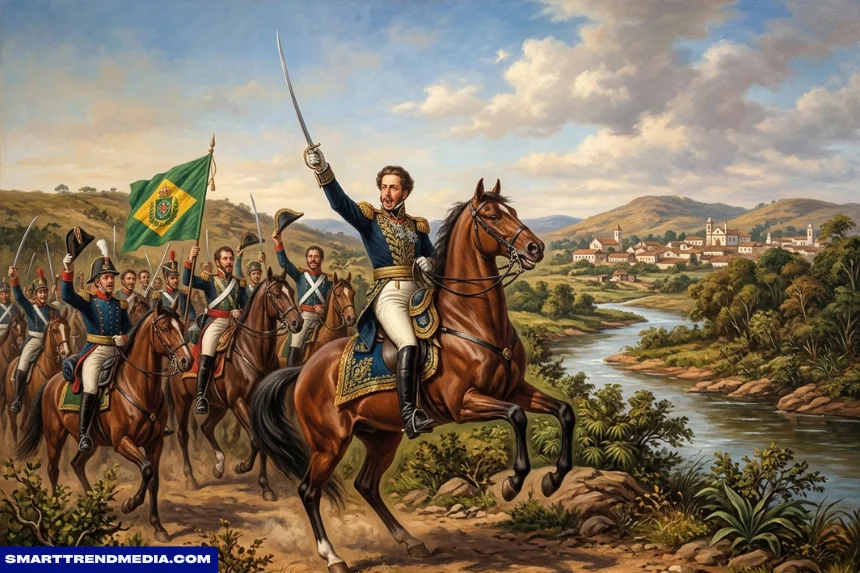
The famous scene usually shows Dom Pedro on horseback surrounded by soldiers.
However, later artistic interpretations shaped much of this image.
Pedro Américo’s famous painting Independence or Death became especially influential.
He completed the artwork decades after the actual event.
Therefore, viewers should treat it as an artistic interpretation rather than a photographic reconstruction.
Historical education becomes stronger when readers separate national symbolism from documented evidence.
The symbolic value of September 7 remains important even when historians reconsider specific details of the traditional narrative.
Did Brazil Become Fully Independent on September 7?
No.
September 7 represents the symbolic declaration, but Brazil still faced major political and military challenges.
Portuguese forces remained powerful in several areas.
Some provinces accepted Dom Pedro’s authority quickly.
Others resisted.
Armed fighting occurred in regions such as Bahia.
Therefore, independence required military victories as well as political declarations.
The Brazilian government’s independence history specifically discusses the armed struggles connected with the process.
Portugal also did not immediately recognize Brazilian sovereignty.
Consequently, the creation of an independent state continued well beyond September 7.
This broader understanding explains why historians often describe independence as a process rather than a single event.
The Independence Struggles Across Brazil
Different regions experienced independence in different ways.
Brazil covered an enormous territory.
Political conditions varied significantly from one province to another.
In some areas, local authorities quickly supported Dom Pedro.
Elsewhere, Portuguese military forces remained influential.
These divisions produced armed conflict.
Supporters of independence had to secure control over strategically important regions.
For this reason, the popular claim that Brazilian independence happened peacefully oversimplifies the historical record.
Combat occurred both before and after the famous declaration.
Regional struggles also involved civilians, soldiers, local elites, enslaved people, free Black Brazilians, and many other participants.
Therefore, understanding independence requires looking beyond Rio de Janeiro and São Paulo.
Dia da Independência do Brasil and Bahia
Bahia offers one of the clearest examples of the broader independence struggle.
Portuguese troops maintained control over Salvador after September 7.
Brazilian independence supporters fought against them.
The conflict continued for months.
Eventually, Portuguese forces left Salvador on July 2, 1823.
That date still holds enormous cultural importance in Bahia.
The state celebrates July 2 as a major independence commemoration.
Therefore, Bahia’s history shows why September 7 cannot explain the entire process.
Political independence required victories in different regions before the new government could exercise authority across the country.
Dom Pedro Became Emperor of Brazil
Brazil did not become a republic after independence.
Instead, leaders created the Empire of Brazil.
Dom Pedro received acclamation as emperor on October 12, 1822.
His coronation took place on December 1.
Therefore, the country began its independent period as a monarchy.
This arrangement distinguished Brazil from many neighboring Spanish American countries, which generally became republics after independence.
Brazil retained the monarchy until 1889.
Dom Pedro I ruled first.
Later, his son Dom Pedro II became emperor.
The imperial period shaped Brazilian politics for most of the nineteenth century.
What Changed After Brazilian Independence?
Political sovereignty represented the largest immediate change.
Brazil no longer accepted Portuguese authority as the basis of its government.
Instead, the new empire developed its own political institutions.
However, social change moved much more slowly.
Slavery continued.
Political participation remained limited.
Large economic and social inequalities also survived.
Therefore, independence did not create equal freedom for everyone.
Brazil abolished slavery only in 1888.
One year later, the monarchy ended.
The country then became a republic.
This timeline demonstrates why independence should not be confused with the abolition of slavery or the creation of republican government.
Dia da Independência do Brasil Became a National Holiday
September 7 eventually became Brazil’s official Independence Day.
Brazilian legislation formally recognizes the date.
Law No. 5,571 identifies September 7 as Dia da Independência and provides rules surrounding official commemoration.
Today, government offices and many institutions close for the holiday.
Schools often hold educational activities before September 7.
Meanwhile, municipalities may organize parades, speeches, flag ceremonies, and civic events.
Celebration styles vary across Brazil.
Nevertheless, September 7 remains one of the country’s most recognizable national dates.
How Is Dia da Independência do Brasil Celebrated?
Modern celebrations combine patriotism, history, education, and public ceremony.
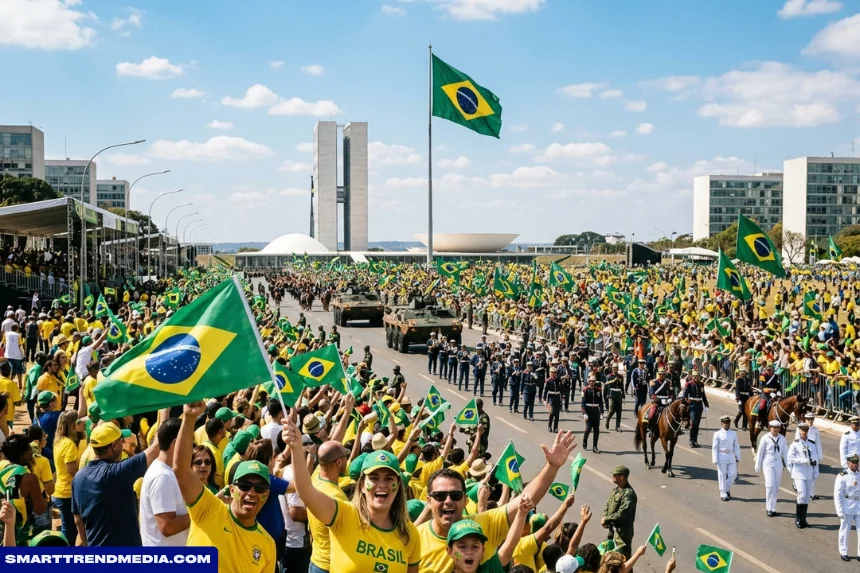
Military parades represent one of the best-known traditions.
Brasília generally hosts prominent national events.
State capitals and smaller municipalities may also organize local ceremonies.
Brazilian flags commonly appear throughout public spaces.
Schools often teach lessons about independence before the holiday.
In addition, families may treat September 7 as a day for rest, travel, or community activities.
However, many Brazilians also use the occasion for political and historical reflection.
The holiday can therefore represent both celebration and debate.
Military Parades on September 7
Military ceremonies have become strongly associated with Independence Day.
Brazil’s Armed Forces frequently participate in official events.
Parades may include troops, vehicles, aircraft, bands, and ceremonial formations.
The specific program changes from year to year.
Nevertheless, the military tradition reflects the country’s long history of civic celebrations connected with September 7.
During the 2022 bicentennial, Brazil’s Ministry of Defense organized events marking 200 years of independence.
Still, the holiday extends beyond military institutions.
Schools, local governments, cultural groups, families, and ordinary citizens also participate.
Brazilian Flags and National Symbols
The Brazilian flag becomes especially visible around Independence Day.
Government buildings commonly display it.
Schools, businesses, homes, and public spaces may also use national colors.
However, Brazil’s current flag did not exist in 1822.
The country used imperial symbols during the monarchy.
The familiar republican flag appeared after the monarchy ended in 1889.
Therefore, modern September 7 celebrations combine symbols from different periods of Brazilian history.
The national anthem also plays an important role during official ceremonies.
Together, flags, music, monuments, and historical stories reinforce national identity.
Dia da Independência do Brasil in Schools
Schools help younger generations understand the holiday.
Traditional lessons often focus on Dom Pedro, the Cry of Ipiranga, and September 7.
However, teachers can create a more complete picture by discussing additional figures and events.
Maria Leopoldina deserves attention.
José Bonifácio also played a major political role.
Students can examine fighting in Bahia and other regions.
They can also study the experiences of Black Brazilians, Indigenous peoples, women, and ordinary soldiers.
This broader approach reduces the risk of presenting independence as the achievement of only one man.
Instead, students can see it as a complex political and social process.

Why the Independence Story Is More Complex Than One Day
National holidays often turn complicated histories into simple dates.
September 7 performs that role in Brazil.
It gives the country one clear day for national remembrance.
However, independence developed through many stages.
The Portuguese royal court arrived in 1808.
Brazil’s political status later changed.
King João VI returned to Portugal.
Dom Pedro stayed.
Dia do Fico strengthened his position.
Maria Leopoldina and José Bonifácio supported separation.
Military conflicts followed the September declaration.
Portugal eventually recognized Brazil as independent.
Therefore, dia da independência do brasil represents the official holiday, while Brazilian independence describes a much broader historical process.
Dia da Independência do Brasil and Black Brazilians
Older independence narratives frequently focused on emperors and elite politicians.
Modern historical research pays greater attention to other participants.
Black Brazilians took part in the political and military struggles surrounding independence.
Free and enslaved Black people experienced the period in different ways.
The Palmares Cultural Foundation has highlighted the need to recognize Black participation in Brazil’s independence story.
An important contradiction remains.
Brazil became independent while slavery continued.
Therefore, national political freedom did not provide personal freedom for hundreds of thousands of enslaved people.
Slavery survived for another 66 years.
That contradiction strongly shaped the independent country.
Indigenous Peoples and Independence
Indigenous peoples also experienced the creation of independent Brazil.
However, independence did not automatically guarantee Indigenous land rights or political autonomy.
Different communities faced different circumstances across the enormous territory.
Some became involved in local conflicts.
Others continued struggling against territorial expansion and government policies.
Therefore, an inclusive history should not treat independence only as a dispute between Portuguese authorities and Brazilian elites.
The new state affected many communities that had little influence over imperial political decisions.
Understanding these perspectives helps readers see the difference between national sovereignty and universal citizenship.
Brazil achieved one in 1822.
The struggle over the other continued.
Why Historians Debate September 7
Historians do not generally dispute September 7 as Brazil’s official Independence Day.
However, they continue studying how that date became the dominant national symbol.
Other events carried significant importance during 1822.
For example, October 12 marked Dom Pedro’s acclamation as emperor.
December 1 marked his coronation.
Regional military victories also played crucial roles.
Therefore, national memory did not develop instantly.
Political leaders, public ceremonies, historical writers, schools, monuments, and artists gradually strengthened September 7’s status.
This process demonstrates how countries create national narratives.
History includes the original event.
National memory determines how later generations understand and commemorate it.
Dia da Independência do Brasil and October 12, 1822
October 12 became another major milestone.
On that date, Dom Pedro received acclamation as Emperor of Brazil.
That formal political event helped establish the new country’s government.
His coronation followed in December.
Therefore, September 7 did not complete every institutional step toward independence.
Instead, it began a new phase.
The imperial government still needed authority, recognition, administrative structures, and military control.
Modern celebrations emphasize September 7 because it provides a powerful symbolic beginning.
However, October and December help explain how the political transformation continued.
The Famous Independence or Death Painting
Pedro Américo’s Independence or Death painting created one of the most recognizable images in Brazilian history.
It presents Dom Pedro dramatically raising his sword near Ipiranga.
Soldiers surround him while the independence declaration unfolds.
However, Pedro Américo painted the scene decades after 1822.
Therefore, the artwork reflects artistic choices as well as historical information.
The painting helped transform independence into a vivid national story.
For generations, school textbooks reproduced it.
Museums and civic materials also used it.
As a result, many people visualize the event through Pedro Américo’s interpretation.
Understanding the painting’s later creation helps separate national memory from direct documentary evidence.
Where Did the Independence Declaration Happen?
The symbolic declaration took place near the Ipiranga River in São Paulo.
The location later became one of Brazil’s most important historical landmarks.
São Paulo now contains monuments and museums associated with independence.
The famous Independence Monument stands near the historic site.
Visitors interested in history can explore locations connected with September 7.
However, São Paulo represents only one part of the broader story.
Rio de Janeiro served as the political center of the new imperial government.
Salvador witnessed crucial military struggles.
Other regions also experienced major political change.
Therefore, historical tourism related to independence extends across several Brazilian cities.
Dia da Independência do Brasil Bicentennial
Brazil marked 200 years of independence in 2022.
The bicentennial generated major historical and cultural programs.
Museums created exhibitions.
Universities held discussions.
Government institutions published historical materials.
Libraries digitized documents.
The Federal Senate’s Bicentennial of Independence portal collected books, historical records, educational materials, and research related to the anniversary.
The bicentennial also encouraged historians to discuss lesser-known participants.
Modern projects increasingly examine women, Black Brazilians, Indigenous communities, regional conflicts, and ordinary citizens.
Therefore, the 2022 anniversary helped expand the public understanding of independence beyond the traditional Ipiranga narrative.
What Does Brazilian Independence Mean Today?
Independence remains central to Brazilian national identity.
Politically, the events of 1822 created a sovereign Brazilian state.
However, modern Brazilians can interpret the holiday in several ways.
Some focus on patriotism.
Others emphasize historical education.
Many use the date to discuss citizenship, democracy, inequality, and national development.
Those perspectives do not necessarily conflict.
A country can celebrate its independence while critically studying its past.
In fact, understanding historical limitations can make the holiday more meaningful.
Brazil changed enormously after 1822.
Nevertheless, debates about equality, representation, national identity, and political participation continue.
Dia da Independência do Brasil Compared With Republic Day
Brazil’s Independence Day and Republic Day commemorate different events.
September 7 marks Brazil’s independence from Portugal.
November 15 remembers the proclamation of the republic in 1889.
The country spent 67 years as an independent monarchy before becoming a republic.
Dom Pedro I became the first emperor.
Later, Dom Pedro II ruled for decades.
The republican movement eventually removed the monarchy.
Therefore, September 7 concerns national sovereignty.
November 15 concerns Brazil’s form of government.
Understanding the distinction helps readers avoid one of the most common misconceptions about Brazilian history.
Why Dia da Independência do Brasil Still Matters
The holiday remains significant because independence changed Brazil’s political status permanently.
The country became sovereign.
Its government no longer answered to Portugal.
Brazil could develop its own political institutions and foreign relations.
Nevertheless, independence also left important questions unresolved.
Slavery survived.
Political participation remained restricted.
Regional inequalities continued.
Therefore, the date offers both a reason for national celebration and an opportunity for historical reflection.
A complete understanding recognizes achievement without ignoring contradiction.
That balanced approach makes September 7 more meaningful for modern readers.
Frequently Asked Questions About Dia da Independência do Brasil
1. When Is Dia da Independência do Brasil?
Dia da Independência do Brasil is celebrated every year on September 7.
The holiday commemorates the 1822 declaration associated with Dom Pedro and the political separation of Brazil from Portugal.
2. What Happened on Dia da Independência do Brasil in 1822?
Dom Pedro received important political messages while traveling in São Paulo.
The correspondence strengthened the argument for separation from Portugal.
He then made the declaration traditionally connected with the Ipiranga River.
3. Who Declared Brazil’s Independence?
Dom Pedro became the central figure in the declaration.
He later became Brazil’s first emperor.
However, Maria Leopoldina, José Bonifácio, regional leaders, soldiers, and many other participants also influenced the wider independence process.
4. Why Is Dia da Independência do Brasil Celebrated on September 7?
September 7 became the national symbol of the political break with Portugal.
Brazilian law also officially designates the date as Dia da Independência.
5. Where Did Brazil Declare Independence?
The famous declaration took place near the Ipiranga River in São Paulo.
The area later became an important national historical site.
6. Did Brazil Become Independent Without a War?
No.
Several regions experienced armed conflict connected with independence.
Bahia became one of the most important examples, where fighting continued until Portuguese forces left Salvador in July 1823.
7. When Did Dom Pedro I Become Emperor?
Dom Pedro received acclamation as emperor on October 12, 1822.
His coronation followed on December 1.
Therefore, the creation of the new imperial government continued after September 7.
8. Is Dia da Independência do Brasil a Public Holiday?
Yes.
September 7 is a national public holiday in Brazil.
Official ceremonies, school activities, parades, and other events commonly mark the occasion.
9. How Do Brazilians Celebrate Independence Day?
Celebrations often include military and civic parades, Brazilian flags, school programs, public ceremonies, music, speeches, and community events.
However, traditions vary between different cities and regions.
10. Why Was Brazilian Independence a Long Process?
Brazilian independence involved political negotiations, regional disputes, military conflict, changing institutions, and resistance from Portuguese authorities.
September 7 became the symbolic date, but the creation and consolidation of an independent state continued afterward.
Conclusion: Understanding Dia da Independência do Brasil
Dia da Independência do Brasil is celebrated every September 7 and commemorates the political separation of Brazil from Portugal in 1822.
Dom Pedro’s declaration near Ipiranga became the defining national symbol.
However, the complete story involves much more.
Maria Leopoldina helped shape crucial political decisions.
José Bonifácio advised Dom Pedro during the conflict with Portugal.
Regional forces fought to secure independence.
Black Brazilians, Indigenous peoples, women, soldiers, political leaders, and ordinary citizens all experienced the transformation in different ways.
Brazil also remained a monarchy after independence.
Dom Pedro became emperor, while slavery and major social inequalities continued for decades.
Therefore, independence created national sovereignty without immediately creating equal freedom for everyone.
Today, September 7 serves as both a celebration and an opportunity for historical reflection.
The simplest answer is that dia da independência do brasil marks September 7, 1822, as the symbolic date of Brazil’s separation from Portugal, while the full independence process developed through political decisions, regional struggles, and military events before and after that day.
READ MORE AT: smarttrendmedia