

The debate over why homework should be banned is not simply about helping students avoid work. Instead, it concerns whether traditional take-home assignments provide enough educational value to justify their effects on stress, sleep, family time, and equal access to learning resources.
Supporters argue that homework reinforces classroom lessons and encourages responsibility. However, critics point out that long, repetitive, and heavily graded assignments can create pressure without producing meaningful learning. Research also suggests that homework benefits vary according to a student’s age, the subject, the assignment’s purpose, and the amount of time required.
Therefore, schools should not assume that more homework automatically leads to better academic results. A stronger policy would ban excessive and inequitable homework while allowing teachers to use short, purposeful activities when they provide a clear educational benefit.
Quick answer: Homework should be banned when it is excessive, repetitive, heavily graded, or dependent on resources students may not have at home. Large homework loads can increase stress, interfere with sleep and personal development, and offer limited academic benefits to younger students. Nevertheless, short and carefully designed assignments may still help some middle- and high-school students.
Why Homework Should Be Banned: Quick Facts
| Key issue | Evidence-based explanation |
|---|---|
| Student stress | A Stanford study of students at high-performing schools connected heavy homework loads with academic stress, physical symptoms, and a lack of balance. |
| Sleep and recovery | Students in the Stanford research reported that homework contributed to sleep deprivation and exhaustion. |
| Academic value | A Duke research synthesis found stronger benefits for secondary students than for elementary pupils. |
| Homework quantity | The commonly used guideline suggests about 10 minutes per grade level, although assignments should be adjusted for age and subject. |
| Assignment quality | Purposeful practice may support learning, but repetitive work does not automatically improve understanding. |
| Recommended policy | Schools should restrict excessive, repetitive, heavily graded, and resource-dependent homework. |
| Better approach | Teachers can use targeted practice, independent reading, classroom support, and formative assessment instead. |
The evidence does not support one identical homework policy for every grade. Consequently, an effective policy must consider age, educational purpose, workload, and access to support.
What Does Banning Homework Actually Mean?
Banning homework does not necessarily mean preventing students from reading, studying, or completing every learning activity outside school. Instead, a well-designed ban would target traditional compulsory assignments that provide little educational value or place unreasonable demands on students.
Schools could restrict homework that is:
- Excessively long
- Repetitive or based mainly on busywork
- Assigned without a clear learning objective
- Heavily weighted in a student’s final grade
- Dependent on parental assistance
- Dependent on reliable internet or expensive technology
- Regularly assigned during weekends and school breaks
- Used to teach material that has not been explained in class
Meanwhile, students could still choose to review notes, why homework should be banned read independently, prepare for a test, or complete a carefully planned long-term project.
Therefore, the strongest argument is not that learning must stop when the school day ends. Rather, schools should stop treating large amounts of compulsory take-home work as an automatic sign of academic rigor.
Should All Homework Be Completely Banned?
A complete ban across every grade and subject would be difficult to defend. Some assignments can provide useful practice, particularly for older students who are preparing for examinations, advanced courses, or college.
A major Duke University research synthesis found a generally positive relationship between homework and academic achievement. However, the connection was stronger among students in grades 7–12 and considerably weaker among elementary-school students. The research also indicated that assigning too much work could reduce its effectiveness.
Consequently, schools should distinguish between purposeful practice and excessive homework.
For example, completing a few mathematics problems may help a student apply a newly learned method. In contrast, completing dozens of nearly identical problems may consume time without substantially improving understanding.
Similarly, reading a selected chapter before a classroom discussion may prepare an older student to participate. However, assigning several unrelated worksheets simply to fill time provides a weaker educational justification.
A practical homework ban would therefore focus on:
- Elementary-school workloads
- Repetitive worksheets
- Assignments that regularly require several hours
- Work that students cannot complete independently
- Tasks without useful teacher feedback
- Homework used mainly for discipline or grade penalties
This approach supports learning while removing the why homework should be banned forms of homework most likely to create unnecessary pressure.
1. Excessive Homework Can Increase Student Stress
One of the strongest reasons why homework should be banned or restricted is its connection with student stress.
Homework becomes especially stressful when several teachers assign large tasks at the same time. Students may finish a full school day, attend extracurricular activities, travel home, eat dinner, and then face several additional hours of academic work.
As a result, students may begin viewing learning as a constant source of pressure rather than a meaningful process.
A Stanford study examined 4,317 students from ten high-performing high schools in upper-middle-class communities. The students averaged more than three why homework should be banned hours of homework each night. Moreover, 56% identified homework as a primary source of stress. Researchers also found connections between heavier homework loads, academic stress, physical health complaints, and a lack of balance in students’ lives.
However, these results require careful interpretation. The research focused on high-achieving schools in relatively privileged communities. Therefore, the findings should not be presented as proof that every American student completes three hours of homework or experiences the same effects.
Nevertheless, the study demonstrates an important point: homework can become counterproductive when its demands exceed the time and energy students can reasonably provide.
How Homework Pressure Builds
Homework stress rarely comes from one short assignment. Instead, pressure grows when students experience several demands at once, such as:
- Multiple assignments with the same deadline
- Large projects combined with daily worksheets
- Fear of losing marks for incomplete work
- Limited time because of sports, employment, or family duties
- Difficulty understanding material without teacher support
- Pressure to maintain high grades
- Unclear assignment instructions
- Work that takes much longer than teachers expected
Furthermore, students do not always control their after-school schedules. Some care for younger siblings, work part-time jobs, attend medical appointments, or travel long distances between school and home.
Consequently, a standard assignment may require 30 minutes why homework should be banned from one student but several hours from another.
Stress Does Not Automatically Produce Better Learning
Moderate academic challenges can encourage effort. However, excessive pressure may make it harder for students to concentrate, remember information, or why homework should be banned remain interested in a subject.
A student rushing through an assignment late at night may focus on finishing rather than understanding. Likewise, a student who copies answers to avoid a penalty is not gaining the intended educational benefit.
Therefore, schools should evaluate homework according to learning quality instead of the number of pages completed.
A meaningful assignment should have a clear purpose. It should also be manageable, connected to classroom instruction, and followed by useful feedback. When those elements are missing, homework can become an exercise in compliance rather than learning.
2. Heavy Homework Loads Can Interfere With Sleep
Sleep is essential for attention, memory, emotional regulation, and classroom participation. Nevertheless, students may delay bedtime when they have not finished their assignments.
The Stanford research found that students associated heavy homework demands with sleep deprivation, headaches, exhaustion, and other health complaints. In an earlier Stanford report involving students at high-performing schools, two-thirds of respondents said homework or schoolwork often or always prevented them from sleeping.
Homework is not the only cause of poor sleep. Early school schedules, mobile-device use, employment, extracurricular commitments, and personal circumstances may also reduce sleep time.
However, teachers and schools directly control assignment workloads. Therefore, reducing unnecessary homework is one practical way to protect students’ evening recovery time.
The Late-Night Homework Cycle
A harmful cycle may develop when a student:
- Returns home after a long school day.
- Begins homework after dinner or other why homework should be banned responsibilities.
- Works late to avoid losing marks.
- Sleeps for fewer hours than needed.
- Arrives at school tired and unable to concentrate.
- Struggles to understand new lessons.
- Requires even more time to complete the next assignment.
As a result, homework intended to reinforce learning may indirectly make classroom learning more difficult.
Moreover, students who are exhausted may complete work carelessly or depend on copied answers, online answer services, or artificial intelligence tools. In that situation, the assignment becomes less useful as evidence of independent understanding.
Homework Should Not Compete With Basic Needs
Schools often treat homework as necessary while regarding sleep, exercise, and free time as optional. However, students need recovery to remain attentive and engaged.
After-school time may also include:
- Eating with family members
- Participating in physical activity
- Attending religious or community events
- Completing household responsibilities
- Developing hobbies
- Maintaining friendships
- Resting after an demanding day
- Preparing clothing and materials for school
Therefore, homework policies should consider the student’s complete day rather than treating every evening hour as available academic time.
3. Homework Has Limited Academic Benefits for Younger Students
Another major reason to reconsider homework is that its educational value differs by age.
The Duke University synthesis reviewed why homework should be banned research conducted between 1987 and 2003. It found a stronger positive relationship between homework and achievement among secondary students. In contrast, the relationship was much weaker for elementary-school pupils.
This difference matters because young why homework should be banned children have different developmental needs. Elementary students require time for play, movement, family interaction, exploration, and adequate sleep. Moreover, many younger pupils cannot complete complicated assignments without adult assistance.
Consequently, homework in early grades may become work for parents as much as work for children.
Younger Students Need Different Learning Experiences
Young children often learn effectively through:
- Classroom discussion
- Guided practice
- Creative play
- Reading with family members
- Hands-on activities
- Outdoor exploration
- Teacher feedback
- Social interaction
- Age-appropriate educational games
These activities can develop language, curiosity, cooperation, and problem-solving abilities without requiring long worksheets.
Therefore, eliminating compulsory elementary homework would not mean abandoning education. Instead, it would shift attention toward learning experiences that better match children’s developmental needs.
The Ten-Minute Guideline Is a Limit, Not a Target
Many U.S. school districts follow a guideline of approximately 10 minutes of homework per grade level. Under this approach, a first grader might receive about 10 minutes, while a sixth grader might receive around 60 minutes.
However, the National Education Association describes the guideline as a rule of thumb that teachers should adjust according to the student, subject, and assignment. It is not a requirement that every child must receive the maximum amount each night.
Therefore, teachers should not assign homework simply because a time allowance exists.
The first question should be:
What specific learning benefit will this assignment provide?
If a teacher cannot identify a clear benefit, the assignment may not be necessary.
Homework Can Shift Teaching Responsibility to Families
Elementary homework often requires parents or caregivers to:
- Explain instructions
- Correct misunderstandings
- Find materials
- Monitor progress
- Provide technology
- Help with research
- Ensure the work is submitted
However, not every adult has the time, language skills, subject knowledge, or schedule needed to provide this support.
As a result, students may receive different amounts of help even when they attend the same classroom. One child may complete the task with a parent who understands the subject, while another must work alone.
That difference makes heavily graded elementary why homework should be banned homework difficult to defend as a fair measure of individual learning.
The Central Argument So Far
The case for restricting homework does not depend on claiming that every assignment is harmful. Instead, it rests on three evidence-based concerns:
- Excessive homework can contribute to stress and an unhealthy lack of balance.
- Large workloads can delay sleep and reduce students’ ability to function during the school day.
- Homework offers weaker academic benefits to younger students than to secondary students.
Therefore, schools should judge assignments by their purpose, quality, fairness, and developmental suitability—not by the belief that more work must always produce more learning.
4. Homework Can Deepen Educational Inequality
One of the strongest arguments for why homework should be banned or redesigned is that students do not complete assignments under equal conditions.
Inside a classroom, students generally have access to the same teacher, instructions, learning materials, and working time. At home, however, their circumstances can differ dramatically.
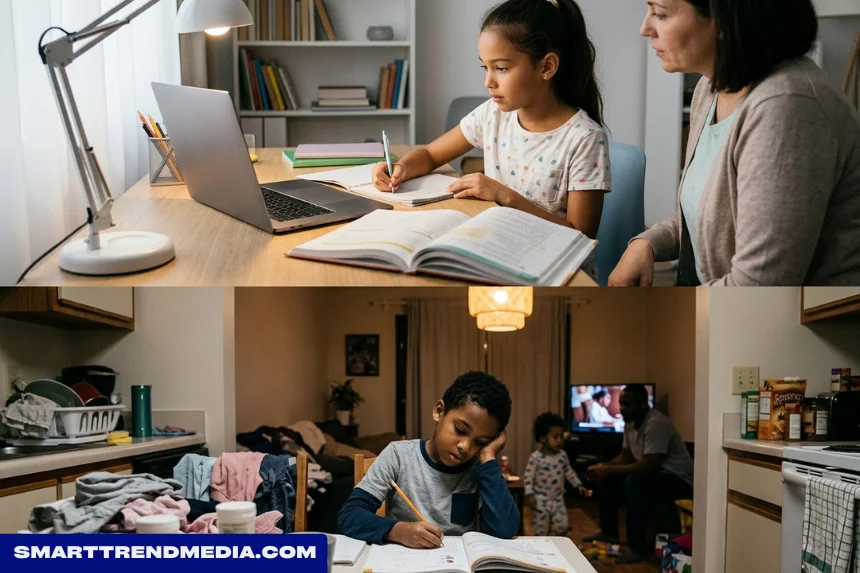
One student may have a private bedroom, a laptop, reliable broadband, and a parent who understands the subject. Meanwhile, another may share a device, work in a crowded room, care for younger siblings, or depend on an unstable mobile connection.
Consequently, the same assignment may test academic why homework should be banned understanding for one student but household resources for another.
The Digital Homework Gap
Technology-dependent homework can disadvantage students who lack reliable internet service or an appropriate device.
The National Center for Education Statistics reported that, in 2019, approximately 5% of U.S. students ages 5 to 17 lived in homes without internet access. However, the rate varied significantly according to income and location.
Among students whose families lived below the federal poverty threshold, 12% lacked home internet access. In contrast, the figure was 2% among students from households earning more than 185% of the poverty threshold.
Geographic differences also remained why homework should be banned important. In 2019:
- 76% of rural students had fixed broadband at home.
- 79% of students in towns had fixed broadband.
- 80% of students in cities had fixed broadband.
- 87% of suburban students had fixed broadband.
- Only 69% of students in remote rural areas had fixed broadband.
These figures do not mean that every student without fixed broadband is completely unable to access the internet. Some may use mobile service, public Wi-Fi, libraries, or school-provided devices.
Nevertheless, completing a lengthy research project on a phone is not equivalent to using a laptop with a stable broadband connection. Similarly, travelling to a library or parking outside a public Wi-Fi location creates demands that other students do not face.
Therefore, schools should not assume that assigning an online task gives every student an equal opportunity to complete it.
Access to a Device Is Not Enough
Even when a household has internet access, several family members may share one device.
For example, a parent may need the computer for work while multiple children need it for school assignments. Moreover, mobile data limits, slow connections, broken equipment, and software requirements can create additional barriers.
Digital assignments may also require:
- A printer and paper
- Paid software or subscriptions
- A webcam or microphone
- A specific operating system
- Large file downloads
- Video-streaming capacity
- A quiet place for recorded presentations
As a result, a seemingly simple assignment may create expenses or practical difficulties that a teacher never intended.
Homework Often Depends on Adult Support
Household inequality involves why homework should be banned more than technology. Homework can also depend on the availability and educational background of parents or caregivers.
Some adults have enough time and subject knowledge to:
- Explain difficult instructions
- Review written work
- Correct mathematical errors
- Purchase project materials
- Help with research
- Communicate with teachers
- Monitor deadlines
Other caregivers may work evening shifts, hold multiple jobs, face language barriers, or have limited experience with the subject. In addition, some students live with adults who cannot consistently supervise schoolwork because of health, employment, or caregiving responsibilities.
Therefore, heavily grading take-home assignments may reward access to adult assistance rather than independent student ability.
Students Have Different Responsibilities After School
Schools may treat the hours after dismissal as free time. However, many students have significant responsibilities outside the classroom.
They may:
- Care for younger siblings
- Help an older or disabled family member
- Prepare meals
- Complete household work
- Attend medical appointments
- Work a part-time job
- Travel long distances home
- Participate in religious or community obligations
These responsibilities do not indicate that a student lacks commitment. Nevertheless, they reduce the time available for traditional homework.
Consequently, strict penalties for incomplete take-home work can punish students for circumstances beyond their control.
Graded Homework Can Measure Privilege
A student’s final grade should primarily reflect knowledge, skills, and progress. However, heavily weighted homework may also reflect:
- Internet quality
- Parental availability
- Access to tutoring
- Transportation
- Household stability
- Available study space
- Ability to purchase materials
For that reason, schools should be cautious about using homework as a major part of academic grades.
Short, ungraded practice may still help students identify areas that require improvement. In contrast, high-stakes take-home work can distort assessment because teachers cannot control the conditions under which it was completed.
5. Homework Reduces Time for Family and Personal Development
Students do not develop through academic work alone. They also need family interaction, friendships, physical activity, creative interests, and unstructured time.
However, excessive homework can consume the evening hours needed for those experiences.
The Stanford research discussed in Part A found that heavy homework affected students’ lives outside school, including time for family, friends, and extracurricular activities. The participating students also reported difficulty balancing academic demands with other parts of their lives.
Although the study focused on students at high-performing schools, its central concern remains relevant: homework has an opportunity cost.
Every additional hour spent on an unnecessary worksheet is an hour that cannot be spent on another useful activity.
Family Time Supports Student Development
Regular family interaction can give children opportunities to communicate, discuss problems, learn household skills, and receive emotional support.
For example, family time may include:
- Eating dinner together
- Talking about the school day
- Helping prepare meals
- Visiting relatives
- Caring for pets
- Playing games
- Reading for enjoyment
- Participating in cultural traditions
These experiences may not produce a worksheet or grade. Nevertheless, they can support communication skills, emotional security, responsibility, and a sense of belonging.
Homework becomes a problem when it repeatedly forces families to choose between basic interaction and meeting school deadlines.
Homework Can Create Conflict at Home
Assignments may also turn parents into nightly supervisors.
A caregiver may need to remind a student repeatedly, check every answer, enforce a deadline, or explain instructions that the child did not understand in class. As frustration grows, homework can become a source of conflict instead of productive learning.
This problem becomes more serious when:
- Instructions are unclear
- The work is too difficult to complete independently
- Parents learned a different method
- The assignment requires unavailable materials
- The child is already tired
- The deadline leaves little flexibility
Furthermore, parents may unintentionally complete too much of the work. In that situation, the submitted assignment no longer provides an accurate picture of the student’s understanding.
Schools should not design routine assignments that require adults to act as substitute teachers.
Students Need Time for Physical Activity
After sitting through much of the school day, students benefit from opportunities to move.
Sports, walking, outdoor play, dance, and other physical activities can why homework should be banned support health while helping students recover from prolonged academic concentration.
Nevertheless, a student facing several hours of homework may give up exercise first because assignments carry immediate grade consequences.
As a result, traditional homework can crowd out activities that contribute to a balanced routine.
This does not mean that students should never study after school. Instead, schools should ensure that academic work does not consume most of the evening.
Extracurricular Activities Provide Real Learning
Clubs, sports, music, volunteering, art, debate, and community programmes can develop valuable skills that ordinary worksheets may not provide.
Through these activities, students may learn:
- Cooperation
- Leadership
- Time management
- Creativity
- Communication
- Conflict resolution
- Persistence
- Practical problem-solving
Therefore, extracurricular participation should not automatically be treated as less valuable than additional written work.
A student rehearsing for a school play, training with a sports team, volunteering at a community centre, or learning an instrument is still developing knowledge and discipline.
Unstructured Time Also Matters
Not every hour needs a scheduled educational purpose.
Students need opportunities to rest, think, explore personal interests, and decide how to use their own time. This freedom can encourage independence and curiosity.
In contrast, a schedule controlled from early morning until bedtime may leave students feeling that learning is something imposed on them rather than something they why homework should be banned can pursue voluntarily.
Consequently, a sensible homework policy should protect part of each evening for rest and self-directed activity.
6. Repetitive Homework Can Reduce Motivation to Learn
Homework supporters often argue that regular assignments build discipline. However, discipline does not develop simply because students complete a large quantity of work.
When assignments feel repetitive, disconnected from classroom learning, or designed only to keep students busy, they can weaken engagement.
Students may begin asking:
- Why am I doing this?
- Will the teacher review it?
- Does this affect anything we are learning?
- Why must I repeat a skill I already understand?
- Is finishing more important than learning?
If teachers cannot provide convincing answers, students may view homework as a compliance exercise.
Busywork Encourages Completion Rather Than Understanding
Consider a student who understands a mathematical method after completing five practice problems. Requiring the student to solve 40 nearly identical questions may add little value.
Instead of thinking carefully, the student may rush, copy answers, or search for an automated solution.
Similarly, repeatedly writing definitions may produce a completed page without helping the student apply the concepts.
The Education Endowment Foundation’s evidence review concludes that homework quality appears more important than quantity. It also notes that impact may decline as the amount of time spent on homework increases. Assignments connected to classroom learning and followed by useful feedback tend to be more effective.
Therefore, schools should not evaluate academic rigor by counting pages, questions, or hours.
Students Need to Understand the Purpose
A worthwhile assignment should have a clear and specific objective.
For example:
- Practise one newly introduced skill
- Prepare ideas for a classroom discussion
- Read a short text that will be used the next day
- Identify questions about a difficult concept
- Revise work after receiving feedback
- Gather a small amount of information for a supported project
The Education Endowment Foundation recommends making the purpose of homework clear to students. It also reports that assignments integrated with classroom teaching generally produce stronger results than work added without a meaningful connection.
When students understand why a task matters, they are more likely to approach it as learning rather than punishment.
Excessive Pressure Can Encourage Academic Dishonesty
Students do not always cheat because they are lazy or indifferent. Sometimes they feel overwhelmed, cannot understand the material, or believe that an assignment is pointless.
Stanford education researchers reported that students commonly describe several reasons for cheating, including excessive homework, insufficient time, lack of support, and assignments that feel like busywork.
Cheating does not become acceptable simply because a student feels pressured. However, widespread copying should prompt schools to examine assignment design rather than treating every incident as an isolated character failure.
When many students feel that completing the work matters more than learning from it, the system may be rewarding the wrong outcome.
7. Homework Is Not Always a Reliable Assessment
Teachers need accurate information about what students understand. However, traditional homework provides limited control over how the work was completed.
At home, students may receive help from:
- Parents
- Siblings
- Friends
- Private tutors
- Online answer sites
- Translation software
- Calculator applications
- Artificial intelligence tools
Therefore, a polished homework submission does not always demonstrate independent mastery.
Likewise, an incomplete assignment does not necessarily show a lack of understanding. The student may have faced technology problems, family responsibilities, unclear instructions, or limited time.
Consequently, homework grades can misrepresent both achievement and effort.
Teachers Cannot Observe the Learning Process
During classroom work, a teacher can see:
- How a student approaches the task
- Which step causes confusion
- Whether the student can explain an answer
- How long the task takes
- Whether the student applies feedback
- When outside help becomes necessary
Take-home work generally reveals only the final product.
As a result, the teacher may not know whether the student completed it independently, struggled for several hours, copied it quickly, or received extensive adult help.
For assessment purposes, supervised classroom tasks often provide more useful evidence.
Homework Feedback Frequently Arrives Too Late
Homework can support learning when teachers review it promptly and provide specific feedback. However, the value decreases when assignments are:
- Marked only for completion
- Returned after the class has moved to another topic
- Checked by students without explanation
- Never discussed
- Given only a numerical score
- Left unreviewed because of time limits
The Education Endowment Foundation reports that homework studies involving feedback show higher learning effects.
Therefore, teachers should assign only the amount of work they can realistically review and use.
If an assignment will not influence teaching, feedback, or future learning, its purpose should be reconsidered.
8. Artificial Intelligence Has Changed Traditional Homework
Generative AI has made it easier for students to produce essays, summaries, explanations, and answers outside the classroom.
However, schools why homework should be banned should avoid simplistic conclusions. Stanford researchers reported in 2023 that their survey data had not shown an increase in the overall frequency of student cheating after the release of ChatGPT. They noted that cheating rates were already high and that students often cheated because of pressure, limited time, difficulty obtaining help, or work they considered meaningless.
Therefore, AI has not created every academic-integrity problem. Nevertheless, it has made some traditional homework formats less dependable as evidence of independent student ability.

Product-Based Assignments Are Easier to Outsource
A teacher who assigns a generic essay question may receive fluent writing without knowing:
- Who developed the main argument
- Who chose the evidence
- Whether the student understands the vocabulary
- Whether the student can defend the conclusion
- How extensively AI generated or revised the response
Similarly, an online tool may solve routine mathematics questions without requiring the student to understand the process.
Consequently, schools need assessments that examine thinking rather than only finished products.
Banning Technology Is Not a Complete Solution
AI can also support legitimate educational activities, including:
- Explaining a difficult concept
- Generating practice questions
- Providing language support
- Offering initial brainstorming
- Supporting differentiated instruction
- Giving students accessibility assistance
In July 2025, the U.S. Department of Education issued guidance supporting responsible AI use in education, including AI-enhanced tutoring, instructional materials, career guidance, and personalised learning. The guidance also emphasised responsible adoption, privacy, stakeholder involvement, and AI literacy.
Therefore, the goal should not be to pretend that AI does not exist. Instead, schools should redesign homework and assessment around transparency, explanation, and supervised demonstration of skills.
Better Assessment Requires Visible Thinking
Teachers can make assignments more meaningful by asking students to:
- Explain how they reached an answer
- Compare two possible solutions
- Discuss the work orally in class
- Submit drafts and revisions
- Connect an argument to a classroom discussion
- Apply a concept to a personal or local example
- Reflect on which tools they used
- Identify and correct an AI-generated error
These approaches do not make dishonest assistance impossible. However, they make the student’s reasoning more visible.
Moreover, they shift attention from merely producing an answer to understanding how and why the answer works.
9. Homework Can Turn Learning Into a Grade-Chasing Exercise
When every task receives points, students may focus on protecting their grade instead of developing knowledge.
For example, a student may ask whether an assignment “counts” before deciding whether it deserves attention. If the work carries many marks, the student why homework should be banned may complete it by any available method. If it carries none, the student may ignore it entirely.
This behaviour suggests that the grading system, rather than curiosity, has become the main source of motivation.
Completion Is Not the Same as Mastery
A completed worksheet can hide several problems:
- The student may not understand the answers.
- A parent may have provided most of the help.
- The student may have copied from a friend.
- An online tool may have generated the response.
- The student may have rushed to meet the deadline.
- The same misconception may appear in every answer.
Therefore, completion should not automatically receive substantial academic credit.
A better approach is to use homework primarily for low-stakes practice and then verify understanding through classroom discussion, short checks, demonstrations, or supervised work.
Punitive Homework Policies Can Distort Priorities
Some schools reduce grades sharply for missing assignments even when a student performs well on tests or classroom assessments.
Such policies may cause the final grade to reflect organisation and home circumstances more strongly than subject knowledge.
Organisation matters. Nevertheless, it should not completely overshadow whether a student can read, calculate, analyse, explain, or apply the required material.
Consequently, schools should separate academic mastery from behavioural concerns whenever possible.
10. What Are the Arguments Against Banning Homework?
A balanced discussion of why homework should be banned must acknowledge that homework can provide educational benefits under certain conditions.
Supporters commonly argue that homework:
- Reinforces lessons taught in class
- Provides additional practice
- Encourages independent study
- Builds organisational habits
- Helps students prepare for tests
- Allows parents to see what children are learning
- Gives teachers more time to cover material
- Prepares older students for college-level study
These arguments are not entirely wrong. A Duke University synthesis of more than 60 studies found a generally positive relationship between homework and academic achievement. However, the relationship was considerably stronger for students in grades 7–12 than for elementary-school pupils. The researchers also warned that excessive amounts could become counterproductive.
Therefore, the debate should not treat all homework as equally valuable or equally harmful.
Can Homework Reinforce Classroom Learning?
Yes, a carefully designed assignment can help students practise a skill introduced during class.
For example, a short set of mathematics questions may reveal whether students can apply a new formula independently. Similarly, reading a brief text before a class discussion may help older students prepare ideas and questions.
However, reinforcement works only when the assignment:
- Connects directly to classroom teaching
- Matches the student’s current ability
- Has a clear learning objective
- Can be completed without excessive adult help
- Receives timely teacher feedback
- Requires a reasonable amount of time
The Education Endowment Foundation recommends prioritising homework quality over quantity. It also advises teachers to connect assignments to classroom learning, explain their purpose, address barriers to completion and provide useful feedback.
Consequently, the argument that homework reinforces learning does not justify repetitive worksheets or several hours of nightly work.
Does Homework Teach Responsibility?
Homework may give students why homework should be banned opportunities to practise planning, organisation and meeting deadlines. Nevertheless, merely assigning more work does not automatically teach responsibility.
A student who receives several unrelated assignments may learn to rush, copy or prioritise points rather than understand the subject. In contrast, a structured long-term project with classroom support can develop planning skills more effectively.
Schools can also teach responsibility through:
- Classroom routines
- Group projects
- Student leadership
- Service activities
- Managing personal materials
- Setting learning goals
- Revising work after feedback
- Reflecting on progress
Therefore, responsibility should be taught deliberately rather than treated as an automatic result of homework.
Does Homework Prepare Students for College?
Older students may benefit from practising independent study before entering college. However, college preparation should involve more than completing large quantities of work.
Students also need to learn how to:
- Read critically
- Take useful notes
- Evaluate sources
- Plan long-term assignments
- Ask for assistance
- Manage competing deadlines
- Explain their reasoning
- Revise work
- Use technology responsibly
Purposeful assignments can support these skills. On the other hand, repetitive worksheets and tasks completed only for points offer limited preparation for independent academic work.
The strongest research why homework should be banned support for homework appears among secondary students rather than young children. Therefore, age should remain central to any homework policy.
11. Why These Benefits Do Not Justify Traditional Homework
Possible benefits do not justify assigning homework without limits.
A useful comparison is the difference between exercise and overtraining. Physical activity supports health, but excessive training without recovery can cause harm. Likewise, purposeful academic practice may help students, while excessive or poorly designed work can reduce motivation and interfere with other needs.
The central question should not be:
Does homework ever provide a benefit?
Instead, schools should ask:
Does this particular assignment provide enough benefit to justify the time, pressure and resources it requires?
This distinction matters because two assignments described as homework may have little in common.
One may involve ten minutes of targeted practice followed by classroom feedback. Another may require several hours, internet access, expensive materials and extensive parental assistance.
Treating both assignments as equally valuable ignores differences in quality, fairness and educational purpose.
More Work Does Not Automatically Mean More Learning
Schools sometimes associate a demanding workload with academic excellence. However, the number of questions completed does not reveal whether students understand the material.
A student may finish 50 problems by repeating the same method without recognising when or why it should be used. Meanwhile, another student may develop deeper understanding by solving five carefully selected problems and explaining each answer.
The Education Endowment Foundation why homework should be banned describes homework as potentially useful but rates the underlying evidence as limited. Its guidance emphasises well-designed tasks, clear objectives, appropriate support and high-quality feedback.
Therefore, schools should judge homework by its effect on learning rather than its length.
Homework Must Compete With Other Educational Needs
Every assignment carries an opportunity cost.
Time spent on homework cannot also be used for:
- Sleep
- Exercise
- Family interaction
- Reading for enjoyment
- Creative interests
- Community involvement
- Employment
- Household responsibilities
- Independent exploration
These activities are not necessarily distractions from education. Instead, many develop communication, discipline, creativity, physical health and practical skills.
Consequently, schools should not why homework should be banned assume that academic development occurs only through teacher-assigned tasks.
12. Benefits of Banning Excessive Homework
A ban on excessive and low-value homework could improve school life without lowering academic expectations.
The goal would not be to eliminate effort. Rather, it would redirect effort toward activities that provide clearer evidence of learning.
Students Could Focus More During Class
When students know that lessons provide the main opportunity to learn and practise, they may take classroom activities more seriously.
Teachers could also identify confusion immediately instead of discovering it later through incorrectly completed homework.
In-class practice allows educators to:
- Observe students’ methods
- Correct misconceptions
- Adjust explanations
- Provide individual help
- Verify independent understanding
- Group students according to immediate needs
Therefore, supervised practice may offer more reliable information than take-home work completed under unknown conditions.
Assessment Could Become Fairer
Reducing heavily graded homework would help separate academic mastery from differences in home circumstances.
Tests, presentations, classroom discussions, portfolios and supervised tasks can provide clearer evidence of what students understand.
Moreover, teachers can still assign low-stakes practice without allowing it to determine a large portion of the final grade.
A fairer grading system would distinguish between:
- Knowledge and behaviour
- Mastery and assignment completion
- Independent work and outside assistance
- Learning needs and resource limitations
Consequently, missing one take-home task would not erase evidence that a student understands the subject.
Teachers Could Focus on Useful Feedback
Every assignment creates additional reviewing or grading work.
When teachers assign more material than they can meaningfully review, students may receive only a completion mark or numerical score. However, feedback has greater educational value when it tells students what they did well, where they went wrong and how they can improve.
Reducing low-value homework could allow teachers to provide stronger feedback on fewer, more important tasks.
Families Could Experience Less Conflict
A clear homework policy could reduce nightly disagreements over unfinished worksheets, unclear instructions and missing materials.
Parents could support learning through conversation, reading and encouragement instead of acting as substitute teachers or assignment enforcers.
Furthermore, students could take greater ownership of work designed for independent completion.
Students Could Develop Broader Skills
Less repetitive homework would create more time for sports, arts, volunteering, employment, hobbies and family responsibilities.
These activities can help students develop:
- Leadership
- Cooperation
- Creativity
- Communication
- Resilience
- Practical problem-solving
- Time management
- Community awareness
Therefore, reducing homework does not necessarily reduce learning. It may allow students to learn in more varied ways.
13. What Should Schools Use Instead of Traditional Homework?
Schools do not need to choose between excessive homework and no learning outside the classroom.
Instead, they can replace routine take-home assignments with more focused approaches.
Guided Practice During Class
Teachers can reserve time for students to begin important work while help remains available.
Guided practice allows educators to observe how students approach a problem. Moreover, students can ask questions before practising independently.
This approach is especially useful when:
- A concept is new
- Instructions are complicated
- Students need specialist materials
- Technology is required
- Misunderstandings could become reinforced
- The assignment will affect a major grade

Short, Targeted Practice
Some skills benefit from repetition. However, practice should stop when it no longer adds meaningful value.
Instead of assigning 40 similar questions, a teacher could assign five carefully selected problems that represent different levels of difficulty.
Students could also explain one answer in detail. As a result, the teacher would see both the final response and the reasoning behind it.
Independent Reading
Reading can support vocabulary, comprehension and background knowledge. Nevertheless, schools should avoid turning every reading experience into a lengthy graded report.
Students could choose books suited to their interests and reading levels. Afterwards, teachers might use informal discussions, reading journals or brief recommendations rather than repetitive comprehension worksheets.
Formative Assessment
Formative assessment helps teachers identify what students understand before assigning final grades.
Examples include:
- Exit tickets
- Short classroom quizzes
- One-minute written explanations
- Concept maps
- Oral questioning
- Peer explanations
- Draft reviews
- Error-analysis activities
These methods make student thinking visible while allowing teachers to respond quickly.
Project-Based Learning
Longer projects can develop research, planning, creativity and communication skills. However, students should complete important stages during school hours.
A fair project structure may include:
- Choosing a topic in class
- Reviewing reliable sources
- Creating a plan
- Producing an initial draft
- Receiving feedback
- Revising the work
- Presenting or publishing the result
This structure reduces the likelihood that parents, tutors or AI systems will complete most of the work.
Optional Practice
Teachers can provide extra questions, review materials or digital activities without making every task compulsory.
Optional work may help students who:
- Need more practice
- Want to prepare for advanced study
- Missed part of a lesson
- Are preparing for a test
- Enjoy exploring the topic further
However, optional practice should not create hidden penalties for students who cannot complete it.
Revision After Feedback
Correcting mistakes can provide greater value than completing another new worksheet.
For example, students could review a previous task, identify errors and explain how their understanding changed.
This approach encourages reflection and shows that learning involves improvement rather than one-time performance.
14. What Would a Fair Homework Policy Look Like?
Because education in the United States is primarily a state and local responsibility, homework expectations commonly depend on schools, districts and local education authorities rather than one national rule.
A fair policy should establish clear limits while allowing teachers to respond to different subjects and age groups.
| Policy area | Recommended approach |
|---|---|
| Elementary grades | Avoid routine graded homework; prioritise reading, play and optional family activities |
| Middle school | Use short, targeted practice with coordinated deadlines |
| High school | Allow purposeful independent work but enforce workload limits |
| Time limits | Treat grade-based time guidance as a maximum, not a daily target |
| Weekends | Avoid routine assignments that consume most of the weekend |
| School breaks | Do not assign large amounts of compulsory work during holidays |
| Grading | Keep ordinary homework low-stakes |
| Technology | Confirm that students have access to required devices and services |
| Feedback | Assign only work that teachers can review or use |
| Coordination | Prevent several major assignments from sharing the same deadline |
| Family help | Design routine work for independent student completion |
| AI use | State clearly which tools are allowed and require disclosure where appropriate |
| Accessibility | Provide adjustments for disabilities, language needs and individual circumstances |
| Alternatives | Offer classroom completion time when home conditions create barriers |
Use Time Guidelines Carefully
Many districts use an approximate guideline of ten minutes per grade level. For example, the guideline might suggest about 20 minutes for a second grader or 60 minutes for a sixth grader.
However, the National Education Association describes this as a flexible rule of thumb rather than a required nightly target. Teachers should modify the amount according to the student, subject and assignment.
Therefore, a third-grade teacher should not automatically assign 30 minutes of work simply because the guideline permits it.
The educational purpose should come first.
Coordinate Work Across Subjects
A reasonable assignment can become unreasonable when several teachers choose the same deadline.
Schools should create systems that allow teachers to see:
- Upcoming tests
- Major project deadlines
- Performances and field trips
- School events
- College-application periods
- Examination schedules
Coordination is especially important in middle and high school, where students work with several teachers each day.
Build an Access Check Into Every Assignment
Before assigning take-home work, teachers should ask:
- Does every student have the required device?
- Can the task be completed without a printer?
- Does it require paid materials?
- Can students finish it without adult instruction?
- Is an offline version available?
- Can students complete it during school if necessary?
- Is the deadline flexible enough for technical problems?
The Education Endowment Foundation specifically recommends identifying and addressing barriers such as device or resource access.
Establish Clear AI Expectations
Schools should explain when students may use artificial intelligence and what they must disclose.
For example, a policy could distinguish between:
- Using AI to generate practice questions
- Asking for an explanation of a concept
- Checking grammar
- Brainstorming possible topics
- Generating an entire essay
- Submitting AI-produced answers as original work
The U.S. Department of Education’s July 22, 2025 guidance supports responsible educational uses of AI while emphasising appropriate safeguards, stakeholder involvement and AI literacy.
Therefore, schools should redesign assessment and teach responsible use rather than rely only on bans or detection tools.
15. What Can Teachers, Parents, and Students Do?
A successful homework policy requires cooperation among the people affected by it.
Teachers Can
- Explain the purpose of every assignment
- Estimate completion time realistically
- Coordinate major deadlines
- Provide options where possible
- Avoid assigning work as punishment
- Keep routine homework low-stakes
- Review or use completed work
- Provide classroom completion time
- Ask students how long assignments actually take
- Remove tasks that do not improve learning
School Leaders Can
- Establish clear workload limits
- Create age-specific expectations
- Protect weekends and school breaks
- Coordinate assessment calendars
- Review grading policies
- Provide devices and learning support
- Involve families and students in policy decisions
- Monitor whether rules affect groups differently
- Train teachers in formative assessment
- Create responsible AI-use guidance
Parents and Caregivers Can
- Provide a reasonable working space where possible
- Encourage students without completing work for them
- Inform teachers when assignments regularly take too long
- Explain technology or access problems
- Protect reasonable sleep and meal routines
- Support independent reading
- Discuss learning instead of focusing only on grades
Students Can
- Ask questions when instructions are unclear
- Begin major tasks before the deadline
- Report when workloads become unmanageable
- Use permitted tools honestly
- Explain what support they received
- Focus on understanding rather than completion alone
- Participate in policy discussions
- Suggest alternatives that support learning
Frequently Asked Questions
Why should homework be banned?
Homework should be banned or restricted when it is excessive, repetitive, heavily graded or dependent on unequal home resources. Such assignments may contribute little to learning while creating avoidable pressure and unfair assessment conditions.
Should homework be completely banned?
Not necessarily. Short, purposeful activities may help some older students practise skills or prepare for lessons. However, routine and heavily graded homework is harder to justify, especially in elementary school.
Does homework improve academic achievement?
Research suggests that homework can support achievement, particularly among secondary students. However, benefits are weaker for elementary pupils and depend on assignment quality, quantity, purpose and feedback.
Why should homework be banned in elementary schools?
Younger children receive fewer proven academic benefits from homework than older students. Moreover, they often need adult help and require time for play, movement, family interaction and sleep.
Does homework teach responsibility?
Homework can provide opportunities to practise planning and meeting deadlines. Nevertheless, responsibility can also be taught through classroom routines, projects, leadership roles and goal setting. Excessive work may teach rushing rather than genuine independence.
How much homework is too much?
There is no perfect amount for every student. Many districts use approximately ten minutes per grade level as flexible guidance. However, assignment purpose and student needs matter more than reaching a fixed daily total.
What are the main disadvantages of homework?
Common disadvantages include excessive pressure, reduced sleep and family time, unequal access to resources, unreliable assessment, repetitive work and lower motivation.
What can replace traditional homework?
Alternatives include guided classroom practice, formative assessment, independent reading, short targeted exercises, project-based learning, revision after feedback and optional study resources.
Is reading at home considered homework?
It can be, particularly when a teacher requires it. However, independent reading differs from repetitive worksheets because students may choose books that suit their interests and reading levels. Schools should encourage reading without attaching unnecessary written tasks to every book.
Can homework be fair?
Yes, but schools must design it carefully. Fair assignments should have clear purposes, realistic time requirements, low grading stakes, accessible materials and classroom completion options.
Are homework rules the same throughout the United States?
No single homework policy applies to every U.S. school. Education remains primarily a state and local responsibility, so districts and schools commonly establish their own expectations.
Does banning homework lower academic standards?
Not automatically. Schools can maintain high expectations through demanding classroom instruction, supervised practice, projects, discussions, assessments and useful feedback. The goal is to remove low-value work rather than reduce learning.
How has artificial intelligence affected homework?
AI tools can generate answers, explanations and written material, making some take-home assignments less reliable as proof of independent understanding. However, AI can also support learning when schools establish transparent and responsible rules.
Conclusion
The strongest explanation of why homework should be banned does not depend on claiming that every assignment is harmful. Instead, it recognises that excessive, repetitive, heavily graded and resource-dependent homework can create more problems than educational benefits.
Traditional homework may increase pressure, interfere with important activities, deepen inequality and provide an unreliable picture of independent learning. Moreover, academic benefits are weaker for younger students and depend heavily on the assignment’s quality.
However, banning harmful homework does not mean abandoning effort or high standards. Schools can replace low-value assignments with guided practice, formative assessment, independent reading, meaningful projects and revision based on feedback.
Ultimately, the best policy is not “homework at any cost” or “no learning outside school.” It is a fairer system in which every assignment has a clear purpose, reasonable workload and genuine connection to student learning.
LEARN MORE ABOUT : The Second Great Awakening